
Exhibitions Wellington
ANDREW MARTIN
The First Fifty Years
From the end of October, in an exhibition spanning over into the New Year, the National Art Gallery showed its collection of twentieth century British art. The publication of the catalogue (which is in effect a handbook to this part of the permanent Collection) in fact coincides with the establishment at last of a team of professional staff within the Gallery. This exhibition and its excellent catalogue designed by Lindsay Missen is the combined achievement of that staff: of Anne Kirker, curator of prints and drawings; Kate Pinkham, registrar; Don Murchison, conservator; Tony Mackle, curator of paintings and sculpture; Jeremy Richards, photographer; and Louise Upston, exhibitions officer. The Director, Luit Bieringa, also acknowledges 'the detective work' of Ann Calhoun.
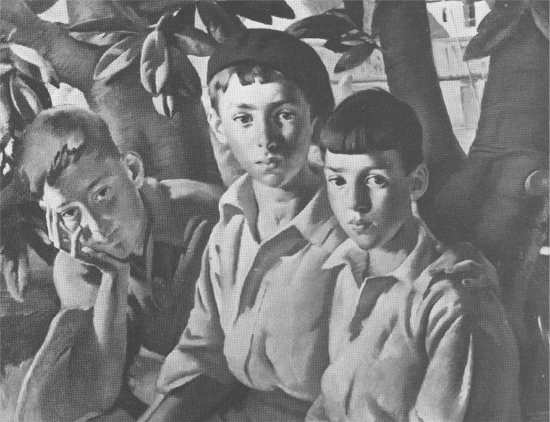
BERNARD
FLEETWOOD-WALKER
Three Boys c.1936
oil on canvas, 750 x 920mm.
(Collection of The National
Gallery, Wellington)
It is indicative of the policies and attitudes of those who dictated the general nature of the National Gallery's acquisitions in the early years that they should have chosen to collect almost exclusively works of British origin. In the 'thirties and 'forties it must have seemed no more than aesthetic patriotism to stand by Britain as a bastion of truth in the obscuring fogs of modernism.
By the 'fifties, however, the kind of British art the Gallery was collecting was being held up to criticism in more informed circles in this country. Charles Brasch, in his quarterly Landfall (number 30, June 1954), reviewing an exhibition of 'recent acquisitions', had harsh things to say. He considered that many of the English works shown were purchases of doubtful wisdom, and singled out particular pieces by Matthew Smith, Spencer Gore, Ivon Hitchens and Muirhead Bone for special criticism.
Fortunately, by the 'sixties, the Gallery was receiving the advice in London first of Ernest Heber Thompson and later of Mary Chamot, art historian and curator at the Tate Gallery. It was at this period that most of the key works in the British Collection were purchased. (See Arm Kirker's interview with Mary Chamot elsewhere in this issue.)
Ann Kirker's informative introduction to the catalogue sketches in the background of British art over the first half of this century (this exhibition includes Irish, Welsh and Scottish artists, and also those of foreign and colonial birth who spent most of their careers in Britain). To begin with there were the exhibitions of Impressionists, Post-impressionists and Futurists in London at private galleries before the First World War. As Ms. Kirker writes: 'The appearance of Italian Futurism, performances by the Russian Ballet, and an influx of writers and artists who came to settle from America, particularly Ezra Pound, T. S. Eliot and Jacob Epstein, as well as Gaudier Brzeska from France, produced work of unparalleled modernity in London just before the outbreak of war in 1914.'
Fauvism, Vorticism, Cubism, Surrealism were progressively to have their influences . . . from 1920 there were the exhibitions of the Seven and Five Society . . . Ms Kirker outlines all these developments up to the early 'fifties, fitting in individual artist to movements, events, schools and galleries.
Today we can look at British painting more objectively. The avant garde movements in the 'fifties (toward what was then called tachisme, for instance) are themselves a part of history; much water has flowed under the bridge since then (some of it brackish enough). More research and writing on these artists has been published. It begins to seem as if policies of concentrating on British art were not, after all, so misguided. The Mark Gertlers and Henry Lambs and Christopher Woods come together to form a homogeneous school in which one can see how British painters adapted lessons learned from more innovative centres of European art. And the two New Zealand-born artists, Raymond McIntyre and Frances Hodgkins who belong, with them, after all,to (the British School) are seen in proper context among them.
Though the National Art Gallery's collection of twentieth century British art, seen over-all, is perhaps nothing very startling, there are some satisfying high points. There is the Alfred Wallis, for instance: a very fine one - better, I think, than that held by the Auckland City Art Gallery, which was a gift from Lucy Wertheim. There is the handsome figure painting by Mark Gertler, reproduced in colour as a frontispiece to the catalogue - again, I think, better than the Auckland Gallery's rather stodgy Gertler, presented by the Contemporary Art Society. There is the exquisite Harold Gilman; the Wyndham Lewis beach scene, a drawing of 1920; Henry Lamb's Death of a Peasant (1911) - these and other individual works give the collection distinction.
It is heartening to see the National Art Gallery coming of age with this substantial exhibition and catalogue. As the Auckland City Art Gallery has been proving for many years, it is very much by the standards of a public gallery's publications that it tends to be judged by the world at large.