
Exhibitions Auckland
GORDON H. BROWN
Barry Lett Paintings
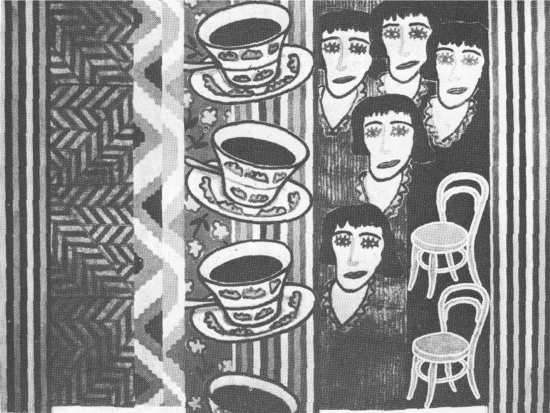
The change of direction in Barry Lett's recent paintings initially owed a big debt to the example provided by the American artist Kim MacConnel. The common basis is the varying strips of canvas, on each of which has been painted a formalized repetitive pattern, with the canvas strips butted together to form a series of vertical panels so as to create a single work. With each painting neatly aligned along the top, but with the panels different in length, some drop slightly below the adjoining panel to produce an irregular bottom edge.
In all the works a variety of patterns are employed. The dominant ones appear vaguely familiar, suggesting designs from the South Pacific area; while others are derived from stylized objects such as seen in the repetitive flower patterns. The way the parallel, upright panels of geometric and floral patterns are arranged not only adds variety and visual richness, but also establishes a controlled orderliness.
Although Lett has retained this underlying basis of panels for all his subsequent paintings, the introduction of large, stylized, figurative images, which are superimposed over the patterned panels but to some extent related to them, lifts the works into a new dimension. This considerably alters the initial concept behind his first imitative work, called Seed.
These stylized, recognizable images are also repetitive in nature: but less rigidly ordered than are the panels. In Her World five versions of the same woman's head are grouped in one area above two identical kitchen chairs; and these in turn are related to a vertical line of cups, saucers and tea-spoons. Each sequence of a single image is of the same size, but the scale of each group of images is quite unrelated, the cup for example being larger than the woman's head. In Hanly's Chairs I & II, chairs, leaves and flowers, unrelated in scale, are repeated in the same manner.
BARRY LETT
Her World 1981
acrylic on unstretched cotton,
2030 x 2650 mm.
The way the panels fit together create their own rhythmic arrangement, while the images of superimposed chairs, heads and leaves - which sometimes cross from one panel into the next - further adds to the impression of overlapping planes. The patterns and the images are precisely drawn and carefully placed within the overall scheme of each work. Barry Lett's use of colour is rich rather than bright, and is used for controlled decorative purposes rather than for any means of personal expression.
Greer Twiss A Three Legged Device: Recent Works
In Art New Zealand 18 Peter Leech dealt with some works by Greer Twiss which overlapped what were recently shown in Auckland, and because what he wrote is still relevant, I will not touch on the aspects of humour in the Three Legged Devices or their link with technology.
With an obvious affinity to the surveyor's tripod, the Three Legged Device series is a natural sequence to Twiss's Site and Barrier series. Notwithstanding their preoccupation as lightly constructed forms existing in a hypothetical space which they occupy yet do not fill, they still retain sufficient association with the activities of public construction works to present a dichotomized reading both as a conceptual abstraction and as figurative objects.
From their basic three-legged form the surveyor's tripod association extends its structural form in various directions. In some the addition of a fourth rod, which extends up from the foot of one leg, is sufficient to weaken the dominance of the simple tripod image without reducing its effectiveness as a motif. In most of the works the slight awkwardness of the junction at the apex where the legs join adds just the right amount of tension at a natural focal point.
It is the accessories, small though they are, that add an associational dimension which can be both visually intelligible if somewhat irrational. There are the straps, cast in metal, which supposedly hold the tripod legs together; or the wedges, clamps and cushions which have no apparent function. Between these come the chains and plumb-weights of Anchorage and Triangle, whose true function cannot be fulfilled on account of where they are attached to the tripod legs.
In contrast with the economy of the Three Legged Devices, which appeared more like lines drawn in space, was the enclosed solidity of an additional work, Remember New Zealand. A strictly figurative work commenting on the recent confrontation between Police and Anti-Rugby Tour protestors, this new work shared much in common with the Athletes and Protest Marchers that Twiss modelled and cast in bronze during the nineteen-sixties. In this work tension is created by contrasting the line of almost identical policemen with the swarming mass of protesters.
Eion Stevens Recent Paintings
Eion Stevens is a very competent, precise painter who has a good sense of colour and compositional design and possesses a sure command over the various pictorial skills which he utilizes to beneficial effect in his work. His paintings are lively, full of allusions: but in working with a style that edges on to the Pop Art idiom, his own native talent is somewhat crowded by the influence of the Anglo-American painter R.B. Kitaj.
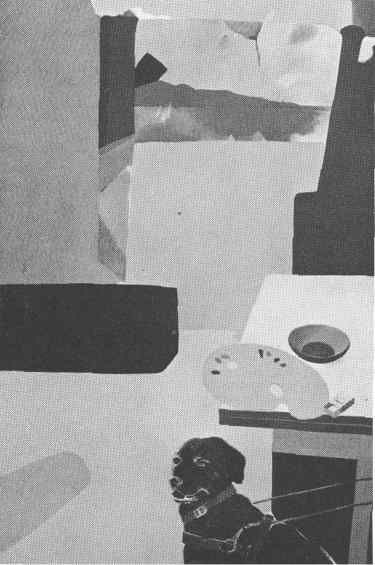
What is in question does not concern any direct imitation of Kitaj's work in the sense of identifiable imagery, but relates directly to technique and its related stylistic dependency. The technique of applying paint in works like Portrait of a Marxist or Portrait of a Magistrate makes this obvious, especially in the carefully modulated tonal painting that defines the head. And the definition of bodily form by outIine shape and rather flat colour, as well as the subjective overtones of both works, matches rather closely certain factors in the work of Kitaj from the middle of the nineteen-sixties.
EION STEVENS
The Studio 1981
acrylic on canvas, 1995 x 847 mm.
(RKS Art)
At the same time, Stevens remains independent of Kitaj's practice of fracturing his composition into fragmented, if related, shifts of pictorial scale, and the stylistic juxtaposition of realism, abstraction and almost caricature-like distortion. In this sense, Stevens aims at establishing a greater degree of realism in his pictorial construction, even if he retains an element of spatial-shift in the way his pictures are assembled.
Because Stevens's works are not dated, it is difficult to tell for certain the direction of their development. Among his paintings are a number where the Kitaj influence is minimal. Presumably earlier paintings like Domestic Sculpture Garden and Table Number Four display many of the same admirable qualities as the two paintings already referred to. Conventionally they are still-lifes, one in a landscape, the other in an interior setting, yet without quite fitting into these traditional categories. What is significant is the almost stage-setting construction which, as in nearly all his works, create an artificially contrived reality carrying the implications of philosophical statement.
One may hope that the sort of personal independence indicated in a work like A Cancelled Homecoming will again be asserted in his next exhibition. His talent is one of real potential.