
Mary Chamot &
The First Fifty Years
Mary Chamot, a former assistant keeper at the Tate Gallery and author of the book Modern Painting in England (1937) was a co-writer of the Tate's catalogue of Modern British Paintings, Drawings and Sculpture (2 vols, 1964). Her career has been a distinguished one. She is a world authority on Russian art and her monograph on Natalya Contcharova (1972) is the most comprehensive to date.
For a full decade (1965-75) Mary Chamot lent her expertise to building up the collection of British art in the National Art Gallery, Wellington, advising the then director, Stewart Maclennan, and his successor Melvin Day, on contemporary works. A few of her recommendations were regretfully not acted upon (they were deemed too 'abstract): but among those that found their way into the National Art Gallery are Stanley Spencer's Joachim among the Shepherds, one of the artist's early small masterpieces, a 1920 pen and ink drawing by Wyndham Lewis, Ben Nicholson's Painting (J.L.M.) February 2-47 which was dedicated to the architect Leslie Martin; and Frances Hodgkins' Double Portrait (Katherine and Anthony West) of 1937.
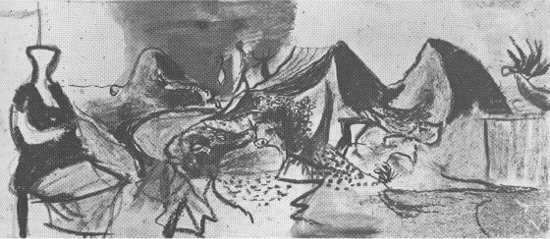
GRAHAM
SUTHERLAND
Study for
a Decoration -
Mountain Range
and Woman 1945
crayon, ink &
gouache,
173 x 376 mm.
Invariably Miss Chamot's choices were judicious and perceptive. They lend weight to the 180 or so items listed in the Gallery's handbook on British twentieth century paintings and drawings, which was published in October this year, and are among the highlights of the accompanying exhibition, The First Fifty Years. According to Luit Bieringa, the project represents the first major review of a significant aspect of the National Art Gallery's permanent holdings. It has involved the efforts of professional staff for over a year; and as part of the preparations Anne Kirker, curator of prints and drawings, spent several weeks in London on research leave. There she took the oppo tunity to interview Mary Chamot at her home in Kensington.
ANNE KIRKER: Miss Chamot, the main reason I want to talk to you today concerns a handbook we are producing on aspects of the early twentieth century British collection of paintings and drawings in Wellington. Knowing you were London advisor to the Director from 1965 for ten years on such purchases, I would like to ask you a number of questions about them: why particular works were recommended, and how you feel about them today. But first ... you were Assistant Keeper at the Tate from 1950 to 1965. Who was the Director at that time?
MARY CHAMOT: Sir John Rothenstem, until the last year, when Norman Reid took over.
I was mainly concerned with producing a catalogue, including all that had been acquired since the pre-war catalogue appeared. We then set to work on a very much more detailed catalogue; and it was decided to begin, not with the oldest picture, but with the most modern, because we could then write to the artists and get all the information we could about why and how the work was produced.
A.K.: Who did you work with on the staff?
M.C.: My colleagues were Ronald Alley and Martin Butlin.
A.K.: Who approached you from Wellington to take up the position as an advisor for the National Gallery?
M.C.: The previous advisor, Heber Thompson. He was an old friend of mine. We were at the Slade together and he knew that I was working at the Tate. He was living in the country at that time and found it increasingly difficult to come to London to see exhibitions. I don't know how many years he had been doing it, but it had been for some time and he was getting old and he asked me whether I would carry on, so I did. I had to go around exhibitions anyway for the Tate so it was possible to combine the two.
A.K.: Did you attend sales at Christie's and Sotheby's as well?
M.C: I didn't attend the sales, but we had to go and look at things beforehand. We used to take it in turns, and I would go with Martin, or Dennis Farr, who was another of my colleagues.
A.K.: How did you determine what to collect for Wellington? How did you know what was in the collection already?
M. C.: I did visit Wellington, when I went around the world. During that time I was already buying and I was very interested to see the collection. It was easier for me afterwards to recommend things.
A.K.: What impressed me about the works that you did recommend is that they all seem to be among the significant 'moderns' of the British art scene. For instance ... Graham Sutherland.
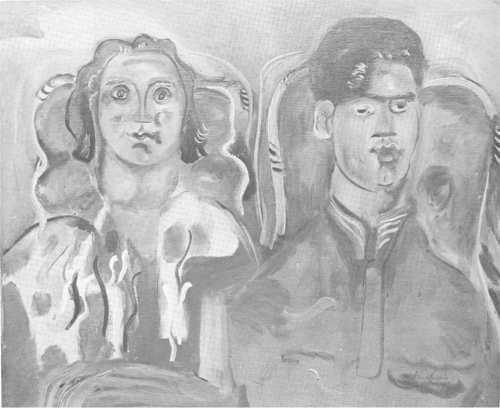
FRANCES HODGKINS
Double Portrait
(Katherine and Anthony West)
oil on canvas, 690 x 825 mm.
M.C.: Certainly one of the reasons why we concentrated on modern works was that they were less expensive then and I think New Zealand didn't have a great deal of money to buy.
A.K.: I'd like to refresh your memory on some of the works you obtained. This photograph is of the Eileen Agar collage - it's 1936.
M.C.: I like her work very much. She lives just around the corner here. I think she is a principal surrealist and I thought the tendency was something that should be represented.
A.K.: Wyndham Lewis ... a pen and ink drawing of Figures on a Beach ... you obtained that from the Mayor Gallery.
M. C.: Yes. I was very much involved with him at one time because I arranged the Lewis exhibition at the Tate Gallery. I visited him several times.
A.K.: A Burra watercolour, of The Juke Box?
M.C.: I don't remember buying that. Was that not got by Heber Thompson before I took over?
A.K.: Judging from the correspondence it concerned you both. It was the first work that you had anything to do with.
M. C.: Yes, one or two works he took me to see before I officially took over. I must say I'm not a great admirer of Burra's work and I don't think I would have chosen it. But I think he is an important artist and it's a good thing to have him in the collection.
A.K.: In the mid-sixties who were the artists who commanded attention in Britain?
M.C.: Well I should think Sutherland certainly ... Hitchens, Henry Moore.
A.K.: I noticed in going through letters between the Director and yourself that you tried (and I personally wish that you had succeeded) to get an early Peter Blake and a Bernard Cohen into the collection.
M.C.: I certainly remember seeing Peter Blake's work when I was going around exhibitions at that time. You haven't got one yet?
A.K.: No. Now Frances Hodgkins . . .
M.C.: Well, she was a New Zealander and when I visited New Zealand after my tour around the world I met the director of the gallery in Auckland (C.C. Docking), and after that he wrote and asked me whether I'd help to assemble the works here, so I was very much involved with the Centenary exhibition. I had done some work on Hodgkins before.
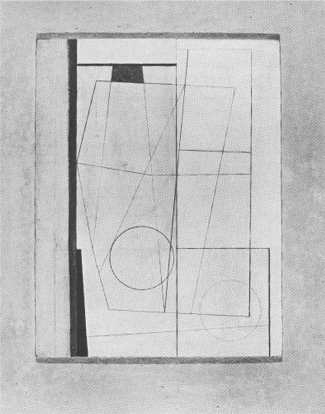
BEN NICHOLSON
Painting (J.L.M.)
February 2-47
oil& pencil on board,
374 x 304 mm.
A.K.: Among the works that you recommended for Wellington, was this painting by Ben Nicholson, of 1947.
M.C.: I admired his work very much. I knew him. I had been down to St Ives where I met a lot of the artists; and I certainly think that he is an important person to have in the collection. Ben Nicholson certainly did more interesting work at that time. I saw his most recent exhibition just last year and I thought the paintings were rather dull. Or is it the same jargon in a different position?
A.K.: Which galleries did you concentrate on?
M.C.: In those days the Leicester Galleries and the Lefevre Gallery had good things. Tooth's, Bond Street. Wherever there was an interesting exhibition I would go and see it.
A.K.: Can you remember whether there was a particular artist or a particular painting that you would have liked to have seen represented in the collection but were unable to obtain?
M.C.: I don't remember any specific examples: but I do know that New Zealand couldn't run to any enormous sums of money. Some of the artists were already pretty expensive.
A.K.: You had a budget of about £2,000 a year. We were very fortunate to have someone like you as an advisor for purchases, with your background. You wrote a book, published in 1937, on modern English painting. . .
M.C.: Yes. It's hard to get now because during the war all the unbound copies were blitzed and it wasn't reprinted. That covered the period; and I used some of my Country Life articles on modern artists.
A. K.: You would have known many of the artists personally.
M.C.: Yes. Some had been at the Slade with me: Eileen Agar was a little bit younger but she was there.
A.K.: One of the drawings which we obtained through you was by William Roberts: The Tip. I believe you went to see his widow and obtained it directly from that source.
M.C.: Yes. There was a Roberts exhibition at the Tate while I was there, and she helped to organise it. He was rather unapproachable - I never met him, but he painted that picture with Wyndham Lewis and the other artists at the Eiffel Tower (Restaurant).
A.K.: How was an artist like Matthew Smith viewed in the mid-sixties?
M.C.: He was just coming on then. We had a big exhibition at the Tate Gallery. He had been painting for some time. He was quite an old man then, but I think that was just the time when his work became generally accepted.
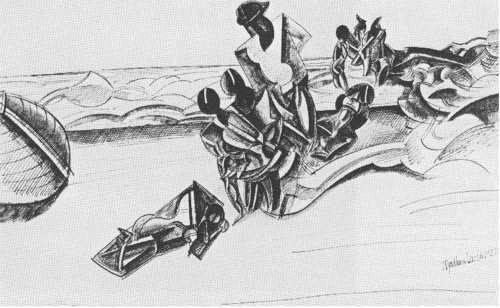
WYNDHAM LEWIS
Figures on a Beach 1920
pen & ink & wash,
292 x 475 mm.
A.K.: Now, The Seven and Five Society. I remember there is a passage in your book which I think goes something like 'Most of the artists in this group will with time turn out to be amongst the most progressive in England'?
M.C.: Yes. They really were. The Society didn't last very long, but it did bring together a lot of the progressive people of that period.
A.K.: And it moved towards Abstraction.
M.C.: Yes. Some of the artists. Not all of them.
A.K.: Can you remember the Surrealist exhibition in London?
M.C.: Yes, I do. It was opened by Dali, who appeared in a divers costume with a large dog on a lead. Sweltering hot day. Finally he had to take the headgear off because he couldn't breathe.
A.K.: Most of the artists you recommended are extremely well-known names now. There are one or two, however, who are less significant. For instance, Fred Ulhman, who was I think probably a 'primitive' - or how would you describe him?
M.C.: He's of German origin. Sort of primitive, yes. Alfred Waffis was a real primitive. Ulhman wasn't. He was a lawyer by profession - a highly cultivated man. Alfred Wallis was, by comparison, a fisherman.
A.K.: We are fortunate to have a Christopher Wood painting.
M.C.: Yes. He's a very important artist. When I first started lecturing at the Tate, Jim Ede was Assistant Keeper, and he was very much a patron of that group of artists.
A.K.: Who was the most colourful painter as a personality that you met?
M.C.: I should say Stanley Spencer. He was small and looked like a workman and was very energetic and very intense in everything he said. He was very widely read and extremely interesting. I once had a party of my old Slade colleagues and he was the life and soul of it.
(This interview was conducted with the generous support of Radio New Zealand)