
Billy Apple
Points of view: RKS Art
WYSTAN CURNOW
By virtue of being imbued with their surroundings, the four works variously reflect inherent qualities of those surroundings. In comparison, much artistic expression might be viewed as artifice, idealization, or isolated, private reality, whereas these Berkeley works remain very much "in the world." Art, in this case, brings the viewer's attention back to an examination of life as it is. Art and life therefore converge instead of being related by analogy, metaphor, or representation.
Mark Rosenthal, Andre, Buren, Irwin, Nordman: Space as Support. (1980).
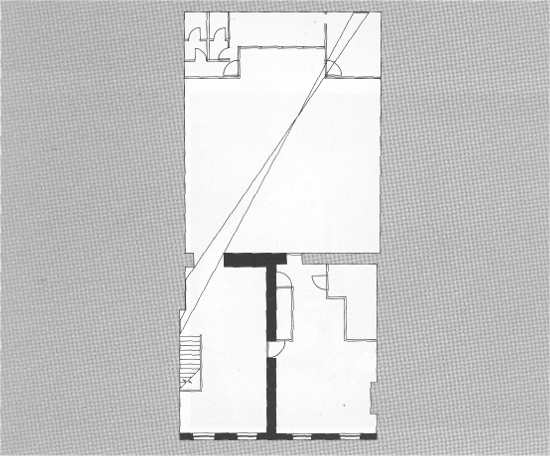
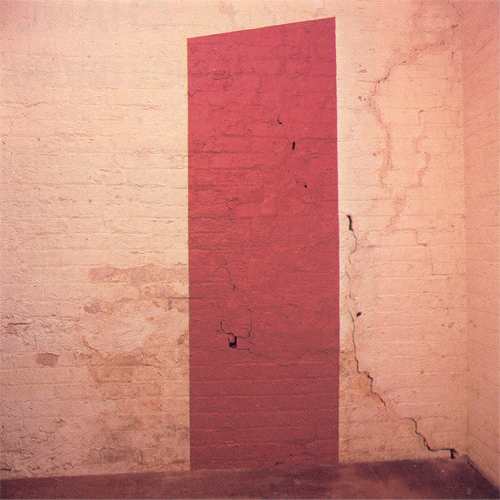
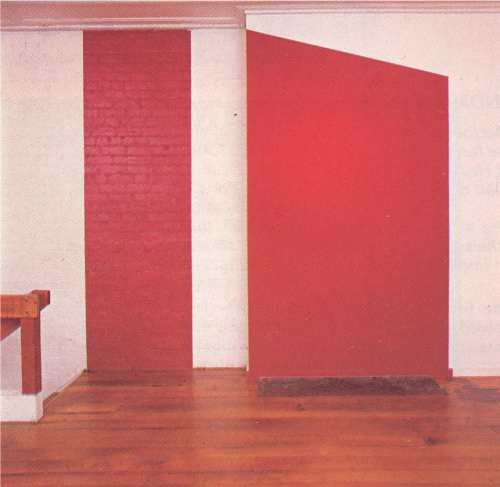
In November 1979 Billy Apple pointed out certain features of Peter McLeavey's Gallery which were sore points with him by painting them red and making a show of them. He did the same with the Leo Castelli and Charles Cowies galleries in New York in November last year. He likes to think of himself as a painter. And, on the strength of Points of View at least, I'm inclined to agree. For this was no censure. And those generous slabs of red painted directly onto the wall were very handsome. I did want to think of them as 'wall paintings.' Distinct from Killeen's 'cut-outs', from Trusttum's painted paper-works blue-tacked to the wall, both of which use the wall as 'support.' Distinct from murals. More like Neil Dawson's recent wall painting at the National Gallery, or John Bailey's wall drawings, to be painted out, cleaned off, at the end of the show. And not at all like Rob Taylor's paintings with which Points of View shared RKS Art.
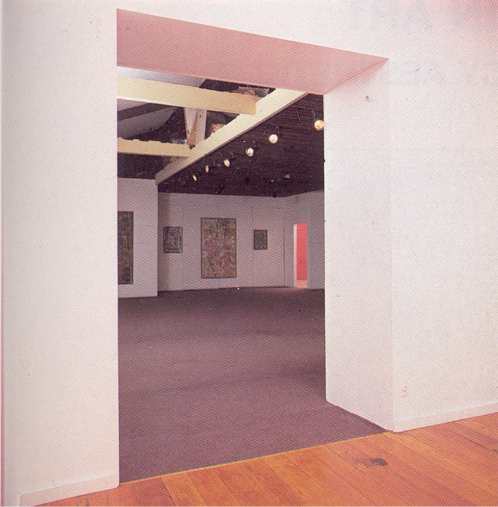
View through Main Gallery
entrance and Storeroom
Taylor's works 'might be viewed as artifice, idealization, or isolated, private reality', as being related to the world by 'analogy, metaphor or representation.' Let T.J. McNamara make the point; he wrote: 'Sometimes they are like ikons, sometimes like tablets of abstruse lore. Sometimes they have receding depths that give a sense of mystery'. ('Room for Points of View', New Zealand Herald, September 9, 1981.) Apple's work on the other hand, reflected the inherent qualities of its surroundings and so remained very much 'in the world'. RKS Art thus offered us two quite distinct points of view about art.
Paintings do move me. Up close, to the side, for the tactile; back for the whole picture, the scale of it. But seldom am I moved so far or to such specific purpose. These paintings were not in the Main Gallery but as soon as I saw their relationship to the doorways off that gallery, that is where I was moved to go. I took a path between the two openings seeking a point from which my view through a door was all red.
As often as not RKS has two shows on, each in its own gallery, but Points of View in effect occupied both. Not only was it at odds, as art, with Taylor's paintings but it also contested their possession of the territory they occupied. Not that Taylor's paintings so moved me that it became a distraction; as a matter of fact it was simply not visible from most positions in the Main Gallery. Nor was there anything personal. The two had clashed verbally at Apple's slide talk at the Dowse two years ago and Taylor did write a longish rather skeptical piece on him for Notus (December, 1979), but Apple had no say as to whom he was to show with. The point is almost any RKS show would have done: art which relates to the world by 'analogy, metaphor or representation' is its staple fare.
Points of View only ended up on the wall as painting. it began as an idea about the givens of the space: that being to find the maximum angles of the lines of sight taken from each doorway (the point of view) through the other and onto the wall, and to paint the shape thus projected.'. Doors, we should always remember, are two-faced: they shut off and open up. They give in and they give out. They are thresholds. They are points of issue. Looking from one through the other all you saw there was red, a colour I must now take as a sign of Billy Apple's politics, of his desire to engage the givens, confront issues, open debates.
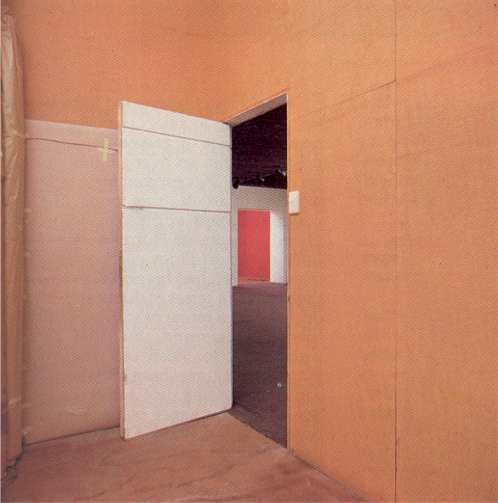
View through Storeroom
door and Main Gallery
entrance to Front Gallery
The doorway from the Front to the Main Gallery has no door. It is generously wide and all but opposite the stairs to the street below'. The other has a door which is normally shut; behind it is a storeroom - a service area, private space. Points of View indicates the architectural limits of RKS's space. Also, it directs us off the street, straight past art into business and back again. Its displacement of merchandise from the Front Gallery and the artist's acceptance of sponsorship from Phillips and Impey Ltd. - they paid for the paint (Samson Semi-Gloss Vinyl Acrylic, Bright Red, B.S. 0-006) and the announcement - reinforced the artist's engagement with the give and take of art and commerce.
1. The artist was assisted by John Bailey, lan Bergquist, and Rodney Kirk Smith (painting and measuring) and Desmond Williams (photography).
2. It was once but a window-sized opening; there was a narrow doorway off to the right. Billy Apple 'altered' all that in 1979 (see Art New Zealand 15.) the window became the door, the old one disappeared. Then, in March of this year, when Barry Lett Galleries became RKS ART, he enlarged it to its present size. It is to be noted that a large number of his works since 1975 have dealt with doorways. Also, that this particular concept goes back to a 1978 proposal for the Auckland City Art Gallery (see Art New Zealand 15) and to one made last year to the Brooke-Gifford and Barry Lett Galleries which involved simultaneous openings.
Painted areas,
Front Gallery wall