
Exhibitions Wellington
ANNE KIRKER
Patrick Hanly The Painter as Printmaker
When the sun shines more years than fear
when birds fly more miles than anger
when sky holds more bird
sails more cloud
shines more sun
than the palm of love carries hate, ...
Janet Frame wrote these lines in the sixties when similar utopian imagery was coming across in the folk songs of Bob Dylan and groups such as Peter, Paul and Mary, in protest against Vietnam and the threat of nuclear war. The message is as potent and relevant today and in the visual arts in this country is nowhere better served than by the work of Pat Hanly. Throughout his highly productive career, Hanly has consistently maintained a humanist stance. In fact, one could go further and suggest that the strongest underlying theme to his paintings and prints is one which unashamedly celebrates life and, on occasions, points the way to a better future.
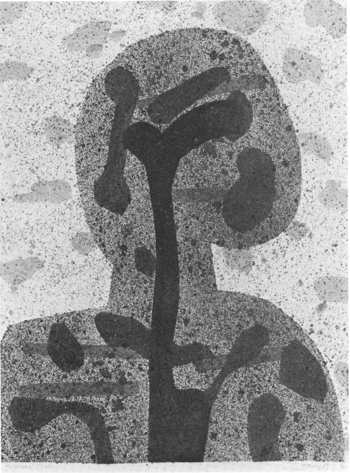
PATRICK HANLY
Molecular Man 1969
screenprint / splatter,
700 x 550 mm.
We currently have a chance to trace the development of his work, thanks to the commendable efforts of the Wairarapa Arts Centre, in a touring retrospective exhibition of prints made by the artist between 1959 and 1980. Hung at the National Art Gallery during June and July, the show comprises forty-three entries which bring to light hitherto unknown images: such as Dawn Mt. Eden (1974), a soft and surprisingly atmospheric interpretation; as well as more familiar images like Tamarillo (1969), which has appeared in a number of states.
Highly idiosyncratic in his printmaking methods, Hanly until recently rarely produced editions of more than eight impressions, and even within this small number, intriguing inconsistencies occurred. Using the processes of monotype, drypoint and screenprint, enlivened by handcolouring, and by spatter in the late 'sixties, he provided a refreshing alternative to much of the work produced by printmaker members in the Print Council of New Zealand. (He regularly exhibited with the Council during its existence from 1967 to 1975.)
When Barry Lett Galleries decided to publish a set of twelve screen-printed multiples by established painters in 1969, Hanly was included. Whereas the others - McCahon, Mrkusich and Hotere for example - settled for flat and minimal compositions (distillations of their paintings) Hanly flicked dots of bright watercolour over his black stencilled design in accordance with the series of 'molecular' paintings he was currently producing. Inside the Garden, which served to title individual works as well as the series in general, stood for a new departure in his work: one which sought to discover, as he put it, the 'reality of accidental creation'. The companion prints, Molecular Woman (1968) and Molecular Man (1969), on display in the present exhibition, belong to this genre. From each, Hanly has employed simple head and torso forms, printed with transparent and opaque inks, through and on which a network of vital organs and the rudiments of a skeleton play. Throughout, the addition of variegated spatter unifies the images, and the colouring in both is scintillating.
At times Hanly has been accused of eclecticism, of overtly borrowing from European examples, at the expense of finding his own way. Chagall, followed by Picasso and Matisse, are the artists we most readily associate with Hanly's approach: but although such influences have been and continue to be necessary for his development Hanly turned to 'new ultimates' in 1966. The Sengai scroll paintings shown in Auckland during May and June that year convinced him that images of real consequence could be produced by using simple, abstract imagery. For a brief period he broke away from a dependency on the human figure, which the two preceding series, Figures in Light and Girl Asleep, revealed, and instead, adopted a system of 'signs'. Only one print in this exhibition, Pacific Icon (1967) marks this stage in Hanly's career.
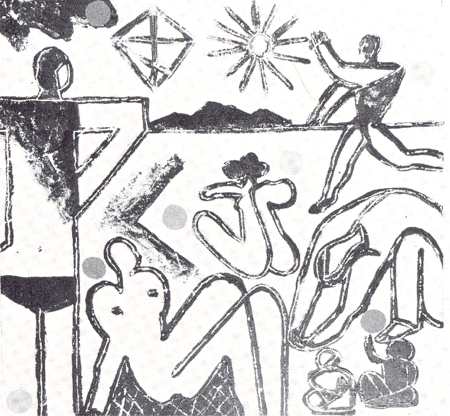
PATRICK HANLY
The Golden Age 1979
reverse intaglio/stencil,
520 x 530 mm.
Since that interlude, Hanly has re-evaluated his position and acknowledged that his is a talent which responds best to the world immediately within his grasp. It is one that proceeds in accordance with the belief that 'Composition is the art of arranging in a decorative manner the various elements at the painter's disposal for the expression of his feelings. In a picture every part will be visible and will play the role conferred upon it, be it principal or secondary' (Henri Matisse, Notes of a Painter 1908).
The most recent paintings and prints to emerge, the Golden Age series of 1978-80, could be described as Hanly's contribution to the arcadian pastoral tradition in western art. Through them, he has evoked a similar spirit to Matisse's Luxe calme et volupté (1904-5).