
Exhibitions Christchurch
BARRY CLEAVIN
Peter Ransom The Darker Side of Human Nature Etchings & Watercolours
Tom Wolfe was 'jerked alert' by the notion that 'to lack a persuasive theory is to lack something crucial'. This fact provides the base for a little story called 'The Painted Word'. 'The Painted Word' broadcast the fact that 'modern art has become completely literary: the paintings and other works exist only to illustrate the text'. The Boho made the pictures, to make the theory, to be enshrined in the books that were published.
The visual word by Peter Ransom reverts the Boho to Hobo and calls a spade a spade - not a black, not a playing card, not in advance of a broken arm, but a common garden spade. Webs of lines snare the eye of the beholder. Beauty it is not. Zip water heaters, electric jugs, toasters, machettes and guillotines - the stage props for the actions. Invented space inhabited by objects remembered through an impeccable but personally reconstructed reality. So far as the humans occupying this linear world are concerned: they appear as clothed containers for fragile or violent actions.
From Le Point, 1939 (Fauve) Matisse stated 'I have always considered drawing not as an exercise of particular dexterity but as above all a means of expressing intimate feelings and moods, a means simplified to give greater simplicity and spontaneity to expression, which should speak without heaviness directly to the mind of the spectator'. This is an excellent and civilised description of drawing, to be kept in mind while surveying Peter Ransom's work-the paradox being that Matisse and his colleagues were claimed as visual 'wild beasts' (by an easily terrified critic), There is no anxiety there in retrospect - it is now a most civilised and familiar jungle.
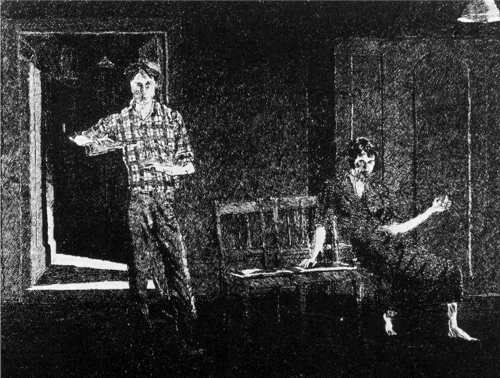
PETER RANSOM
Interior
etching
(Gingko Gallery)
Angst is caged in the zoo. Humans pace the kitchen as the lion roams the painted cage. Peter Ransom often provides this zoo, without bars.
In new and swiftly changing times the artist must devise an idiom of expression consistent with his own temperament and experience. The present artist is a consummate printmaker with the visual imagination of a born story teller. The world dissected in this exhibition unravels the artist's personal history (but in an extended way to a universal, not an embarassing genre); interpretations of Heinrich Boll, Emile Zola, Christopher Isherwood: the character sometimes poignant, sometimes disastrous. There is fact that satisfies - it comes out so easily, and yet it's all so complicated. Ransom has the printmaker's tradition contained by an economy of technical means. The technique is so contained it's almost absent.
The most important aspect of Ransom's exhibition is that it upholds a condition that is the tradition of the graphic artist's involvement with society - through pungent and universal comment - offering a convincing alternative to Wolfe's observations of literary intellectualism illustrating art works. The result is doubly interesting in that the image has neither the coldness of the over subservient illustrator's design, nor something else that we are used to. In short, here is something crucial.