
Exhibitions Auckland
LEONARD BELL
Don Driver Recent Sculpture
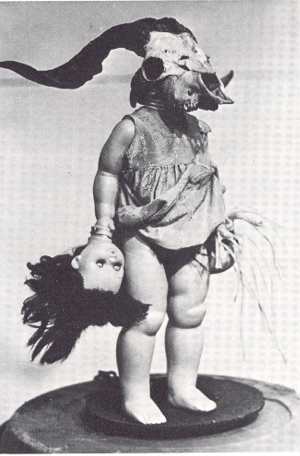
Don Driver's exhibition was made up of thirty-nine assemblages - combinations and permutations from a store of 'found objects'. Buckets, barrels, tins and other containers (plastic and tin), dolls, toys, feathers and stuffed birds (peacock, seagull), ragbag clothes, stools, boots, headware, and skulls (natural and artificial) featured most frequently-with the occasional appearance of less familiar artefacts: a giant tin snail, for instance.
DON DRIVER
Standing Figure
assembled materials
(RKS Art)
To sample the items: There was Girl with a Skull: a three foot high green plastic barrel to which was chained a rusted metal plate supporting a large doll clutching its own head in one hand and in the other a plastic skull efflorescing yellow twine; Feather Helmet: three feet of pipe set vertically in concrete on top of which sat a plastic bucket, and upon that a feathered green skull and bucket hat; Three Ladders: just that, painted yellow, red and blue, leaning a foot apart against the wall, tops clothed with seedy grey gaberdine coats, back view. The deadpan titles 'identifying' the often vaguely humanoid configurations - Helmet, Dressed Bird, Pillar - helped remove the work from the hazards of simplistic expressionistic declamation or surrealist cliché and overstatement-as if the bizarre and quirky combinations were normal or inevitable.
The installation was crucial for the effect. The works - thirty-seven free-standing, one on the wall, one leaning against it - mostly large (about four to five feet high) occupied much of the gallery floor space. Little free room remained for the viewer or participant-in this museum, maybe, or of a sitting-room overcrammed with trophies, 'tasteful' bric-a-brac, ornament, and 'well-appointed' furnishings.
I imagine some people could feel crowded out by Driver's recycled junk, his reworked civilised detritus. The grotesquerie, the emphasis on the moribund could repel: yet, as is usually the case with Driver's work, you could dwell if you liked rather on the interactions of textures (rusted, painted, rough, smooth, natural , artificial), colours, and materials (feather, bone, rubber, tin, plastic, wood) alone; or simply on the manner in which a seemingly random (in fact not so) assortment of unlikely objects of little intrinsic formal interest or aesthetic value had been transformed into an ensemble rich in visual and spatial play.
The exhibition did not reveal any new departures for Driver. Rather, it was an intensification of preoccupations and methods that have increasingly dominated his work over the last five years. As in his earlier assemblages, combinations of materials and objects which could easily seem trite and hackneyed in lesser hands, usually (though not always) manifested that attention to detail, care and subtlety in placing and spacing of the various elements, and that edge of absurdity, wit and anxiety necessary to bring them individually and collectively 'alive'.
Mary-Louise Browne Marks Working Drawings
100m2 is a bare warehouse-like space, ground area about 35 by 20 feet, brick walls painted white. On the right wall (from the entrance) near eye level were 4 sequences of lean and compressed interweaving loops and criss-crosses, light reddish in colour (marker pen-), covering 2 bricks-width of the wall - each sequence extending horizontally about 8ft, separated from the others by the protruding columns, and numbered (from rear to entrance) 2, 1, 3, 4. These were Browne's marks. The card announcing the exhibition included two sentences on the reverse side: 1. The hand is not only the means of the work but also its product. 2. Protogenes e Apelles-la storia delle arti antiche'. . . cues for a reading, clues revealing something of the ideas and sensibility that sustained the work?
To pursue them further the second first: Protogenes and Apelles were two of the most renowned Ancient Greek artists, who became more mythical than historical figures in later European culture - Appelles, the constant draughtsman reworking the world in line, the richly rewarded favourite of Alexander the Great, who permitted no-one else to take his portrait, so the story goes; Protogenes, toiling away in poverty and obscurity until well past 50 until rescued from oblivion by Apelles. Protogenes or Apelles - the history of antique art.
And then, the first statement suggests, perhaps, the notion that ,process' or 'becoming' embodies the primary or essential principle of 'creativity' - the hand makes the marks and is made by the marks.
So you have the reductionism of Browne's work - a simple, spare calligraphy - the 'measure' of the person. Indeed each, nearly head-high sequence of marks approximated in length (a little more) to an outstretched arm-span. That could spark off another antique and classical echo. What were the viewers or rather the visitors to this space so-treated left with? Merely an 'academic' exercise, some arcane graffitti; or working drawings of interest in themselves and in the manner they serve to activate the space they inhabit? Whatever the response, Browne's Marks had a coolly elegant quality, even if the austerity of the exhibit seemed designed to keep potential viewers at a distance.
Max Gimblett New Paintings
In this show were six large and three small acrylic polymer paintings and a suite of four drawings. The more spacious gallery housed five large paintings, while the remaining works were confined in a much smaller side gallery adjoining the storage area.
MAX GIMBLETT
Black/Blue 1981
acrylic on canvas, 1300 x 1300 mm.
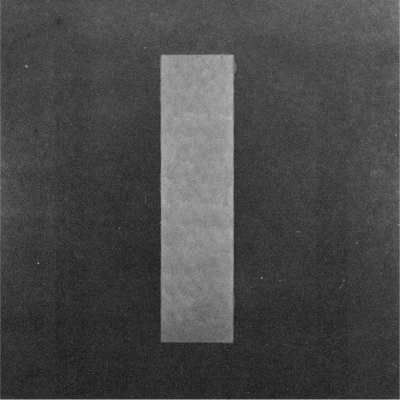
The paintings were titled simply according to the colours used - Burnt Umber: Burnt Sienna, Titanium White - though one Cerulean Blue, was sub-titled, To Len Lye - the intensity, the concentration, the purity of the blue recalling Kandinsky's transcendent blue ('a call to the infinite') or Matisse's 'the bluest of blues . . . to the point where blue, the idea of blue was conclusively, absolutely present.' I wonder how deliberate such echoes were. The paintings certainly looked/felt' as if they had been thoroughly 'thought through' in an art-historical sense - with Barnett Newman surely the presiding inspirational source and force, both formally and emotively. So these 'pure' paintings were in many ways quite 'traditional' Fine. Given that, Gimblett does what he does very well.
Two large paintings were rectangular with a long narrow oblong running close to each vertical edge nearly top to bottom - intensifying the 'empty' central area: in Crimson: Red holding it taut as if a spark was about to leap across. The other four large paintings followed a square or rectangle within a square format - the smaller interior shape, of the same hue as its surrounds, central, or centered, in relation to the over-all shape of the canvas.
These paintings required time and close attention from the viewer. In Burnt Umber:Burnt Sienna, for instance, a thickish 'skin' of burnt umber had been applied over the sienna, of which only thin, almost stain-like glimpses were apparent round the edges. The central umber rectangle, gloss, the brushwork readily visible, was set in an umber field, matt, more uniform in handling. These relationships, along with the sienna-umber shifts, generated some fine light, textural and colouristic interactions. You needed to move round Gimblett's painting. The same 'simple', near monochrome work could look very different viewed from different positions (not that the gallery's extensive fluorescent lighting installation, which diminished subtleties of light and colour, really allowed the fullest experience of this).
In two paintings, Titanium White and Ivory Black:Prussian Blue (and also in the three smaller paintings, the paint was more thickly worked - six inch 'waves' (two inch in the smaller) of brushstrokes, each with a curl or lip at the 'top' - so that your consciousness of the substance (paint) itself, and the business of its application became much more dominant in a manner recalling the emphasis on material used Robert Ryman style, for example. While these paintings were as authoritative as the others, for me the strongest works in the show were the quieter, 'meditative' pieces, more restrained in brushwork, such as Cerulean Blue and Burnt Umber:Burnt Sienna.
The suite of drawings, immaculately rendered, presented an investigation into the possible resonances of various combinations of line and shape - diagonal, rectangular, circular, pyramidal - perhaps a hint of things to come.