
The Auckland City Art Gallery
A Modern Prints Sampler
TIM WALKER
The Auckland City Art Gallery's Modern Prints Sampler was just that: a show giving us a taste of the Gallery's Print Collection, which is itself a sampler of what is offering. As a look at what they have been up to on the purchasing front over the past decade the show certainly impressed. It offered convincing evidence of a sustained attempt to cover the field. While there was the inevitable disappointment of finding some major printmakers not represented, (Cy Twombly, for example) the Gallery appears to have brought together as comprehensive a collection as possible, given their obviously limited resources.
The inclusion of work from five nations outside the heavily-favoured British and American schools gave at least an indication of the diversity existing in printmaking. The hanging of New Zealand works amongst those of the overseas 'name' artists brought a welcome sense of perspective to the show. It was good to come across familiar, home-made images, allowed to stand up for themselves amidst the onslaught of images steeped in the inherent authority of being 'Foreign'. If some could not muster enough strength to hold their own then it was certainly not by virtue of their nationality, the various degrees of quality in the show existing apart from any such arbitrary division. Denys Watkins's Hairlip looked wonderful still, meeting the complementary richness of William Wiley's Line Fever on ground shared rather than disputed, won or lost.
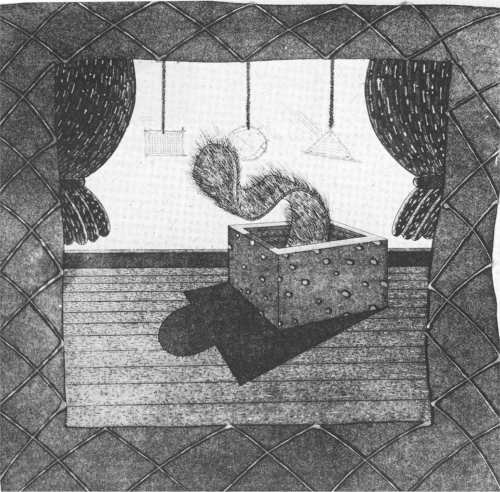
DENYS WATKINS
Hairlip 1978
etching and aquatint,
800 x 600 mm.
(Auckland City Art Gallery)
While the show succeeded as a collection of often outstanding work it was less successful as an exhibition of those images. The space-one and a half of the large upstairs galleries-was awkward and uncomfortable, its scale bearing down on the images and its whiteness ganging up with the ubiquitous white mounting board to severely undermine the ability of the work to pass on its information.
There is a measure of remove inherent in the printmaking process: both in the 'removal' of the image from the usual value-play of art as unique image and in the 'removal' of its production from the artist's hand.
Add to that the more immediate level of remove set up by the sheet of perspex between image and spectator and you have a medium with particular properties and needs. The frequently small scale of the prints is not helped by placing them on large, overlit white walls -a situation which causes the mounting board to squeeze in on the image rather than lending it weight.
Other than mishandling the inherent needs of the work, the show also saw some rather peculiar notions of display. The large and luscious John Walker Juggernaut was hung half in and half out of the gallery space, making it difficult to see; while across the gallery the panel describing the details of Ed Ruscha's six panels HDetc was followed by only four panels, despite the excess of available space. The large Michael Heizer was insensitively neutralised, its extensive white ground merging with the walls, taking the power of the huge print with it.
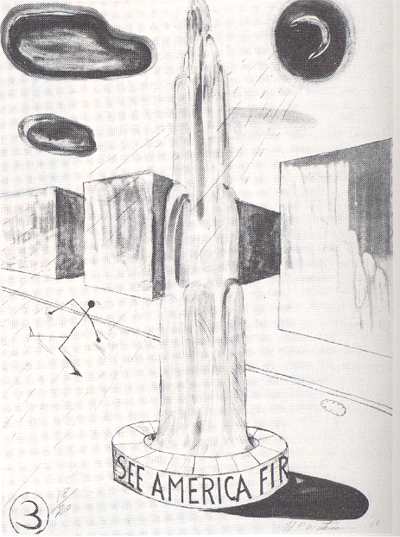
H. C. WESTERMAN
See America First
Lithograph 765 x 555 mm.
(Auckland City Art Gallery)
The Auckland City Art Gallery has shown itself in this show to be doing a fine job of keeping our collection up to date and balanced. In handling the show in such an apparently offhand way however, it is perhaps avoiding its prime responsibility: that of creating a place wherein such work can pass on its information, clearly and directly, to Auckland audiences.