
Exhibitions Christchurch
MICHAEL THOMAS
Ned Dawson
Rosemary Johnson
Two distinctive pieces of environmental sculpture have appeared in Christchurch which display extremely diverse interests.
Neil Dawson's Echo, a tubular sculpture suspended seven metres above the quadrangle at the Christchurch Arts Centre, is ephemeral in character. It is a concise visual statement about linear perspective, and consists of wire 'outlines' of the front and side of a building. These are constructed of fibre-glass tubes threaded over steel wires which are attached to the top of the actual building which the sculpture describes. The thin black tubes make a 3D form which appears to be drawn in the sky. As one walks around the quad and looks up, the perspective view reverses itself. At one moment the front of the building is seen from below, and in the next instant the view changes and the building is seen from above.
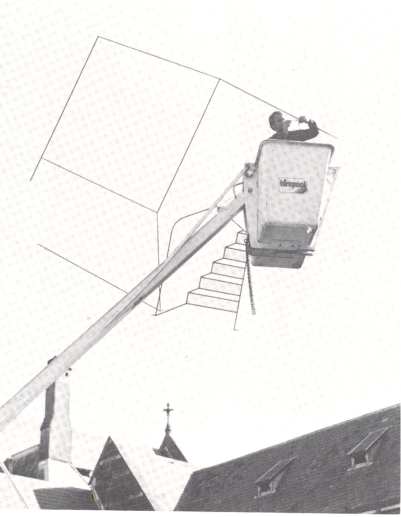
Neil Dawson
constructing Echo
at the Christchurch Arts
Centre
This 'magical shift' takes place against the ever changing Canterbury sky which makes a pleasing backdrop to the geometric lines of the piece. Although the frail wire 'house' hovers some distance away from the surrounding architecture, it acts as a catalyst to draw attention to the decorative Old University buildings around the quadrangle, and it creates an awareness of the architectural space in which it hangs.
In contrast Rosemary Johnson's sculpture at Christchurch Teachers College seems to emerge from the soil as it spreads outwards from a central axis across several metres of ground. Permanent in nature, it consists of huge spherical boulders, a heavy steel disc still partly embedded, an earth mound, and a fence. All these combine to form a symbolic 'cosmos' which has implications of a spiritual sort.
The circle off-sets the angularity of the Teachers College buildings, and carries the central idea of the piece; that of the universe with its cosmic energy reaching out in all directions. Set in a cross shape, the fences form straight lines which direct the eye to distant parts of the College. The fence is perhaps a metaphor for time passing as it progresses through the man-made hillock, which suggests a burial mound, and culminates in a single post from which the lines of the sculpture radiate. Inscribed in the centre of the steel disc are the words 'at the centre of all is the circle', suggesting the all-encompassing theme of the work.
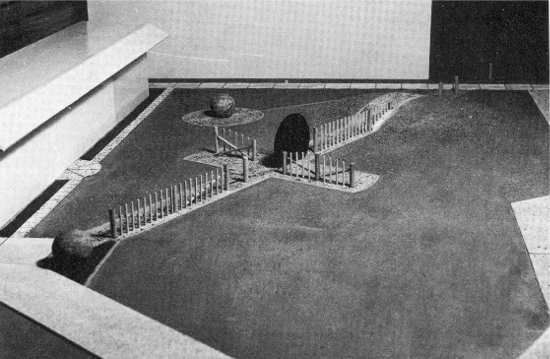
Model of
Rosemary Johnson's
sculpture at the
Christchurch Teachers'
College
The sculpture is at present rather stark and new-looking; but time will mellow its appearance. The piece has a reassuring feel of permanence which is unusual today when so much contemporary sculpture seems transitory in nature.
Neil Dawson sees no need to produce monuments. in addition to the different attitude which he reveals regarding time, there are other contrasting qualities between his sculpture and Rosemary Johnson's.
Johnson's work is primarily a vehicle for meaning. It is not and does not attempt to be technically clever. Visually it is cluttered: with too many different materials being used. Nothing is concealed; the work openly displays its constructional method. There is a timelessness about the stones in particular which makes the surrounding multi-storey buildings look temporary.
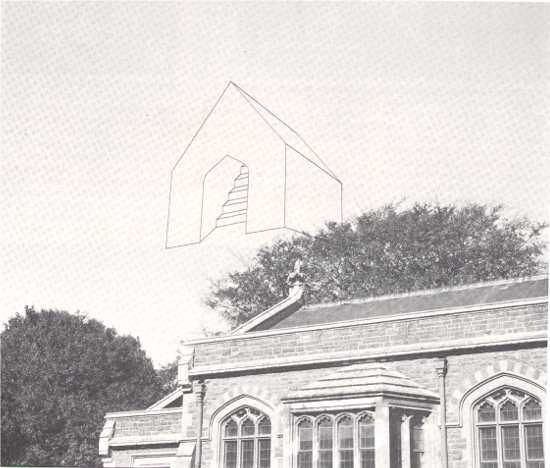
Neil Dawson
Echo 1981
fibre-glass
(Christchurch Arts Centre)
Dawson's Echo has the reverse effect. Its simplicity of form accentuates the grace of the massive stone buildings beneath. Secrets are concealed behind the parapet, where an elaborate pulley system dissipates the considerable force from the wires needed to keep the construction taut. Although it appears simple, the construction is complex. The piece is primarily a technical statement about architecture, optics and engineering.
Rosemary Johnson's sculpture, on the other hand, seems to be attempting to express beliefs that are beyond the visual.