
The Quiet after the Quakes
Street Still-Lifes by Graeme Russell
KRISTINE WALSH
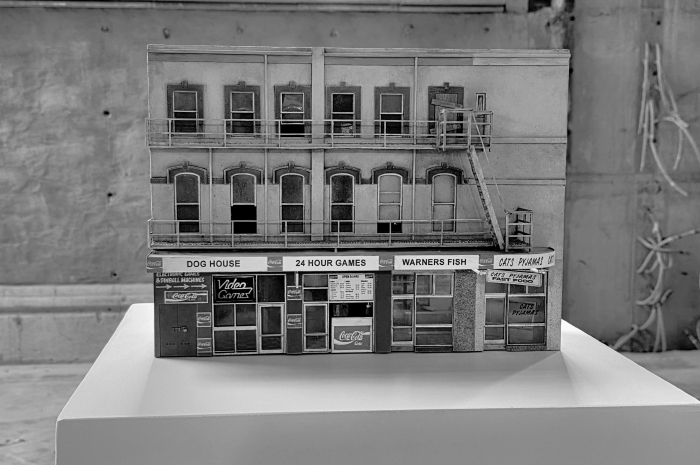
GRAEME RUSSELL Dog House 2025 Black-and-white photograph
There is a kinetic energy to many of the thousands of black-and-white photographs Graeme Russell has shot on the streets of Christchurch. A banjo player is captured in mid-song. A pedestrian marches in tune with his own shadow. The ‘hssst’ of a spray can is almost audible in his many images of graffiti art.
Others, however, are more quiet . . . a stillness evident in these moments captured in time.
It is this lack of noise Russell taps into for the images he shot of the miniature buildings constructed and this year exhibited by local artist Ghostcat (Mike Beer).
And so it should be: the buildings represented are no longer, victims of the 2010/2011 Canterbury earthquakes. The miniatures ― and the photographs that depict them ― are literal snapshots of entities forever suspended in memory.
Not that Russell remembers those quakes well: originally from Wellington, in the late 1980s he moved to Auckland where he spent the next three decades living around the chaos and colour of Karangahape Road.
By 2018, when he relocated to Christchurch, it was still a city under construction, which ‘really brought home what had happened just a few years before’.
Seeing Beer’s intricate miniatures, he says, provided yet another jolt of recognition in terms of what the region had suffered . . . and lost.
Among the heritage buildings represented is the three-level Dog House, where people could once have punctuated 24-hour gaming binges with a feed from the eponymous burger joint; the Spanish Mission-style twin towers of Lyttelton’s old Harbourlight Theatre; the flamboyant Repertory Theatre ― also in Spanish Mission style; and the seedy Atami Bath House, on which teeny replicated signs advertise ‘private suites’, ‘XX videos’, and an abruptly-halted schedule of strip shows.
Also included is an image of a 1970s police kiosk with its swooping, peaked roofline. Although not a direct victim of the quakes, it was removed from Cathedral Square to make way for the relocated Citizens’ War Memorial, which was.
‘I found Ghostcat’s work so affecting I just had to capture it,’ Russell says.
‘The miniatures themselves are wonderfully vivid but, for me, shooting in black-and-white strips away all that noise and leaves a kind of emotive quiet.’
While depicting the ‘ghosts’ of times past, the work of both artists lives into the future ― Beer with Ghosts On Every Corner, a book showcasing his miniatures; and Russell in forthcoming group shows in his new(ish) hometown.
Of his work process, Graeme Russell says he rarely leaves home with a plan . . . ‘if I do, I generally end up with nothing. I’ll just see something while I’m out that compels me to photograph it, and that’s what happened here.’
Published in issue 195, Spring 2025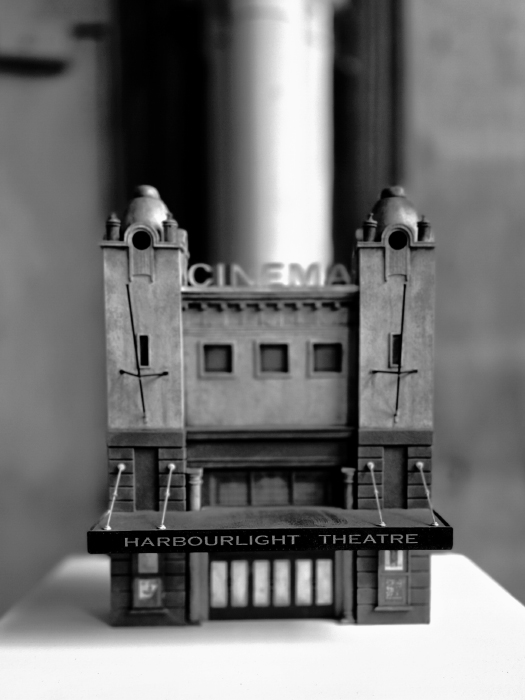
GRAEME RUSSELL Cinema 2025 Black-and-white photograph
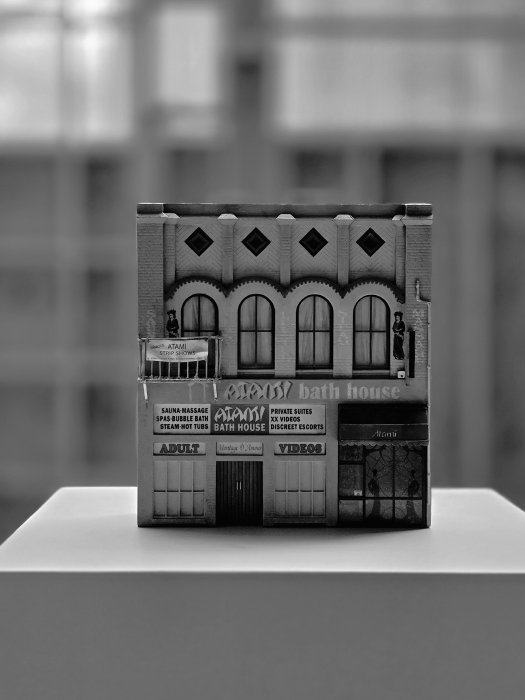
GRAEME RUSSELL Bath House 2025 Black-and-white photograph
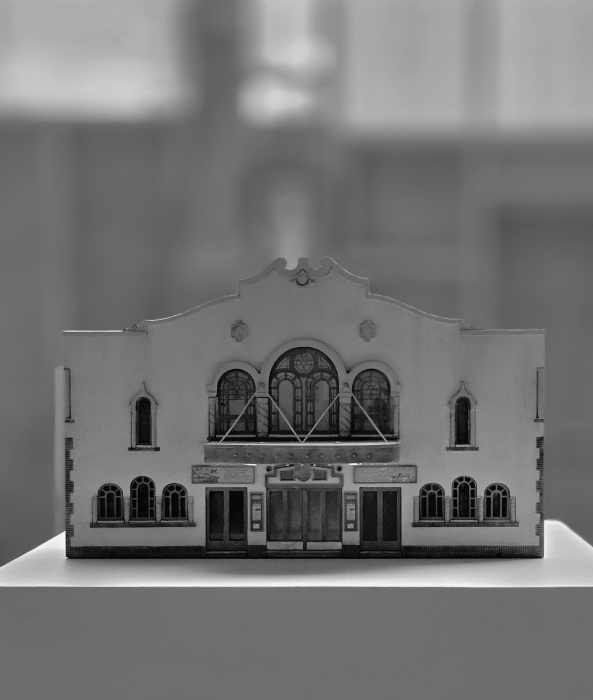
GRAEME RUSSELL Repertory Theatre 2025 Black-and-white photograph
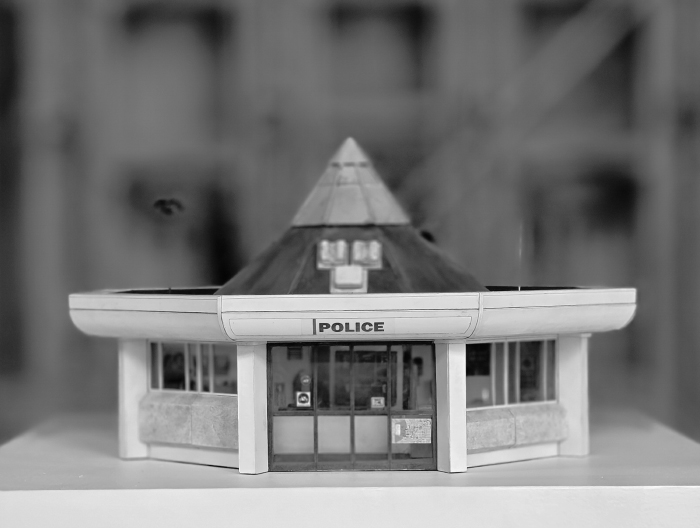
GRAEME RUSSELL Police Kiosk 2025 Black-and-white photograph