
Pleione
GEOFF CHAPPLE
Pleione is an experimental dance work composed and performed by Judith Exley, Pamela Gray and Jennifer Shennan. The work was divided into nine sections, each including the three performers: but each using a different conjunction of 'active' and 'passive' dance and music roles.

That formal structure underlay the performance but, insinuated into it by Judith Exley's flute or aroused by the long drones of Pamela Gray's cello, appeared ideas more dark. This was performance art: a junction of music, dance, and sculptural form, with stark images, (crystallised mainly by dancer Jennifer Shennan) from the surrounding media of sound and movement.
In their most general sense, the images were of freedom and repression. At the start of the work the stately step of the Pavan, a sixteenth century European dance, gave way to a quick glimpse of the twentieth century goosestep. In another of the early sections, an expressionistic dance by Jennifer Shennan, buoyed by the voice of a partner, collapsed grotesquely when the voice was withdrawn.
Such images took place outside a giant rope triangle, suspended at its apex against the gallery wall and curving down to enclose floor space in its two base angles. But it was inside that space that Pleione developed the more specific tensions of its freedom-repression theme.
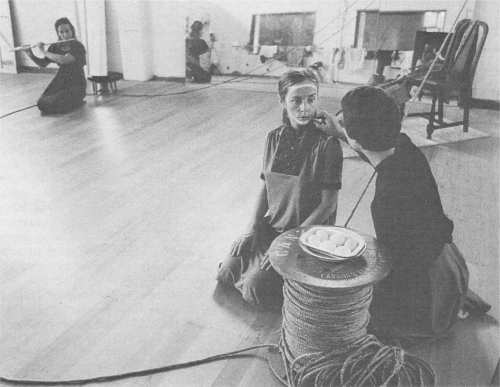
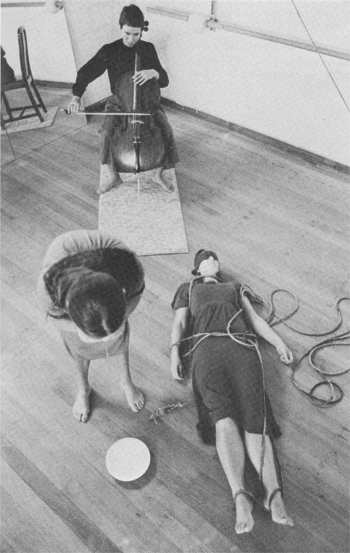
In one of the base angles, a dancer was masked. The suggestion was of a role adopted a withdrawal to the first degree of false consciousness. In the other corner, the dance playing flute was blindfolded, the flute taken, the woman roped. From the third position under the apex of the triangle, the cello drone began: harsh and unremitting.
Beside the roped and recumbent woman an egg was punctured and blown empty. This image seemed unambiguous -the empty egg was placed at the centre of the triangle, and remained there, signifying, I would guess, the chemical or IUD-induced sterility which is now part of a modern woman's choice.
Two more eggs were smashed and thrown in the abrupt climax to Pleione; and a third was picked up for throwing but placed back, after a moment of choice, in a dish beside two other unbroken eggs. The score, if you like, was therefore three-all. From this point the dangerous emotion of Pleione seeped away -to a quite passive section and was taken through to a stage featuring maternal and filial images. Finally, in a strong portrayal by Pamela Gray, the empty egg was invested with the qualities of, alternately, joy and rejection.
To analyse in print a work of this kind is to do it an injustice. Pleione takes its name from the faint so-called 'mother' star within the Pleiades star group. Its themes were direct enough, but floated within a milieu of suggestive ambiguity as the musician/dancers changed both their force and their relation to each other throughout.
In its portrayal of twentieth century woman, the group's images were occasionally too overt, but it was a bold performance. The lead-ups to its various conjunctions were beautifully spaced. In its wider ramifications it seems to illustrate Jean Paul Sartre's famous summation - that we are doomed to choice.
A sung poem from Eileen Duggan ended the piece, as Sartre might, without judgement, but with affirmation.
Where is the woman that should complain of travail?
She, by her pangs bequeathes the Pleiades.
These spinning hemispheres air-dipt, land-dappled.
The gipsy brine of seas.
Many the women that go to clay unchilded
Their lien is upon the skies afar
But she who bears deeds breath unto another
And has entailed a star.