
Companion Pieces
Two Taranaki Sculptures by Shona Rapira Davies
NGAHUIA TE AWEKOTUKU
Two large sculptural installations by Shona Rapira-Davies recently featured at the Len Lye Centre at New Plymouth’s Govett-Brewster Art Gallery. Over 12 months, linked thematically, they shared time and space for a few weeks. During this brief period, I visited the gallery.
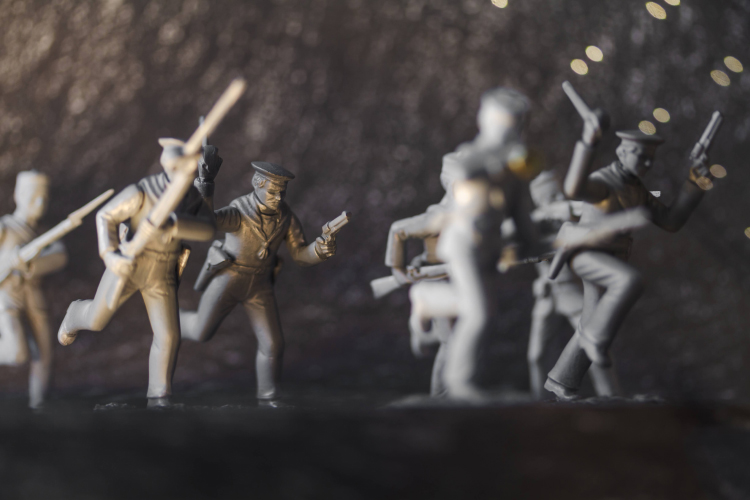
Detail of Shona Rapira Davies’ Ko Te Kihikihi (2021), at Govett-Brewster Art Gallery | Len Lye Centre, New Plymouth, August 2022 (Photograph: Hayley Bethell)
The first installation, Ko te Kihikihi, was originally part of the successful group show Swallowing Geography, with the late Matt Pine, Kate Newby and Ana Iti. Sensitively curated by Megan Tāmati-Quennell, this exhibition considered human relationships with land and space — how settler communities absorb and exploit the landscape, consume its narratives of indigenous culture and location, and attempt to uplift and establish themselves by redefining and manipulating those ‘traumatic histories [which] speak of environmental and cultural exploitation; of rupture, violence, displacement, alienation’.(1)
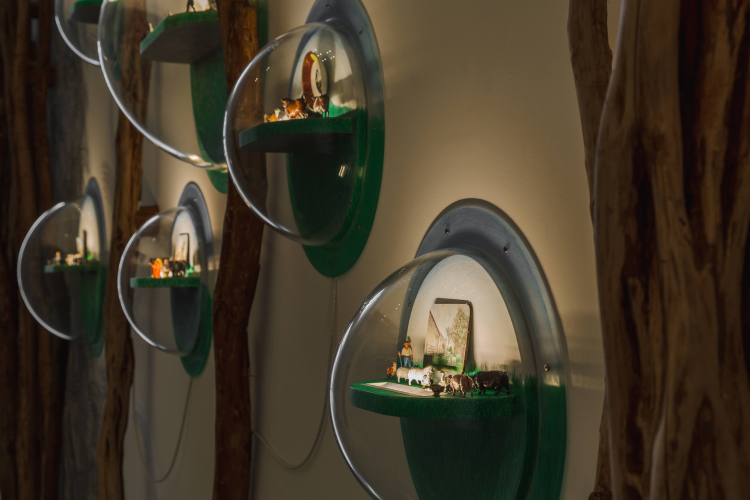
Detail of Shona Rapira Davies’ Ko Te Kihikihi (2021), at Govett-Brewster Art Gallery | Len Lye Centre, New Plymouth, August 2022 (Photograph: Hayley Bethell)
Within the tribal domain, on the slopes of the maunga, Taranaki, and along the coast of Tai Hauāuru, such narratives of loss have persisted. As bitter whānau memories, they have engendered a quiet resilience.
In Ko te Kihikihi, Rapira-Davies calls back these times, in the merry laughter of small children, comparing them to kihikihi, or cicadas, rejoicing in the rich harvest of late summer. She reflects on how they offered big food baskets to the colonial troops who took the produce and, coveting more, captured their source. The Armed Constabulary then swiftly enforced physical containment, asserting British dominance and control of the region’s wealth, and destroying the established productivity of the local iwi. Rapira-Davies explores this process with a scathing irony in this gracefully mannered configuration of spheres set within a jagged line of hūkere, which stretch along the concrete wall.
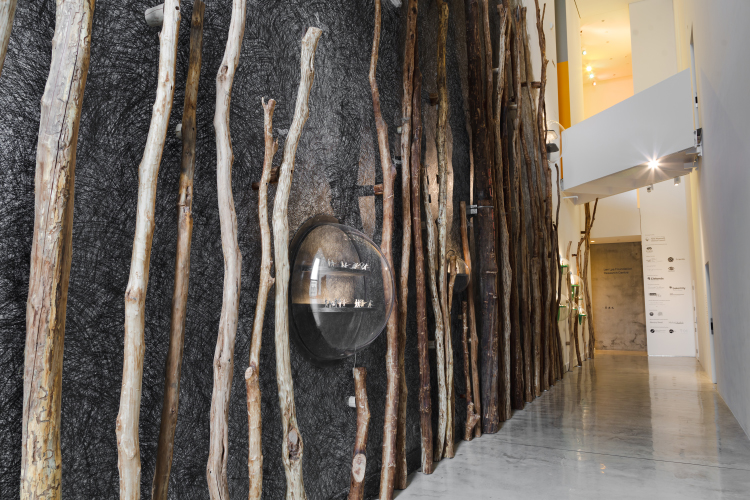
Detail of Shona Rapira Davies’ Ko Te Kihikihi (2021), at Govett-Brewster Art Gallery | Len Lye Centre, New Plymouth, August 2022 (Photograph: Hayley Bethell)
Hūkere — narrow mānuka tines, the defensive timbers of fortified palisading, he pikinga poupou ō Taranaki — thus stake their fierce claim in this clever memento mori. A few are daintily ornamented by barely discernible wire birds which whisper of Rapira-Davies’ 2020 enchanting work, There Are No Bees in My Garden, in the Toi Tū Toi Ora exhibition at Auckland Art Gallery. Here she plays with 100 handmade sparrows which twinkle on metal branches. This droll work questions the colonial project; as the show’s publication records, it ‘gives voice to what Shona Rapira-Davies defines as the impacts of “European moral authority” over Māori land and Māori people, and to the damaging effects of that on the Māori psyche’.(2)
She continues to give voice at the Govett-Brewster, addressing the land wars of Taranaki in a sequence of diminutive scenes enclosed within transparent individual hemispheres.
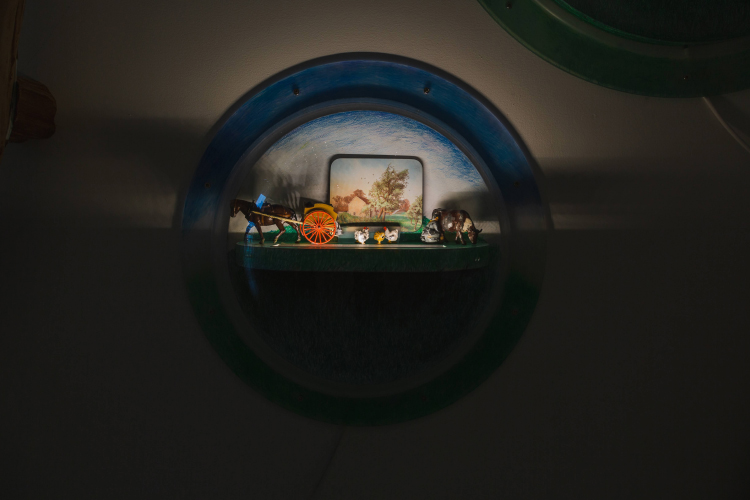
Detail of Shona Rapira Davies’ Ko Te Kihikihi (2021), at Govett-Brewster Art Gallery | Len Lye Centre, New Plymouth, August 2022 (Photograph: Hayley Bethell)
Each pod recounts a specific phase in the 16 decades of Taranaki colonial history. Knuckle-sized toy miniatures of imperial soldiers in stiff formation present a queer counterpoint to the stealthy Māori warriors primed to strike. The military images stand poised against a greyish charcoal background, their monochrome tones reflecting the graphite-brushed wall behind them. Some are softened by a pale gold sunset. Colours eventually emerge; shimmering blue sky, lush green pasture — as the process reveals the gradual introduction of large foreign animals — cows, sheep, horses, chickens — artfully arranged on raw paddocks, or flat barnyards. In one, a plump matron hand-milks a cow; in another, a huge dray horse pulls a loaded cart. Bulky kine walk with dignity in one direction; they are backgrounded by small butter dishes or rectangular coasters, each one painted with romantic English pastoral scenes. The final pods depict a Victorian high-tea setting of bone china plates and delicate gilded cups, thus illuminating a refined colonial sensibility. All the natives have vanished. Gone. Removed from the mountainside. Yet the hūkere, the mānuka timbers, remain, as they declare a deeper indigenous presence. The land remembers.
Is this what the artist wants us to see?
The work further provokes the viewer by making visual access so difficult. To actually witness these tiny vignettes of profound Māori loss and rapacious colonial gain, the viewer must make the effort — peer over awkward balconies to appreciate the vertical impact of the installation, or risk falling through the narrow slits of an adjoining gallery. A few pastoral bubbles — the final scenes — are positioned closer to the floor. What is the artist inviting us to do? Make the effort, to experience the message?
It is an unsettling story; it emphasises how twenty-first-century Taranaki — the agriculture, the wealth, the prosperity — originated in blood, lamentation, and brutality. Ko Te Kihikihi sustains this truth.
Rapira-Davies reminds us that raupatu — the Taranaki land wars of the early 1860s, and the later horrors of Parihaka — persists as a living presence. The region’s exploitative farmlands around the mountain, and the extractive industry ravaging the shoreline continue to reinforce that traumatic history. Rapira-Davies takes the courageous risk of presenting this experience in the form of evocative visual minuteness. She makes the brave move of conscious and controllable reduction in physical measure, because the scale of ongoing destruction and plunder is so inconceivable. For me, this irony suggests an earlier Govett-Brewster exhibition, Tai Moana Tai Tangata by Brett Graham. He also drew upon indigenous memory, effectively assaulting and then aesthetically engaging all the viewer’s senses. Presented in darkness, the dramatic weight and hideous muscularity of his Taranaki work Maungarongo ki te Whenua demanded a visceral response. Kā tangi tonu te ngākau . . . our hearts continue to weep.
Through her singular Ngāti Wai ki Aotea lens, Rapira-Davies reflects the anguish of the Ngāti Te Whiti and Te Āti Awa people. She achieves this by her skilled manipulation of contrast and comparison. The black space of the Brett Graham exhibit is recalled, and then ignited by these tiny story-telling spheres, crafted amidst the towering hūkere, as the lamentation, the tangi apakura, resonates across succeeding generations, to drift beneath the merry laughter of small children, the echo of cicadas.
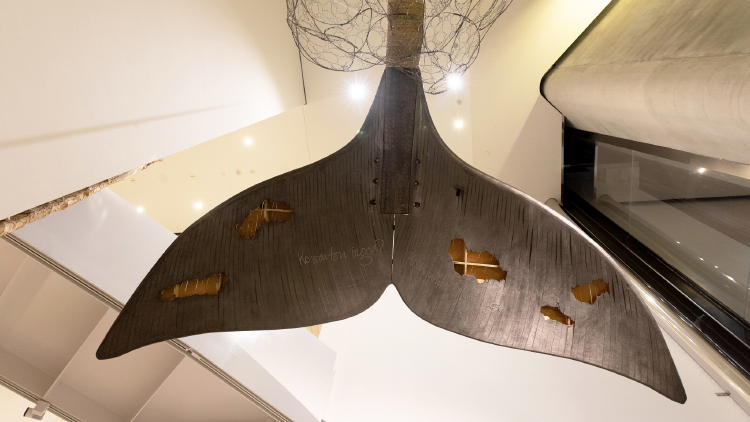
Detail of Shona Rapira Davies’ Ko Te Kihikihi Taku Ingoa (2022), at Govett-Brewster Art Gallery | Len Lye Centre, New Plymouth, August 2022 (Photograph: Hayley Bethell)
Offering a deeper Ngāti Wai ki Aotea perspective, Rapira-Davies’ second work, Ko Te Kihikihi Taku Ingoa, carries both laughter and lingering lamentation. She describes this quirky multimedia construct as ‘a memorial to the sacrifice made by the children and people of Parihaka’. It hangs above the austere concrete corridor and gently folded wall which adjoin Ko Te Kihikihi, the first exhibit. The museum’s website comments further: A northern iwi narrative where the Whale (Tohorā) gives up its life, body and skin, for his brother the Kauri tree, is a metaphor in the work. The narrative about the two brothers—the Whale and the Kauri—in which the Whale originated from land before moving into the sea, is interwoven with iwi histories particular to Taranaki.(3)
Visually, this suspended sculpture challenges the visitor’s imagination. Much depends on the approach taken — directly, through the gallery door, or obliquely, from around the curving wall. Above the door, the solid perfection of an elegantly shaped tail of dark wood and graphite flows into the twisting skeletal backbone of oiled pōhutukawa. Along this line a succession of cloud-like forms, rendered in high-tensile wire, cast ethereal shadows to dance playfully across the upper wall. The biggest roundel suggests a hollow cetacean head, from which spouts a unique energy; not the creature’s breath, but in this instance a perpendicular extrusion of leafy stainless steel that forms a kauri sapling, promising healthy growth and vigorous potential. It is through the healing power of the tohorā’s sacrifice that the kauri tree will survive, overcome adversity, and flourish. This is explained further in another commentary: Ko Te Kihikihi Taku Ingoa melds Shona’s felt response to the colonial past, which remains omnipresent both locally and globally, with the disturbance to the historic migratory patterns of whales off the Taranaki coastline and the sacrifice of the whale — the largest creature in the ocean — for his brother the kauri — the largest tree in the forest.(4)
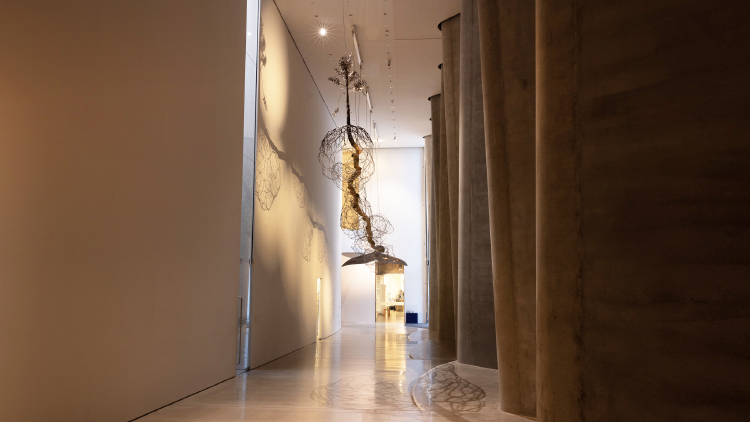
Detail of Shona Rapira Davies’ Ko Te Kihikihi Taku Ingoa (2022), at Govett-Brewster Art Gallery | Len Lye Centre, New Plymouth, August 2022 (Photograph: Hayley Bethell)
As companion installations, Ko Te Kihikihi (It is the Cicada) and Ko Te Kihikihi Taku Ingoa (The Cicada is My Name) achieved an enduring impact. The former demanded close examination of its detail, as each Perspex hemisphere described the Taranaki saga of raupatu, set within the proud lines of hūkere. As metaphorical pikinga poupou o Taranaki, or panels of narrative, they assert sovereignty over the land. The next installation, a sacrificial leviathan situated in a curious space of concrete and light, stimulated more quizzical discussion than wonder. Both shows snatched the viewer’s attention, both echoed with the chattering laughter of small children. Both fulfilled the artist’s purpose, to understand the layered histories around Taranaki the mountain, and through Kauri and Tohorā, to extend those chronicles into the western sea.
He pikinga poupou e, ki roto o Taranaki; ki reira au nei, matakitaki iho Tukutuku roimata e, tukutuku roimata e . . . I watched soaring panels of story in Taranaki; I offered (my) tears . . . (5)
1. Swallowing Geography: Matt Pine, Shona Rapira Davies, Kate Newby, Ana Iti, Govett-Brewster Art Gallery, Ngāmotu, New Plymouth 2021, unpaginated. 2. Nigel Borrell (ed.), Toi Tū Toi Ora: Contemporary Māori Art, Penguin Books, Auckland 2020, p. 150. 3. See http://govettbrewster.com/exhibitions/shona-rapira-davies-ko-te-kihikihi-taku-ingoa, accessed 20 January, 2023. 4. Govett-Brewster Art Gallery|Len Lye Centre director Zara Stanhope, quoted in http://www.e-flux.com/announcements/496251/shona-rapira-daviesko-te-kihikihi-taku-ingoa/, accessed 20 January 2023. 5. See Iwi Anthems: Taranaki, http://www.youtube.com/watch?v=kiIJk_4CNFU, accessed 20 January 2023.