
A Total Art Experience In The Theatre
ROSS FRASER
A recent production by The Opera and Ballet Workshop at The Pumphouse, Takapuna, of two works by Arnold Schoenberg, The Cabaret Songs (The Überbrettl Lieder) and the music-drama Expectation (Erwartung), the composer's first 'atonal' work for the lyric theatre, was a rare opportunity for discerning audiences to experience an audiovisual happening that called up a wide-ranging sensuous response. (The Cabaret Songs were sung by Wendy Dixon, the whole directed by Janette Heffernan, designed by Derek Cowie, with musical direction by William Dart.)
Arnold Schoenberg (1874-1951) is perhaps the single most influential composer of this century. Very briefly, his works can be divided into three main groups: the early 'Romantic' compositions (Transfigured Night, Gurrelieder); the introduction of 'pantonality' (Expectation and Pierrot Lunaire); and serial composition (Moses und Aron and Ode to Napoleon).
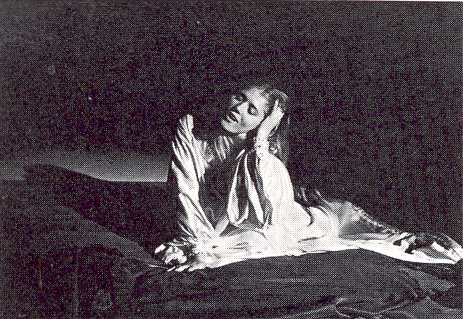
Wendy Dixon in Erwartung
Photograph by Bruce Connew
The Cabaret Songs (1901) were written at the time when the young Schoenberg was conductor and musical advisor to the Überbrettl Cabaret in Berlin. The words are by well-known poets and dramatists of the period: by Otto Julius Bierbaum, for instance, and by Frank Wedekind, the author of Spring's Awakening (recently staged in Auckland by Theatre Corporate) and Earth Spirit and Pandora's Box, from which were derived the libretto for Berg's opera Lulu.
Expectation (opus 17, 1909), on the other hand, is all of a piece: a scenario concerned with a woman lost in a wood, searching for her lover, and finally coming across his dead body half-buried in leaves and bark. This thirty-minute piece is expressed in a tonality that includes the whole of chromatic 'space'., In this period of his work Schoenberg calls up, as one musical historian puts it, 'a world of super-tonality, an all inclusive "pantonality" which spans the enormous space between diatonic harmony on the one hand and sheer chaos on the other'.
Schoenberg's approach to the setting of poetic texts was expressed by him in an essay in Der Blaue Reiter, 'The Relationship to the Text': 'With compositions based on poetry the exactness of rendering the action is as irrelevant to its artistic value as the resemblance to the model is for a portrait. A hundred years later noone will be able to check the likeness, but the artistic effect will always remain. This effect will exist not because a real man, the man apparently depicted, appeals to us - as perhaps the impressionist believes - but because the artist appeals to us ... Once this has been recognised, it is easy to understand that the external congruence of music and text, which reveals itself in declamation, tempo, loudness, has as little to do with the internal congruence, and stands at the same level of primitive imitation of nature as the copying of a model.'
In these years Schoenberg associated with the avant-garde among the German writers and painters - with Kandinsky, Klee, Marc and others - and he makes clear his appreciation of their parallel innovations in the essay already named: 'Kandinsky and Oskar Kokoschka paint pictures in which the external object is hardly more to them than a stimulus to improvise in colour and form and to express themselves as only the composer expressed himself previously. These are symptoms of a gradually spreading recognition of the true essence of art. And with great joy I read Kandinsky's book, Concerning the Spiritual in Art, in which a way is shown for painting that arouses hope that those who demand a text will soon stop demanding.'
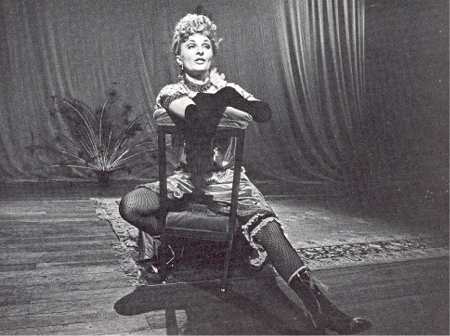
Louise Malloy
performing the Überbrettl Lieder
Photograph by Bruce Connew
The evening of Schoenberg at The Pumphouse opened with an evocation of rich colour harmonies -of vermilion and cerise and mauve in the backdrop and lights - supported by warm tone colours from William Dart at the pianoforte. As she entered, Louise Malloy made great play with a long-stemmed peacock feather, striking attitudes that echoed the lines of projected graphic works from the fin de siècle. With its piquant harmonies and snatches of operetta-like melodies (Schoenberg had a lively appreciation of stylish light music and enjoyed setting satirical poems in the idiom of popular songs) this part of the programme was a vivid recreation of the aesthetic and social milieu of early twentieth century Berlin.
After the interval, in Wendy Dixon's virtuoso performance of Erwartung, we were presented with a different mis-en-scene. The work essentially evokes a kind of 'nightmare' (Schoenberg's word was 'Angsttraum') and the scene changes are evoked as much by the music as by abstract visual elements.
The 'rnoonlight' flooding a big gauze covering most of the back of the stage gradually dimmed to disclose the figure of a woman in a long white satin dress. She is the protagonist of Schoenberg's music-drama - a nameless woman, about to set out on 'the path'; and her monologue begins with the description of her fears.
As the action developed through several tableaus to the denouement when she finds the corpse of her lover and enters into a 'dialogue' with him, Janette Heffernan's production incorporated a number of projections on the gauze and the singer's costume, ending up with some Vasarely compositions that transformed the moving figure into a shifting and dissolving kaleidoscope of colour.
For their next production early next year The Theatre and Ballet Workshop are planning performances of Gluck's Orfeo ed Euridice; and the Auckland City Council, in a heartening display of support for the arts largely stage-managed by Cath Tizard, have agreed to the transformation of the Concert Chamber in Queen Street into a home for the Workshop's opera and ballet productions.