
Alan Pearson
(1929–2019)
Last year I was setting up an end-of-residency exhibition at the Dunedin School of Art when a call came through to my cell phone from the UK. It was from my old art-school classmate Alan Pearson; he needed to talk to someone as his father, the artist Alan Pearson, had just passed away. It was kind of ironic; in 1986, Alan Pearson the elder had held the same Dunedin residency that I had just finished.
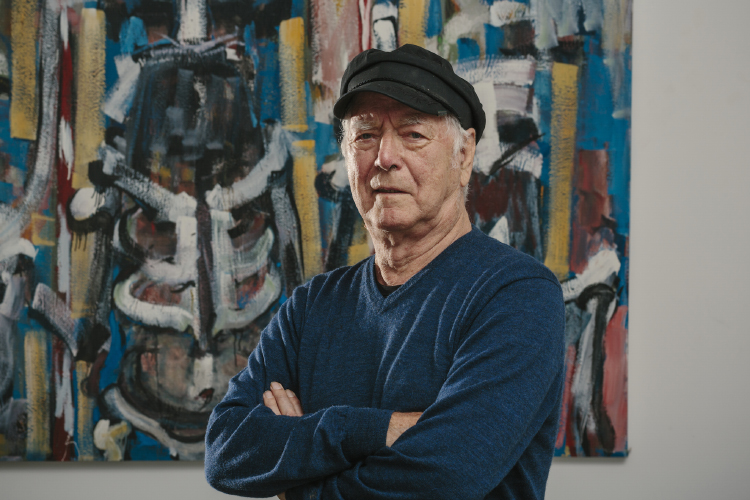
Alan Pearson, 2014
(Photograph: Sam Hartnett)
I went through Ilam Art School at Canterbury University with Alan the younger in the 1980s. His dad had been a student there in the 1950s. Through my friendship with Alan I became very aware of his father as a formidable and unrelenting artist. Listening to him talk at school about the day-to-day methodology of his father’s practice, I soon became aware of the tenacity that would be necessary to even contemplate entering that profession. It was a definite grounding and as important a lesson as anything I ever learnt as a student.
One time my friend Alan asked me to give him a hand to pick up a chest of drawers from his father’s house in Lyttelton. Pearson was away at the time (probably at the Dunedin residency, I assume). I was desperate to check out a real and serious artist’s studio. Some of our lecturers at Ilam had art practices and Riduan Tomkins, head of the painting department, even had a studio at the school itself. It just looked like someone’s office. There was a suspicion that our full-time lecturers were too safe as artists, nurtured within the comfortable bubble of academia.
Pearson was a different kettle of fish altogether. He put it all on the line and you could see that risk factor in every brushstroke. It looked like he meant it and didn’t care whether you liked it or not. His studio in Lyttelton seemed somewhat chaotic with paintings stacked carelessly over top of each other, inside a messy and dark space with detritus strewn about. It was a bit of a shock for me. It was definitely not House & Garden and made art school seem positively salubrious. His son just shrugged and thought it was normal. As I found out much later, it was.
I only ever met Alan Pearson the painter once. He came up to visit his son in a studio I shared with him in Auckland early in 1994. On entering my space he looked hard at all the work. He said some critical and honest things, which were actually quite helpful once I recovered from his observations. However, he did hover in front of one work and pointed at it as he said, ‘Now that’s damn good!’ He looked at the painting for quite some time and never said another word. Later that evening we went to his exhibition at RKS Gallery and when he saw me, he dragged me over to one of his paintings. He leaned into me as he said, ‘I put that one up for you’. He was being both charming and terrifying at the same time. I liked him.
Pearson worked as a full-time artist for most of his adult life. He went out of fashion. He went out of this country, moving to Australia in 1999. He has now gone out of this world. His paintings remain and will be dissected in due course. More important, for me, is that he never lost his desire nor his defiance. It’s there in virtually all of his self-portraits. Pearson had his followers and he didn’t do it alone but the man threw his life totally into his art and he deserves utmost respect for that. He always had mine. Cheers Mr Pearson, you were the real deal.
MARK BRAUNIAS