
Jane Zusters
RHONDDA BOSWORTH
A versatile artist whose inspiration flows freely in photographs, drawings, etchings and ceramics, Jane Zusters makes images out of her experience. Aged twenty-eight, the daughter of a school principal and the product of a conventional academic education, Jane Zusters describes in her work her emotional arc, and reflects a world very different from the environment she grew up in. She has a natural attraction to, and facility with processes. Her equipment includes sundry camera gear, a darkroom, an etching press; and a ceramics workshop is planned. She frames her own work.
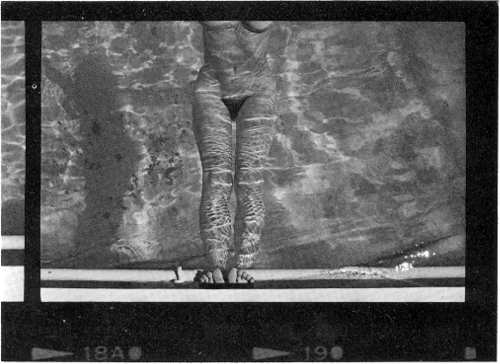
JANE ZUSTERS
Pink Nude in Blue Pool 1980
Colour photograph
Part-time jobs as a postie, and a baker in a workers' co-operative, have kept her going: but the necessity of making her work pay for itself has made her quick in grasping the technical essentials necessary to make her images, and resourceful in utilizing whatever materials are available. In 1978 Jane Zusters was awarded a $5000 grant from the Queen Elizabeth II Arts Council, which financed her darkroom equipment and enabled her to explore the medium of colour photography.
Zusters began taking photographs at twenty-one, when she spent a couple of years at art school in Christchurch. The first year was stimulating: but after that she found she did not want to specialize as the system required. The first photographs to move and inspire her were by Diane Arbus and Ralph Eugene Meatyard. She still has a love/hate relationship with the medium.
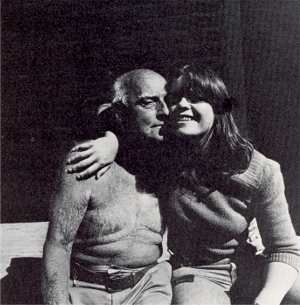
JANE ZUSTERS
Lynne and Cyril 1978
Black-and-white photograph
'The price one pays as a photographer is incredible involvement with one's subject-matter. Sometimes I don't have enough energy for this intense involvement.'
She finds photography so 'white-hot' that she needs to work in other media as well. The expense of photographic materials is prohibitive. Drawing for example, does not require her necessarily to go out and relate to the world; it's cheaper (given a few simple materials); she can do it at night and that is something she does not do with photography because she prefers natural light and has never used a flash. Some of her drawings are based on her photographs: for example, the Embrace drawings in her exhibition of ceramics and pastel drawings at Denis Cohn Gallery, Auckland (December 1979).
'The point that I find most fruitful to work from' she says, 'is that between what I intend and what happens. There is a point at which I don't know what is going to happen. In the best things, you have this merging of what is intended and what happens. There is a point at which I don't know what is going to happen. It's being in touch with one's unconscious self. My work quite often has elements in it I don't initially understand myself.'
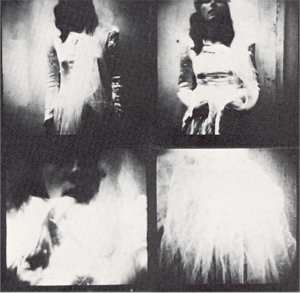
JANE ZUSTERS
Portrait of a woman marrying herself 1978
Black-and-white photograph
She is eclectic, assimilating images from many sources. She pores over art books, drawn to work that is emotionally intense - Sonia Delaunay, Kandinsky, EI Greco, Louise Nevelson. She enjoys the work of New Zealand artists Barry Cleavin, Ralph Hotere, Laurence Aberhart, Allie Eagle, Joanna Paul, Jeffrey Harris, Gretchen Albrecht, Denys Watkins, Anne Noble.
Jane has early memories of sitting under the table - drawing on it. She did her first mural on the back of the fowl-house when she was twelve. Early on, she 'lost the representational bogey that everyone else was hung-up on'. Art was her passion: yet she failed School Certificate art and she did not find, as an adolescent, adult acceptance of her creativity and perceptions. In her twenties, Jane Zusters realized she had to become 'child-like' again; just to do it - make images. Through the Women's Movement in the late 'sixties, she faced the fact that she had to do something for the rest of her life. She didn't believe in the system she'd been brought up to participate in - of marriage in the suburbs or an (academic) career. Her images do not conform to the ideology of political feminism, although her work often has feminist preoccupations: e.g. Woman watching Herself (etching 1976); Portrait of a Woman Marrying herself (photographs, 1978); Over the edge of the rainbow razor (etching, 1978).
Like many women artists, her work is concerned with relationships - with the formal relationships inherent in any creative medium, and with human relationships - her own with the rest of the world; and other people's relationships as she perceives them - woman and man, woman and woman, man and man, child and child. The people who are her subject-matter in photography often appear as couples: some of them very unconventional. For example, Lynne and Cyril, (photograph, 1978): an old man infatuated with a young woman.
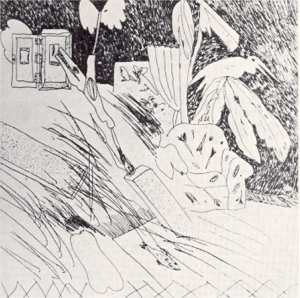
JANE ZUSTERS
The evaporation of the lover's dream 1979
Hand-coloured etching (first state)
Her 'manifesto' for her exhibition at Snaps Gallery, Auckland, (April 1980) read as follows:
a. Love (her subjects' literal physical connections with each other)
b. Space (her subject-matter is seen in simple uncluttered space)
c. Light (unusual and dramatic light situations)
d. Colour (In black-and-white imagery - tonal relationships and in colour images - the relationships between the colours themselves)
In this exhibition, the polaroid sequences were sensitive, searching, close involvements between the models and the photographer. Their worlds were private, personal, intimate, yet exposed to her camera in such a way that one was almost embarrassed at their vulnerability. Her use of light, and subtle, evocative colour, delved into images of loving, touching and feeling. Her imagery is often sensual, sometimes ambiguously sexual-at its best allied with a strong psychological insight. The sequence of Margaret (1980) was a formal essay in the play of light and shade on the woman's emaciated yet sensual body. She has produced some outstanding portraits in black and white photography too: e.g. Tiffany and Margaret (1977). In an attempt to de-mystify the photographic process, she pegged contact sheets and test strips to a yellow line around the walls of the gallery.
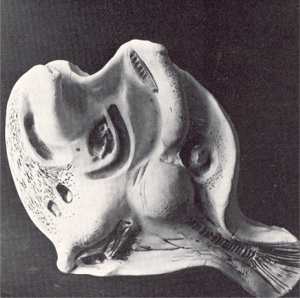
JANE ZUSTERS
Dish 1979
Earthenware with coloured glazes
Jane Zusters thinks she is likely now to become involved in sculptural projects; and she is drawn to teaching because she believes our society alienates people from their creativity. She is interested in the healing aspects of people being involved in expressing themselves. She believes it is far harder to make something beautiful in feeling and form, without being hackneyed, than it is to make a 'savage pain statement'.
'I care about what is happening in the world. I care about human beings and the state of the planet, very much. I think it's important for people to be in touch with their creativity and the child in themselves. It is very easy for people in our society to end up alienated from their creativity and their true selves.'