
Exhibitions Christchurch
JOHN COLEY
The Benson and Hedges Art Award 1980
Rosemary Johnson
Llewellyn Summers
Philip Trusttum
Quentin Macfarlane
The Benson and Hedges Art Award Exhibition drew an enormous number of people to its opening night in Christchurch's C.S.A. Gallery. Most were attracted as much by curiosity about judge Eric Westbrook's choice as by the high-powered promotion that accompanied the event.
As is often the case with such affairs, it was difficult to see the twenty-nine works which had been chosen from the 230 submitted, so close was the crush. As is also usual with art award exhibitions, there were probably only twenty-nine people satisfied with the choice; and a few of those may have had their doubts. The award of $3,500 was won by Angi Lartout. Her Mugshot, a tightly rendered self-portrait in the form of a trompe l'oeil photograph with attached documentation describing the subject in coldly bureaucratic terms and simulated bloodstains, attracted Dr Westbrook's eye as the work possessing the greatest merit. He saw it as a painting 'that doesn't say all it has to say at one look. It has overtones of the artist saying something about herself, about the documentation of civilisation, and it is superbly carried out in a very difficult medium'.
I have some sympathy for Dr Westbrook. He had to come 'cold' to the country and choose from a tremendously diverse range of paintings twenty to thirty which would satisfy the thousands who would subsequently visit the exhibition that these works represented the most significant artists currently practising in New Zealand. It is clearly an impossible task to make a selection that will please all serious followers of the visual arts. I doubt very much whether a home-grown judge could have constructed a fair sampling given a limit of thirty works: fifty to sixty might just do it.
The problem is that there are simply more painters working today than when the Benson and Hedges Award was inaugurated a decade ago. Westbrook, who was the judge in 1972, commented on the tremendous diversity of style and content in the 1980 offerings compared to those of eight years ago.
This show, its critics notwithstanding, had many strengths. Killeen's assemblage of shapes, John Hurrell's colour grid, Gretchen Albrecht's Talisman, Julia Morrison's silver painting, Hotere's Aramoana, Frederick Maynard's Castle Hill, and Paul Johns' black and white op piece were all strong works which would have measured up in any company.
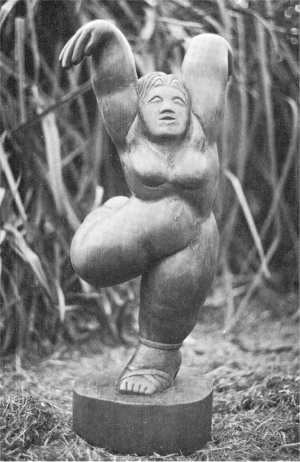
LLEWELLYN SUMMERS
Gay Paree Totara
Rosemary Johnson, a gifted Christchurch sculptor, recently completed a work for Christchurch Teachers' College. Her installation is probably one of the most advanced pieces commissioned in New Zealand in recent years. It occupies a 30x40 metre courtyard, and incorporates massive river boulders, farm fences, pathways and a central Corten steel disc which is 2.5 metres in diameter.
The other elements are arranged around the steel disc, which is placed in the centre of a pathway that bisects the quadrangle and is in turn crossed by a shorter pathway. A hillock rises towards the end of the longer path and the fences are constructed on the pathways.
Moving through the work, one experiences the crunch of pebbles underfoot, the rhythmical marching accompaniment of the fenceposts and the journey over the hillock. The fences, the curve of the hillock and the stony texture of the boulders, introduce elements of the larger New Zealand landscape into the confined regularity of the quadrangle. A screen of native foliage and cabbage trees is also incorporated into the conception and when established will add further to the indigenous feeling the work creates. Posts marking sightlines from the work extend the notional space occupied by the piece to distant locations around the campus.
Unfortunately a bald description of parts fails to convey the strong, singular flavour of the sculpture. It is a complex, major installation that commands one's attention.
Llewellyn Summers is another Christchurch sculptor whose work is not well-known beyond the city. Locally, however, he has always been noted for his large concrete figures which pop up around town on front lawns and any other congenial space he can persuade owners to let him use.
He recently held a successful show of woodcarvings at the Brooke/Gifford Gallery, displaying an increased technical mastery and greater understanding of sculptural form.
His earlier concrete works had an untutored awkwardness about them, for Summers is entirely self-taught. His cast concrete figures often appeared to be wrestling with themselves, or possessed limbs that looked as if they had been extruded from a pasta machine. At their best they had a strong, confident personality and a compelling presence.
Now he is more interested in working reductively and has put his energies into carving. The forms of his carved figures flow together with greater grace and subtlety and he has learned the trick of capturing movement, freezing it at the point of equilibrium.
A totara carving of a robustly elegant dancer is beautifully balanced with the poise one is sometimes surprised to observe in heavy people. Despite his unfashionable commitment to traditional forms of sculpture, Summers' work is worth watching for its individuality, rugged honesty and developing maturity.
Philip Trusttum decided to clear out his painting-saturated house after visiting relatives in the North Island and being greatly refreshed by the experience of living among empty walls. How to dispose of twenty years' accumulation of work; Trusttum's Trusttums, so to speak?
His solution was to hire the largest exhibition space at the CSA, the Mair Gallery, and fill it so full of works, dating back to 1960, that it looked wallpapered with paintings. He also commissioned an auctioneer to dispose of the pieces, leaving the forces of the market place to establish the prices.
The collection hung for two weeks before the afternoon of the auction and there was strong interest shown by visitors to the gallery.
Nevertheless as the hour drew near for the auction to begin, there were fears that the enterprise might founder. Would there be enough collectors to turn up and bid for the work of a painter whose imagery is tough and uncompromising: certainly without wide popular appeal?
There was a breathtaking pause for a long half minute before the initial bid was received for the first drawing. Then things moved along in a brisk fashion as lot after lot was knocked down. At the end of the afternoon over $17,000 worth of paintings had been disposed of.
A good percentage of this figure went towards the expenses of the auction but Trusttum was pleased with the support he had received. More than one buyer thanked him for the opportunity of acquiring an example of his art.
Now Trusttum's walls are bare and he is engaged in the work of filling them with new images.

QUENTIN McFARLANE
Tidal Streams
1650 x 690 mm.
(Brooke/Gifford Gallery)
Quentin Macfarlane's paintings have always related to his local environment, specifically the seascape below his Clifton Hill home at Sumner. A superb technician and colourist, he has a graceful way with paint and a desire to create well-crafted, good-looking images.
At the Brooke/Gifford Gallery recently Macfarlane showed a collection of new canvases called the Clifton Bay Series. The geometry that locked his earlier compositions together is more dominant in these works and more strongly stated.
His colour, previously indulgently luscious, is now drier, slightly dissonant and more subtle, though it still possesses that eye-pleasing handsomeness that has always marked Macfarlane's work. The process of turning paint into image has become the chief content of his work. He is resourceful in applying paint, using broad four inch varnish brushes, delicate watercolour sables, spray guns, house painting rollers, monoprinting and anything else that comes to hand. This results in surfaces alive with visual interest and areas of colour through which unexpected combinations appear to float forward and reveal themselves. His stylish exhibition brought a glow of colour to the art scene of Christchurch in midwinter.