
Twenty-One Sculptors in Masterton
NEIL ROWE
When I reviewed the 1978 Hansells Sculpture Exhibition in Designscape, February 1979, and made the observation there that, with its concentration on the conventional static sculptural object, the exhibition was not really representative of recent developments in New Zealand sculpture I had no idea that ensuring the next Hansells would indeed be so representative would shortly by my own responsibility.
In March 1979, I was appointed director of the Wairarapa Arts Centre, the home of the Hansells Sculpture Exhibition since its inception in 1971 by the then director, Rodney Wilson. With the approval and blessing of Hansells New Zealand Limited's managing director Mr John Maunsell, I immediately set about restructuring the exhibition, which was originally scheduled for October/ November 1979.
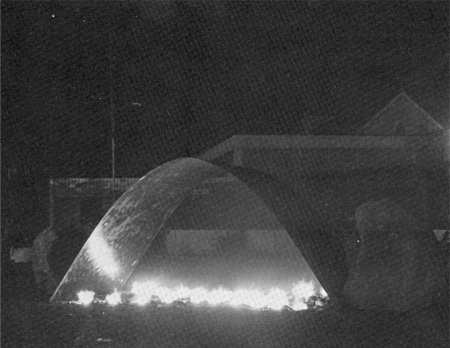
Peter Nicholl's Untitled
installed on the Wairarapa
Arts Centre's Queen Street
frontage
Photograph: Ralph Hopkins
It was quickly realised, however, that a six-month time-frame was too short to effect such radical changes as those planned, and the dates for the exhibition were put back to 4 April - 4 May 1980, thus endorsing the exhibition as a biennial event, which in fact it had been unofficially since 1976.
For well-considered logistical reasons, this year, in contrast to the previous more open award, it was decided to invite proposals from artists on the theme 'Earth, Water, Air, Fire'. Such a theme, it was hoped, would encompass the wide diversity of sculptural activity today as well as suggest something of the potential that the geography of the Wairarapa had to offer. It also meant that the format of the exhibition in terms of the allocation of available space could be controlled from the outset.
Instead of inviting the selected proposals to be freighted to Masterton it was decided to ask the artists themselves to come to Masterton to install, present or otherwise effect the work. The aim in doing this (as was the aim in allocating space for sculptural activity throughout the art centre complex and public spaces outside) was to make both sculpture and the sculptural process itself more publicly visible, and to increase public awareness of, and involvement in, the event. It was also an excellent way to bring sculptors themselves together for an interchange and dissemination of ideas on a scale unprecedented in this country. The dialogue thus generated, it was hoped, would involve the entire Wairarapa community.
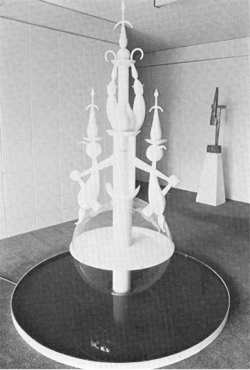
Derek Ball's
Garden of Earthly Delights Fountain
Photograph: Adam West Watson
It may not be generally appreciated how important the Hansells Sculpture Exhibition has been in the development of New Zealand Sculpture in the 'seventies. It has provided the only regular forum for sculptors to show their work, and by way of the award, has given positive support for some of our finest artists. This year, however, with the exhibition's changed format both the award and the competition structure seemed inappropriate. Instead of making an award in 1980, it was decided that the award money should be shared equally between all participants.
The unsuitability of the award system this year was made clearer by the wide variety of media included in the exhibition - twenty-one different artists working in almost as many different media. Always 'a ticket in a lottery', as 1976 Benson and Hedges Award winner Rick Killeen modestly said when receiving that award, any award, dictated to such a large extent by the taste or prejudices of the judge, is inevitably contentious. With the Hansells Sculpture Exhibition 1980 the time seemed ripe for a more democratic approach to be taken.
The change was greeted with enthusiasm by sculptors throughout the country and the response from artists to an invitation to send proposals to be considered for inclusion in the exhibition was extremely positive. Over ninety proposals were received, from which twenty-one were selected for final exhibition.
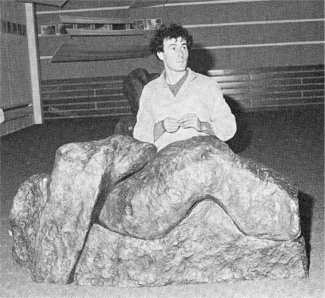
Kingsley Baird
with his Creation: The Lovers
Photograph: Jane Kitchenman
The artists chosen were as follows. Kingsley Baird, of Wellington, submitted two cement fondu groups of anthropomorphic landforms entitled Creation 1: The Lovers 2; The Separation. The geography of the Tararua Ranges was evoked by this piece as well as, symbolically, the Maori creation myth of Rangi and Papa.
Derek Ball, of Dunedin, installed his Garden of Earthly Delights Fountain. In his lucid catalogue note Ball stated: 'This sculpture is intended as a tribute to the vision of Hieronymus Bosch as a painter of images that evoke materials and technology specifically of the twentieth century. The triptych Garden of Earthly Delights, c1492, is particularly rich in this imagery utilising large clear spheres and cylinders far in advance of the glass technology of the time and really only feasible since the development of thermoplastics. . . the point of, the sculpture is that it is a literal transcription of a two dimensional fantasy (one of the fountains from the central panel) into a three dimensional reality. This process was not straightforward - even in the twentieth century visions are not easy to realise and special methods of working with thermoplastics had to be invented in order to make many of the forms for the sculpture. However the fact that it is now possible to realise this vision indicates that for Hieronymous Bosch the twentieth century would epitomise the garden of earthly delights'.
Christopher Booth, of Auckland, installed his Waterwork outside the Arts Centre's link Gallery. It consists of a three-tier stone 'Mountain' held in place with wire mesh by a method used to contain soil erosion. Above the 'mountain' is a circular system of mist-producing nozzles and a black polythene hose water supply. Landscape reference points are explicit, as is comment on soil erosion, and a polemic against the mis-use of the land.
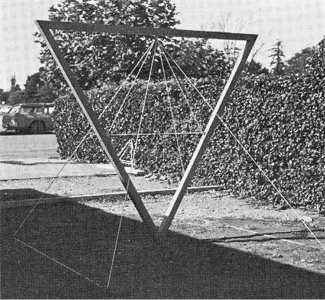
Andrew Cameron's
Triangular Construction
Photograph: Adam West Watson
Andrew Cameron, of Hamilton, installed his Triangular Construction outside the Arts Centre's Studio. His description: 'a continuous rope maintains tension on butt joints and eye hooks of a (2.4m x 75mm x 50mm) rimu triangle. All components are structural - the result - a taut restrained construction having one wooden and one small linear triangle in one plane and two rope triangles at 90" and upturned. The three rope triangles (implying two dimensions) are antitheses of the three dimensional wooden triangle yet all remain unified due to necessity'.
Kate Coolahan, of Wellington, effected her installation Filters in the main gallery. Description: 'White silk sleeves are strung on cords which are stretched across a corner and tied to ring hooks screwed into walls - centre hole is eye level. Photos on right: useable water rainwater, seawater, riverwater, springwater etc. On left: used water - Waiwhetu stream, sewerage outfall, washing up water etc. The screen or filter has been one of my themes for many years. One perceives through filters of knowledge and ignorance. Some of the filters are so dense now e.g. TV that perception is conceptual. The photos and writing on the wall will be just a little bit too small so you will have to work at it. A motor boat is more interesting to most people than the water which buoys it up. . . '
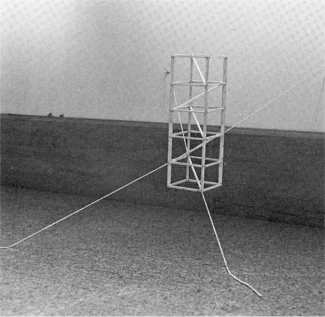
One of Paul Cullen's
Plan Constructions
Photograph: Jane Kitchenman
Paul Cullen, of Auckland, installed his series of small essays in scale and internal/external structural relationships in the Link Gallery. Unfortunately, inappropriate lighting in this gallery diminished the effect of an important aspect of these works - namely the functional role of shadow in the works' total conception.
Neil Dawson arrived in Masterton from Christchurch on the afternoon of April 4 and began work immediately on Airspace in the main gallery. He was back at work early on Saturday 5 and worked until Airspace was completed at 5 am on Sunday April 6, when he caught a bus out of Masterton at 9 am. His statement: One area of investigation in my work involves the relationship between drawing and sculpture. Generally I attempt to give 3-dimensional works a feeling of flatness and 2 dimensional works a feeling of space. Airspace is an attempt to integrate a drawing and a building, the drawing relating directly to architectural features. The process: In December I visited the Arts Centre and took slides of the wall. At this time the concrete blocks appeared to be a hindrance to any work I had envisaged. I then decided to use the mortar as a component in the work. I proceeded to draw ideas centred around creating the illusion of a three dimensional space behind the wall, the mortar remaining on the wall surface giving the effect of a grill on the front of a cage. I constructed a scale model of the imaginary space with a grill in the place of the mortar. I projected a light at the model and photographed the effects. Both front and back lighting were experimented with. the final drawings were achieved using technical drawing projection techniques. These were drawn to a 1-16 scale and later scaled up on to the wall. The position of the actual spotlight on the work corresponds to the imaginary light source in the drawing. The drawing is made using a one point perspective system with the spectator of average height standing 3m from the wall. The materials used are a plastic packaging tape and stick on contact sheet adhering directly to the wall.'
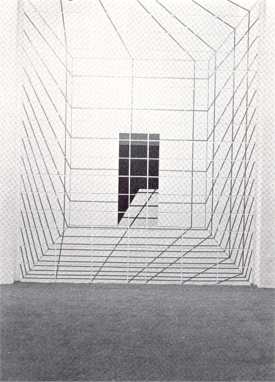
Neil Dawson's
Airspace
Photograph: Jane Kitchenman
Paul Dibble arrived in Masterton two days before the exhibition began on 2 April to install his Keeping Alive Ancient Dreams of Freedom Through Flight. Description: 'A welded polythene man- shaped envelope with feathered wings and perspex limbs attached suspended over a tub of blue dye which circulates throughout its transparent interior. The whole is contained within a transparent plastic curtained box. A label with the in- scription 'Icarus' hangs from one wing and reference is clearly made to twentieth century aero- and astronautics.'
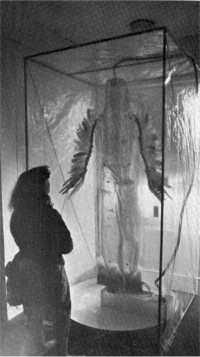
Paul Dibble's
Keeping Alive Ancient
Dreams of Freedom
through Flight
Photograph: Adam West Watson
Jacqueline Fraser arrived with the main contingent of artists at the beginning of Easter and installed Parkpieces in Masterton's Queen Elizabeth Park opposite the Arts Centre. This fragile installation, surprisingly, survived exuberant children and torrential rains until Sunday 13 April, when they inevitably fell victim to vandals. Her statement: 'The Masterton Park was well spaced with a grove of ancient trees. I chose a huge leafy oak, a small bare fruit tree and another huge tree with sparser vegetation. I hung seven silver painted spindly sculptures close to the oak trunk to make their mesh nets and translucent threads stand out in a circle against the dark bark. The seven little straw figures bound with bright cloth I suspended from the tips of the bony branches of the fruit tree. Most people saw them as a dancing merry-go-round. I intended a rosy aura as well. The seven mates to the silver sculptures were the same structure but bound in bright cloth- the same colours I had used on the straw figures. I hung them amongst the bare branches in another circle. To complement the tree dancers I built my own 'tree' from scraped Wairarapa willow with three parallel branches lashed on with the coloured cloth to decorate the branches and relate my 'tree' to the trees I'd chosen.'

Di Ffrench with her
Lunar Eclipse at Carey's Bay
Photograph: Jane Kitchenman
Di Ffrench, of Dunedin, installed her three appliqued and painted jute banners, Weeping Eclipse at Carey's Bay, in the main gallery on 4 April. Excerpt from her statement: 'I made a lunar construction using jute because of its strength. I built up the work with a canvas needle and string, glue sizing it on both sides, then I sprayed latex water-based paint on both sides until the jute was sandwiched between layers of paint. When it dried the work rolled up like a carpet for transportation.'
Auckland artist Peter Gibson's Laser Walk was a performance' piece presented after the official opening of the exhibition on Sunday 6 April. It incorporated a red laser beam, a slide projector with a continuous projection of Niagara falls, a four-foot fluorescent tube, contact microphone amplifier and speaker.
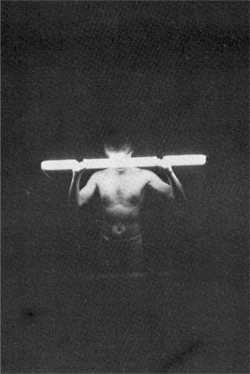
Peter Gibson
performing Laser Walk
James Greig, of Greytown, installed his gaily festive Windbanner before the exhibition opening on April 6. His conceptual / performance work Gravity / Levity was installed on Monday 21 April. It consisted of a helium filled balloon suspended from a cast iron sphere. The concept: 'Gravity - tends towards contraction to a point at the centre of the earth. Levity, (a concept polar to gravity) - tends towards expansion to a plane at infinity. Death: lifeless matter bound to gravity. Life - linked with growth processes of living organisms. Conventional Euclidean: mathematics and Newtonian physics opposed to non-Euclidean projective geometry.' The performance involved the releasing of the balloon into the night sky at the exhibition's closing symposium on Sunday 4 May.
Stuart Griffiths arrived in Masterton from Christchurch on 4 April and worked for long periods intermittently until 15 April on his earthwork Tilted Plane. An excerpt from his statement: '... as the work literally suggests earth movement it becomes very relevant to the Wairarapa which is itself a relatively even sloping plane between two fault lines and the area has a major problem with erosion. . . a negative-positive balance is achieved in the making of this work through the action of what is removed from one side being added to the other. Nothing has been removed or added: the earth has merely been reformed.
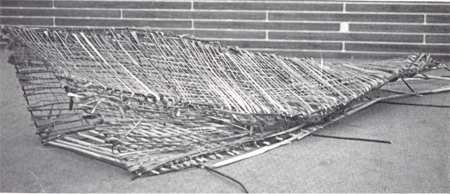
Christine Hellyar's
Nest
Christine Hellyar arrived in Masterton on April 5 and began to gather supplejack, flax and raupo. Her Nest was completed on 6 April and installed in the main gallery. An excerpt from her statement: '... a maintained interest in soft materials v. hard materials, soft shapes v. hard shapes. Truth to material and the method of making. An interest in artefacts, the native bush and the domestic. A growing interest in intense spaces and the possible forms within those spaces and in fragility and protection. . . the idea of a nest or home also being a trap.'
Morgan Jones, of Ashburton, began Gap on the banks of the Waingawa River on 4 April. It was completed on 9 April. That night torrential rains caused extensive flooding in the Wairarapa. Before Morgan Jones left Masterton on the morning of 10 April, Gap had been completely removed by the flooded Waingawa, dramatically emphasising the point of the work, namely man's tenuous toehold on the landscape and the puniness of his labours in the face of nature.
John Middleditch's copper Workforms were the only pieces in the exhibition to be mounted on pedestals.
Ngaire Mules arrived in Masterton from Auckland on Monday 14 April and installed her multi monitor video presentations Workshift and Iho. She left Masterton on Friday 18 April. '. . . Workshift is a four monitor examination of the actions and patterns of movement of male and female hands in 30 different occupational situations. .. the sounds generated by each occupation accompany the image. . . sequences freely connect thematically and rhythmically in a fluctuating four layer image and sound mix. .. In Iho three monitors simultaneously present closeup images of three natural surfaces; plant, female human, water. . . the camera through a magnifying lens pans in slow undulating rhythms examining details of the 'skins' and evidence of movement on or under them. The sounds of bird calls, breathing and water intermingle.'
Peter Nicholls, of Dunedin, effected his Untitled, incorporating a 20 foot x 8 foot sheet of steel, two 2 1/2 tonne boulders and a diesel fueled cross of fire; buried in the ground, on the Arts Centre's Queen St frontage between April 10 and 14. The work was ignited daily at 6.30. '. . . my concern here is with the anxious object, the psychological tensions invoked by seemingly uncomfortable articulations of forms. . . precariousness imparts an emotional gestural quality and conveys a distinct feeling of anxiety and expectation. .. there is intended a tension between the outward thrust of the sprung steel arc and the containing weight of the two boulders. . . the fire aspect acts as a visual and symbolic link reflected off the mirrored inside surface of the steel plate.'
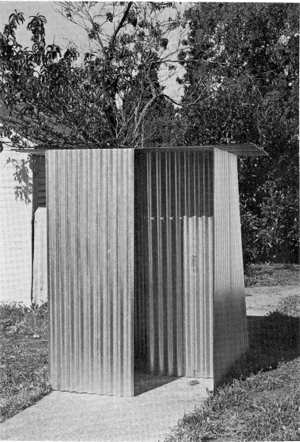
One of Matt Pine's
Path Alteration Pieces
Photograph: Adam West Watson
Matt Pine arrived in Masterton on 7 April and installed his two Path Alteration pieces and Roofpiece the following day and on the morning of April 9 '. . . the two works here are to be read as one and, as with Roofpiece, are looking at the same concerns - vertical and horizontal movement, negative/positive, closed/open, planar/mass, internal/external, flat/undulating (a study of opposites) . .. '
Selwyn Price arrived in Masterton from Auckland on 4 April and effectively operated as exhibition technician, helping several artists install their work before erecting his Inflatable Installation on Monday 7 April'. . . Inflatable Installation was conceived as an all encompassing environment that would alienate the participants from the world as they know it. .. the cave-like interior, the diffused light, the overwhelming noise, the lack of any obvious support and the interior elements all contribute to that effect. . . '
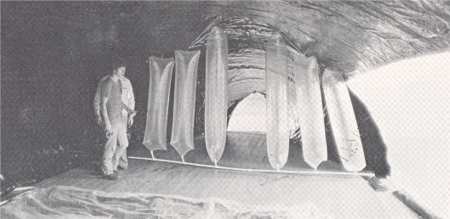
Selwyn Price inside his
Inflatable Installation
Terry Stringer installed his Domestic Interior in the Arts Centre Studio on 5 April. It consists of two life-size armchairs, coffee table with lamp, cup and saucer, book, magazine, spectacles and teddy bear, each component obeying the rules of a distorted perspective. The stage-set like scene is completed by a geometrically painted screen and inlaid carpet. The light was diffused at all windows to heighten the stage-like effect by taping paper over the glass. The screen entitled Clean Screen puns in all directions and is a witty and elegant statement in the mode of the geometric abstract paintings of Auckland artist Richard Killeen. The hinges, and the wit, however, are pure Stringer.
The exhibition, both in terms of the artists' and the public's involvement, was a highly successful experiment, although, possibly because of the public nature of the exercise, some artists, used to working in private, were unable to fully reconcile the conception and execution of their work. The fact that a great deal of the activity was focussed at Easter when shops and businesses were closed meant also that some artists found the unavailability of incidental hardware materials an inhibition. These qualifications however are minor ones and the Hansells Sculpture Exhibition 1980 certainly demonstrated the vigour and vitality of New Zealand sculpture today. It can only be hoped that the optimism it generated reflects trends and developments in the broader sphere of New Zealand society.
New Zealand sculpture owes a great deal to Hansells New Zealand limited for their continued sponsorship of this exhibition, and to Mr John Maunsell for his vision and personal enthusiasm. John Mahoney of the same company has also been a pillar of support this year. Credit must go as well to Queen Elizabeth II Arts Council of New Zealand for their assistance.
In two years time it is hoped to repair the bridge across the Tasman built by Jim Allen and Tom McCullough in connection with the now defunct Mildura Sculpture Triennial, and ensure the participation of Australian artists in Hansells.