
Frances Hodgkins
The Path to Impressionism: 1892-1912
E.H. McCORMICK
Few artists have been more dedicated to their calling than Frances Hodgkins. She was no youthful prodigy, but from the time, in her early twenties, when she began serious work until the year of her death, more than half a century later, her particular branch of art - painting - was at the centre of her life. In order to paint she gave up family, country, friends; she went on painting and experimenting well into old age; and when at last she could no longer paint she lost the will to live.
Inevitably, then, painting - her own and other people's - was a recurring topic of her adult correspondence. In the extant letters that begin during the prentice years in Dunedin and end with a pathetic note sent to her dealer six months before her death she repeatedly dwelt on one aspect or another of this all-absorbing pursuit. She wrote of pictures, planned or completed, of sales or lack of sales, of models and studios and sketching grounds, of paintings that roused her admiration or, on the other hand, of paintings that provoked her dislike. What she seldom, if ever, attempted were extended, reasoned judgments of her own works or those by other painters; she rarely discussed the technical side of painting; and she touched even more rarely on theories of painting or of art in general.
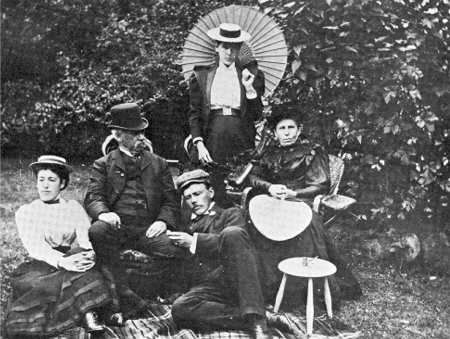
The Hodgkins family
at Cranmore Lodge,
Dunedin, c.1893
Left to right:
Frances, William Mathew,
Willie, Isabel,
Rachel
Explanations for these facts are not far to seek. In the first place Frances Hodgkins was a practising painter, not an art critic and not an art historian. Moreover, some of her correspondents (her mother and her elder brother in particular) had no great interest in art, and she was considerate enough not to bore them with her own passionate preoccupations. Then again, she often wrote at the close of a working day when she wanted to forget about painting or at least to relax in talking of clothes, people, places, books, and all the other interests of a full and active existence.
For such reasons - and I have touched only on the more obvious - the letters of Frances Hodgkins are not remotely comparable with those of two forerunners for whom she expressed her admiration, Van Gogh and Cezanne. Nevertheless, the views she did express are not entirely negligible and even her limitations have their point. So I have used this occasion to collect together for the first time her more significant references to art and arrange them in chronological sequence. Combined with material from other sources, the result may throw light on her development as a painter and even on the special nature of her talents.
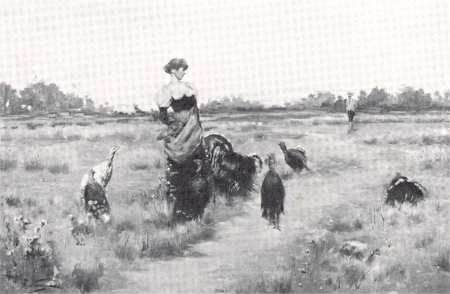
GIRALAMO PIERI NERLI
Woman with Turkeys
oil, 610 x 914 mm.
(Auckland City Art Gallery)
Apart from two childhood trifles, the earliest letters by Frances Hodgkins to survive are half a dozen written in 1892 to her older sister Isabel who was staying with an aunt in Christchurch. Frances was then twenty-three and had been exhibiting for about eighteen months. In a light-hearted manner she often referred to sketching excursions, to commissions, to criticisms of her pictures, and similar topics. Here is a sample, part of her description of a 'Lecture on Ancient Statuary' given by Professor Sale in aid, she said, of the 'Art Gallery Fund':
The lime-light views were splendid but in spite of their beauty when the gas was turned up, several people were found fast asleep. The lecture was too long, so when Father got up to make a few remarks nobody listened, but poured out in a mass, and he was left on the platform with his neat little prepared speech with several apt quotations in it echoing round an empty building.(1)
I cite this passage as a reminder of a permanent influence on Frances. William Mathew Hodgkins was a familiar figure on Dunedin platforms, much given to theorizing. In his opinion the future of New Zealand art lay in landscape painting along the lines laid down by Turner and others of the British Romantic school. Frances had already shown her independence by branching out as a figure painter, and it may be that she treated his theories with the gentle derision she displayed here for his speechifying. But she adopted his medium, watercolour, along with the technical procedures he doubtless imparted. And in more indirect ways, as inspiration and artistic conscience, he remained with her throughout her career.
There was one further mentor of the New Zealand period whose name crops up about a year after the Ancient Statuary lecture and soon after Isabel's marriage to a Wellington lawyer. 'I want to make the most of Nerli's lessons', Frances wrote to her sister, 'and have been painting hard all the week. . . . '(2) In letters of the next three years there are many references to 'Signor Nerli', but unfortunately no account of his teaching methods nor of what she herself learned. On the latter point telling evidence is contained in the bold, semi-Impressionist watercolours that succeeded the tight, often gauche and over-ambitious little works of earlier' years. And a further debt she owes to Nerli - her increasing professionalism - is documented not only in her letters but in exhibition catalogues and examination lists. In June 1895 she announced to Isabel: 'I am slowly settling down to an oldmaidship, and I have only one prominent idea,.. that nothing will interfere between me and my work.'(3) The next year, after taking courses at the Dunedin School of Art, she began her long career as a teacher.
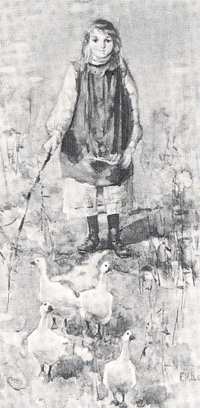
FRANCES HODGKINS
A Goose Girl 1893
watercolour, 337 x 178 mm.
(Collection of Mrs A.R.O. Gabites)
The remaining Dunedin letters record two major biographical facts - the death in 1898 of W.M. Hodgkins and her own decision to go abroad - but they again fail to throw much light on painting methods or theories. There are two partial exceptions. By 1899 she was known well enough for visiting Australian painters to look her up. Tom Roberts was one and another was the less eminent Albert Hanson who called at her George Street studio. According to Frances, he complained that her work lacked what he termed 'quality' and set out to show her what he meant. As she wrote to Isabel:
'Quality' it seems can only be got by rubbing, scrubbing, scratching, sandpapering and otherwise ruining the surface of your paper. Anything like direct straightforward brush work doesn't appeal to him.
Before closing she added:
He left me some nice paper and all my spare time I employ scrubbing & scratching with the awful result that I have lost all my crispness and freshness and as yet not a sign of 'quality'!(4)
Later in the same year, 1899, she ventured to comment on watercolours sent to Dunedin by Isabel who had ceased to paint after her marriage but had again taken up her brushes. 'Your pictures are splendid!' Frances exclaimed, remarking farther on: 'I was prepared to be critical but I must confess I could only admire when I saw them.' Nevertheless, she did offer some mild criticism, implied rather than stated:
Personally, what I feel now about your work is that you want to do more work direct from nature; that added to the strong poetic feeling which you put into your pictures ought to make a combination that very few of us can hope to attain to. I envy you your facility for big clean washes and simple effects and there is a fine sense of refinement and harmony about your colour. . . .(5)
Between them the two passages summed up the lessons Frances had drawn from her early teachers and more than five years of professional experience. In painting the watercolours that made up the great bulk of her work she was opposed to niggling artifice and tried to achieve her effects by the simplest and broadest methods. Like her father and most of her contemporaries, she admired what she called 'poetic feeling'. As a colourist in praising Isabel's 'refinement' she was on the conservative side, a lover of pastel shades and muted harmonies.
Finally, she believed in working 'direct from nature'. like 'truth to nature' and similar catch phrases used by writers from Ruskin to Cezanne, that probably meant a number of things - a preference for outdoor painting over studio work, a stress on independence of vision, an insistence on individual observation and analysis. It did not mean that she aimed at photographic realism.
In short, on the eve of her first departure from New Zealand early in 1901, Frances Hodgkins was a junior but aspiring member of the British watercolour school, her practice modified by the proto-Impressionist methods she had picked up from Nerli and possibly from reproductions she had seen in such - periodicals as The Studio.
MRS STANHOPE FORBES
The Winter's Tale
At each of the Australian ports on the Suez route to England she met artists and conscientiously inspected galleries. Her impressions, usually confined to a word or a phrase, were then shared with the members of her family. In Sydney she was 'disappointed' by what she saw of Tom Roberts (the paintings, not the person); she considered George Lambert 'the coming man', his work 'wonderfully strong and virile'; and she thought one would 'tire quickly' of both Sydney long and Julian Ashton. The Adelaide gallery she found more exciting: a Rossetti made her 'heart beat' and she 'positively ached with pleasure' on seeing pictures by such 'moderns' as Byam Shaw, La Thangue, and Brangwyn. But it was the sculpture of Bertram Mackennal in Melbourne that inspired her to extended comment. A bronze of Circe in the gallery was 'masterly':
a full length figure of a woman, upright on tiptoe with outstretched hands drawing everything towards her with such compelling vampire-like force that it is almost too strong to look at.
She made a special visit to see the artist's 'famous Springthorpe monument' recently erected under his supervision in a cemetery. Here she describes it:
It is a magnificent piece of statuary under a canopy of blood red leaded glass supported by granite pillars. The figure is recumbent and a protecting guardian angel. hovers above while the living figure of grief crouches beside the dead, the difference between the dead, living and the spiritual figures being wonderfully suggested.(6)
It is impossible to forget that the future colleague and admirer of Henry Moore grew to maturity in the Victorian age and in a remote colonial city.
One is constantly reminded of those facts when scanning her comments on the exhibitions and the galleries she visited during the early weeks in London. Not that Frances was overawed by the great names which had become familiar through her father's conversation and her own discursive reading. On the contrary, she saw 'nothing particularly exciting' in the spring exhibition of the Royal Academy and found such 'Old friends' as leader, Waterlow, and Herkomer 'one and all disappointing'. Benjamin Constant's portrait of the late Queen, draped in black and purple and occupying one wall, made her 'gasp' and 'pass on': 'as a portrait', she wrote, 'it is bad and as a picture it is worse'. On the other hand, William Wyllie's painting of the Queen's funeral, 'the Royal Yacht with Its stately escort of battleships against a brilliant sunset', she thought 'the most impressive picture' in the exhibition. She praised some of 'the younger men' - La Thangue, Stanhope Forbes, George Clausen, Frank Brangwyn - and among the portrait painters singled out John Singer Sargent and Charles Shannon. The former received the unique tribute of extended comment:
Sargent is wonderful masterly in treatment & color - he flings his subjects on the canvas in the most audacious manner no attempt at elaboration you stand back and behold meaningless blobs shape themselves into the most perfect modelling and form - A wonderful picture of his a full length of two Jewesses in all their blatant vulgarity, red velvet and white satin and a vast expanse of flesh - painted with an utter disregard to all flattery and refinement. They are the daughters of a man called Wertheimer the richest picture & curio dealer in London.
Shannon, by comparison, was dismissed very briefly: his 'things' were 'all lovely' - 'beautiful duchesses with their offspring in picturesque attitudes grouped gracefully'.(7)
Other exhibitions received more summary treatment. It might be expected that she would have found the work of the New English Art Club, formed in opposition to the Royal Academy, more to her taste. But no, 'there was nothing worth looking at' except for 'a few good things' which, regrettably, she failed to specify. Members of the Royal Association of British Artists fared a little better, though she 'was much surprised at the average standard of work' and complained that most of the watercolours were 'tremendously worked up'. It was 'quite a relief' to find some that were 'crisp and un-worried looking' and she was greatly taken by the exhibits of 'a man called Proctor' (presumably Adam E. Proctor) - 'figure in landscape' and just what she wanted, 'both color and style'.(8)
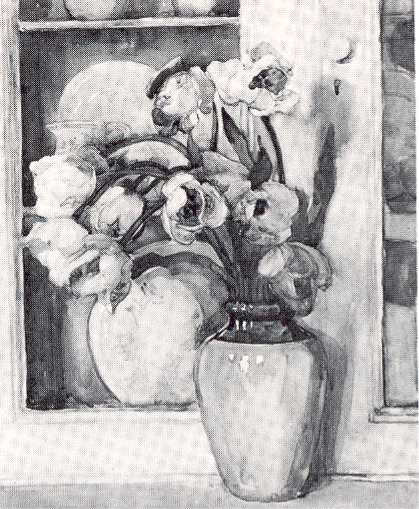
D.K. RICHMOND
Still Life with Tulips
watercolour, 540 x 443mm.
(Auckland City Art Gallery)
Visits to two of the permanent collections with an old Dunedin friend May Garden, who had come from Scotland to see her, yielded little beyond prim comments on May's unconventional conduct. One day they toured the Wallace Collection at Hertford House which Frances found 'such a treasure house, room after room filled with priceless pictures and curios.' May, on the other hand, became bored, wandered off on her own, and was later found 'chatting affably to a dissipated looking old gentleman.' 'No wonder Mr Garden won't trust her alone in London,' Frances exclaimed, 'the idea of speaking to strange men!' Setting out the next day for the National Gallery, they reached Regent Street when May found her petticoat was coming down and 'hopped into a big fashionable flower shop', as Frances related. This time she said nothing about the gallery or its contents. But she did pass a few general remarks on a loan collection of Spanish works at the Guildhall, including many by Velasquez and Goya. 'I did not know what painting was till I saw these', she wrote, 'British art cannot compare with it.(9)
Her first excursion to Paris, where she spent ten days after a painting holiday in Normandy, yielded even less and what she wrote savours strongly of Dunedin prudery and nineteenth-century prejudice:
Oh those marbles at the Luxembourg & the Louvre [sic] they send you crazy with their beauty, modern French sculpture is magnificent and contrary to all expectations I thought the sentiment in both pictures & sculpture far less degrading than I was led to believe, on the contrary I found much that was ennobling & uplifting in most of the pictures. (10)
While travelling elsewhere in Europe she probably saw many collections and during the summer of 1903 undoubtedly visited galleries in Holland, but no impressions are on record. Before dismissing Frances Hodgkins as a superficial tourist, however, it is well to remember that for most of the three years she was away she was busily painting on her own account. In Paris, for instance, she was finishing off watercolours before sending them off to be shown in Dunedin. Further, her surviving correspondence for this period, though abundant, is not complete.
The comments on individual artists scattered through the letters home are often more illuminating than those on galleries and exhibitions. Before leaving for her first sketching excursion in France she attended classes given at the London Polytechnic by Borough Johnston. She had learned much, she acknowledged, from his pencil work which was far superior to his 'very correct & academical' painting. She continued:
he says he would give much to possess what I have in my work & which I don't value, his is knowledge and mine is instinct.
In the same letter, written to Isabel, she remarked once more on the 'low level' of watercolours in England, making one further exception, Arthur Melville, whom she described as a 'strong painter'. Elaborating a little, she went on:
at first sight you laugh, then out of a chaos of blots comes wonderful form & color & you finally end by admiring very much indeed.(11)
The same artist's name cropped up the following spring when she was staying in Cornwall and had five watercolours in one of the local shows held before the exhibitions of the Royal Academy and the New English Art Club. Everybody said 'nice things' about them, she reported, adding that they 'seemed to think I painted like Arthur Melville, which is rubbish or if it is [so] it is quite unconscious'. This was the open season in the artists' colony, an opportunity for Frances to meet the famous and judge them for herself while she went from one studio to another with her friends. Her immediate response was again cool. At St Ives, where thirty-two artists showed, she praised only two - Arnesby Brown and Julius Olsson - and thought no more than ten pictures were any good. Things were a little better at Newlyn, chiefly because Mr and Mrs Stanhope Forbes showed there. She was introduced to both and wrote enthusiastically about the wife's paintings - much better, she thought, than the husband's; in her own words:
they were mostly Shakespearian, mediaeval things - but they simply sang with color & light & brilliancy - no one could touch her - she is head & shoulders above them all down here or in fact in England.
After mentioning such faded notabilities as Lamorna Birch she continued her eulogy:
I am at Mrs Forbes feet - she wins one with her strength of color & design - tho I dont want to be influenced by her - merely seeing her work helps one.(12)
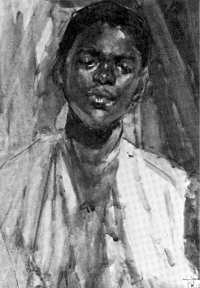
FRANCES HODGKINS
Study of a Sudanese 1903
watercolour, 356 x 260 mm.
(Collection of Mrs R.D. Todd)
During the Cornish spring of 1902 it happened that three of New Zealand's leading women painters were together for the first and probably the only time. Frances was with Dorothy Richmond, the companion of her continental travels, and not far away lodged Margaret Stoddart. While she was devoted to Miss Richmond as a person, Frances had no exalted opinion of her artistic gifts: 'she will never be a great painter,' was the verdict, 'she has nice taste & judgement but lacks fire & originality'.(13) Now she turned her critical gaze on Miss Stoddart's work, only to report:
It struck me as being hopelessly dowdy & uninteresting or rather most of it did, some things were splendid - but her old vigour & freshness has given place to wooliness & want of form - which she seems to have lost in her searchings after tones & values.(14)
When they met again the following year in the artists' resort of Bushey Frances wrote:
After our work is over we go for long walks & talks in the evening. She is full of theories, and I have none at all, which leaves me all the freer to disagree with hers - she thinks I am suffering from want of teaching & I think her chief fault lies in too much teaching - it is easy to paint like your master & to think other peoples thoughts, the difficulty is to be yourself, assimilate all that is helpful but keep your own individuality, as your most precious possession - it is one's only chance.(15)
Despite the prejudice against theorizing disclosed in her remarks on Margaret Stoddart, she did occasionally use some of the hallowed abstractions herself. In a letter to Isabel she deftly combined praise of her sister's painting with radical criticism:
I wouldn't for worlds have you exchange that cunning slickness of yours for the more 'worried' look that strivings after quality sometimes gives. Many can worry quality into a picture but few can run up a tree with that magical touch of yours & sell said tree for £14. My only fear for you is that you are too clever and facile which rather takes the place of a more subtle insight into nature. I take it there can be no abiding pleasure in a picture which lacks truth. . . .(16)
'Nature' in another guise appears in a later passage where she was defending herself against the attack of one of her own critics:
She thinks with a few other of my friends that nothing can be learnt out of a Paris Studio - but I find Nature good enough for me & less expensive - my experience of Studio pupils is that they can never do anything once they leave it, without a top light & a master at their backs to tell them what to do - & I doubt if many of them could have supported themselves in Europe for 2 years on what they earned from their easels. . . .(17)
That was written from Morocco in January 1903. She supported herself for a further twelve months (with the aid of gifts and loans from her relatives) and by Christmas was back in New Zealand. In the three years she had spent abroad she had been more successful than most colonial aspirants. She had exhibited in three London galleries, been 'hung on the line' at the Royal Academy (reputedly the first New Zealander to achieve that distinction), and had won the admiration and friendship of a circle of middle-class artists. Freed from the necessity of teaching, with more leisure than she had enjoyed for years, she had painted industriously and was a better artist than when she left home - more fluent, more confident, more professional. In addition, she had benefited both from the stimulus of fresh surroundings and from the opportunity to see the work of other artists, living and dead. But at the end of her stay she was still doing the same kind of work as she had in New Zealand. She continued to paint in watercolour and she maintained her allegiance to the conservative English tradition in which she had grown up. Obviously, too, she remained an intuitive artist, suspicious of theory, pinning her faith on a few simple precepts and catch phrases - truth to nature, directness of approach, originality of treatment, and so forth.
To sum it up in different terms, when she returned home at the end of 1903, Frances Hodgkins could in no exact sense be said to belong to the modern movement in European art. She began her tentative journey in that direction only when she again left New Zealand in January 1906 after an unhappy interlude in Wellington, complicated by a broken engagement.
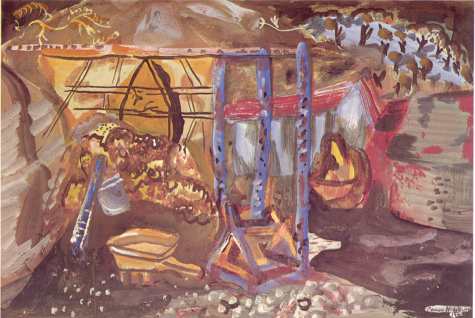
FRANCES HODGKINS
Root Crop 1943
watercolour, 371 x 546 mm.
(Auckland City Art Gallery)
Her second visit to Europe lasted nearly seven years and was a turning point in her career, perhaps the turning point. The fact is apparent in the works Frances brought back with her in 1912. What led to the transformation is not, however, so clear. She continued to write home, though less often and less exuberantly than before, and rarely to Isabel who during the earlier visit had been the chief confidante in matters of art. Moreover, many letters covering the vital period in France seem to have been lost or destroyed. Hence, while the correspondence covers outward events reasonably well, it fails to throw much light on her development as an artist.
The comments on galleries and individual artists, for example, are far more perfunctory than before. Soon after arriving she set off for Venice and wrote to her mother that she had been 'doing a great deal of sight seeing, pictures & churches'. 'It is a great education', she continued, 'seeing this beautiful city which until now has existed only in my imagination.(18) Yet the only painter she named was Tintoretto and that was merely in a reference to a fellow-pensionnaire in the Casa Frollo where she was staying:
There is a Boston Blue Stocking who wears no corsets & is writing a Thesis on Archaeology. I asked her one day if she had seen a certain Tintoretto. With much precision she said, 'I am not studying that period just at present' & that closed the conversation.(19)
At various times she visited the Scottish Academy in Edinburgh, the Walker Art Gallery in Liverpool, and in London numerous studios and dealer galleries; she attended a private view at the Royal Academy; and during four years in France she mentioned excursions to galleries, churches, studios together with tours of such places as Barbizon and Fontainebleau. The sum total of her impressions could be contained in a paragraph or so of banalities. A stay in Holland lasting about fifteen months yielded a little more. She merely generalized about the 'fine pictures' in the Rijksmuseum at Amsterdam but was rather more specific on the subject of the Frans Hals portraits in Haarlem:
. . . I liked them infinitely more this time than the 1st visit 4 years ago - they are like Sargent in their wonderful freshness & vigour - or rather he is like Hals - frightfully human & living men - such painting - a tingling vividness about them that sets one on fire - I remember disliking them when I first saw them - I am wiser now-(20)
While she was in northern Holland she also referred to three Dutch artists - Van der Velden, Jozef Israels, and Anton Mauve. She sent her mother a postcard reproduction of a painting by Mauve and described one of his models, a shepherd. But she made no mention of his nephew, Vincent van Gogh, of whom at this period she may not have been aware.
Scattered remarks emphasize views expressed during the first visit. Of a wealthy pupil who joined her class in Holland Frances observed:
she is very pleased with her lessons & she should be a good judge having learnt from nearly every teacher in Europe - full to the brim of excellent theory but quite unable to put any of it on to paper - (21)
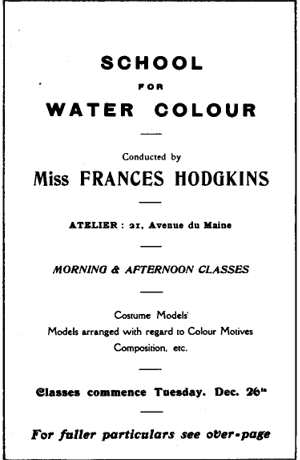
Notice for classes conducted
by Hodgkins in Paris, 1911
In Montreuil-sur-Mer two years later she wrote again in similar strain, this time of a rival teacher: She gives criticisms twice a week & talks for 2 hours on the various methods of putting on the paint - but her pupils judging from their work would thrive better on a little more practice & not quite so much theory.(22)
But she was prepared to acknowledge that mere practice was not enough. She noted of a colleague and rival of the New Zealand days:
I am so glad Miss Stoddart is doing well she is such a good honest brave hearted old slogger - on whom the Divine Spark has not alighted but she does capable competent work & I wish her luck.(23)
She herself was satisfied with a simple artistic credo that made no explicit reference to inspiration. When discussing with her mother the difficulties of achieving recognition she exclaimed:
It is a slow thing getting a footing one can only give them sincere & honest work - one can do no more - (24)
There were other obstacles in the path of a serious and impecunious artist. A would-be patron had disappointed her by keeping only the smallest and cheapest of a series of watercolours she had sent off at his request. She poured out her indignation to Mrs Hodgkins:
He is a wealthy old batchelor who lives with his Mother and I always notice when there is a woman in the case they invariably advise their husbands or sons not to buy pictures - I can hear this old dame saying No dear dont get any, or only keep the little one, they are so impressionistic - Everything they dont understand is put down to impressionism - (25)
That, to the best of my knowledge, is the only reference to impressionism in the letters of Frances Hodgkins and the word is deliberately used in the loose, popular, derogatory sense. Nor does she mention Post-Impressionism and the movements which followed in its wake. Here it is instructive to list some of the events which occurred in Paris from the time she settled there towards the end of 1908 until she left again four years later. Not long before she, arrived, Matisse, leader of the fauves, won acceptance after a struggle: a large collection of his paintings was included in the Autumn Salon. On the other hand, Braque's latest work had been rejected from the same exhibition but shown by a private dealer, giving rise to the term 'Cubism'. In 1909 Diaghilev's Russian ballet performed for the first time in Paris. A large Matisse retrospective was held at the Bernheim-Jeune Gallery in 1910 and the first manifesto of the Italian Futurists was published in Figaro. The following year the Cubists - Braque, Picasso, and their followers - gained admittance to the Autumn Salon, while early in 1912 the Futurists held a conference and showed their work in the Bernheim-Jeune Gallery.
Was Frances Hodgkins unaware of this artistic ferment? Was she even oblivious of the names and achievement of the leading Impressionists? So it might be assumed from the contents of her letters. There is, of course, the eloquent evidence of her paintings. to prove otherwise. But it is helpful to have it confirmed and amplified by her own verbal testimony. And this she supplied when she brought herself to fulfil a promise to her mother by returning home at the end of 1912. As a result of the excitement caused by her exhibitions in Australia, she was interviewed by a number of journalists who, unlike most of their New Zealand counterparts, had some knowledge of art and knew what questions to ask this' Artist of. the Moderns' as C. Hay Thomson called her.
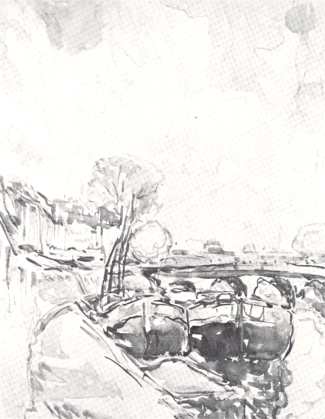
FRANCES HODGKINS
Barges on the Seine c1912
watercolour, 570 x 438 mm.
(Dowse Gallery)
Thomson's interview, though useful for its biographical details, is comparatively light-weight. It appeared after the Melbourne exhibition in a popular journal where it competed with an article on another notable woman, Mayme Pixley by name and American by birth, who painted not pictures but chimney-stacks. Frances acknowledged the debt she owed her father, described her early Dunedin successes, and gave her reasons for leaving:
Perhaps I ought to have been content with what was a very interesting life, but l felt I was only groping; that I had not realised myself; that I wanted to see the masterpieces of all time; learn what was being done in my chosen medium, and measure myself with the moderns.
She touched on her travels in Europe and Morocco and, prompted by the interviewer, outlined her career in Europe - the acceptance of her work by the Royal Academy, the New English Art Club, the Walker Art Gallery - and something that meant more to her, success in Paris - at the Salon, on the staff of the Academie Colarossi, and finally in her own school. As she explained: Here my students work out their own ego, I hope; for, where original talent shows itself, it should be nursed, not stamped out, as often happens from the teacher insisting upon all work being more or less an imitation of his own.(26)
Her Sydney show at Horderns' Gallery in April 1913 created an even greater sensation than the Melbourne one and produced reams of publicity. Most of it is ephemeral, but one article adds greatly to the meagre details of her artistic education and life in Paris. It was written by A.G. Stephens, described by Frances as Australia's 'leading literary prophet' - 'a fat bearded giant not unlike King Edward VII but... reputed to consider himself more like Jesus Christ'.(27) Whatever her private opinion of Stephens, she responded without reserve to his questioning. While she acknowledged the help she had received both from her father and Nerli, she claimed to be self-taught:
When I found I had to learn drawing, I went with a model in solitude, like Degas, and struggled. That is what Degas was told, you know; his drawing wasn't good enough. So he shut himself up till he acquired it.
Yet she was modest about her own accomplishments, admitting: 'My drawing passes; I won't say more for it.' Other influences, some already mentioned in the letters, are named in answering a question about her favourite medium: What are the qualities of a good watercolour? That it should be liquid; it should be transparent and luminous; it should flow. There are very few painters who can give you these qualities. . . I learned most in Holland - from the Maris brothers and Anton Mauve - unsurpassed. Then in England - with what delight I discovered Arthur Melville.
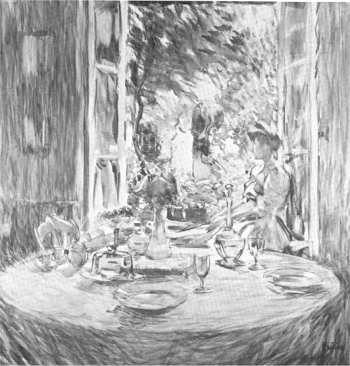
FRANCES HODGKINS
At the Window c1912
watercolour, 655 x 636 mm.
(Art Gallery of South Australia)
She continued with a simplified account of her travels, deliberately omitting any reference to the unhappy episode in New Zealand from the end of 1903 to the beginning of 1906:
In Morocco another woman and I had all sorts of adventures; and we revelled in the light and colour. It gets right into you. Then I went to Holland. . .-.: saw in a Maris how colour could be taught to flow, to vibrate, to thrill. Then to Paris, and plunged into the competition. Plenty of struggles; and a little success every now and then to cheer one up. With the help of the two M's, Morocco and Maris, I got through. And there's a third M - Mauve. And a fourth M - Manet. And perhaps a fifth M - Me - to make a little difference from the rest; though, mind you, all the other M's are on the heights that Me can only look up to and try towards. . . So I'm going back to Paris and the little place waiting for me - I suppose for life.
Stephens may have contributed something to that passage, though Frances Hodgkins was given to such word play and at this period was capable of similar coyness in speaking of herself. She had now finally settled one issue: she had decided to return to Paris - for the rest of her life, she supposed - and went on to give her reasons. What attracted her, she said, was 'the excitement of artistic effort, the continual bubbling of artistic ideas'. Rather inconsistently for someone who had so often expressed her scepticism of theories and ideas she further explained:
The French are so eager for new ideas; they give them such a welcome; and the progress must come with new ideas, mustn't it? We can't go on, with modern minds, painting like the old masters. You don't feel that welcome for new ideas in England. Paris will seize a thing eagerly, and set to work on it - in the world of art, I mean. London will look down its nose at it, and drop it. But a couple of years later, when the novelty is an old story in Paris, London will suddenly discover it and be tremendously impressed.
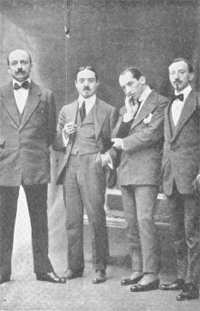
Left to right:
Futurists Marinetti,
Carrà, Boccioni and Russolo
To illustrate her view of Paris she gave a long and lively description of the Futurist Conference she had attended in February 1912. A 'dense crowd of journalists, dealers, Beaux Arts students, beautiful models - with a sprinkling of the Parisian haut monde and plutocratic Americans heard the Italian poet Marinetti expound the latest creed:
The world, especially the world of art, must wipe out imprisoning traditions and stultifying formulae. . . Wipe them out by argument, satire, force, fire, melinite - anything - so that they were swept away to give human genius room to grow. All the artistic masterpieces of the world - clear them away! Destroy the museums and galleries - especially in Italy - they must go! Art schools, academies of all kinds - they must go! (Howls from the students!) Models must go! (Shrieks from the models!)
According to Frances, Marinetti's advice to practising artists was along these lines:
Paint ideas! - not appearances. When you see a horse running, what do legs matter? Four legs! Paint twenty-four legs so long as you get the idea of a horse running. You will show the horse that truly is because you show the horse that actually isn't!
He summed it up in a sentence: ' "Find your sensation and put a line round it!" , The new movement, as far as he could see, would culminate in pure abstraction:
No media - no paint and canvas and dealers (execrations from the dealers!) all done away with. Then - how? Why, coloured lights thrown on a screen will, in their ) beautiful variety of simplicity convey symbolically any idea or sensation required. Be synthetic! be naive! be symbolic! and to the devil with the crude apparatus of the outlived Past!
'Well, that's Paris', Frances finally exclaimed and went on to pay the city her final tribute: Whether it agrees or not, it wants to hear, to learn, to discuss. It's receptive, however combative. It gives everybody a chance. London doesn't give novelty a chance. It presents a cold wall of indifference - and then, years after, you see the light struggling through the chinks.(27)
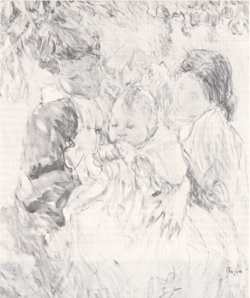
FRANCES HODGKINS
Summer c1912
watercolour, 600 x 505 mm.
(Dunedin Public Art Gallery)
Stephens gave qualified praise to Miss Hodgkins's exhibition. After describing a recent work, which is obviously Barges on the Seine, he prophesied: 'If she can perfect herself in this manner her cosmopolitan rank is assured.'(28)
Her last Australian exhibition was held in Adelaide where she was interviewed by a well-informed but anonymous journalist. On this occasion she spoke quite explicitly of the painters whose work had become known to her during the years in Paris. When asked what school she belonged to her reply was:I prefer not to label myself at all. The central idea of my work is light and action. I am always searching for light. Light is one of the most difficult problems that artists have to face, and water colours lend themselves better to the rendition of it than other processes. The charm of Paris is that in the search of these and in the expression of ideas you are allowed to go your own way.
Nevertheless, she revealed that when she first went to Paris - by which she evidently meant when she settled there in 1908 - she was 'strongly impressed' and 'influenced' by the Impressionist work she saw: paintings by Monet, Pissarro! Degas, and Sisley, the 'heads', she said, of the movement. She qualified this by asserting:
My chief aim, however, is not to be beholden to any school, but to work out my own salvation in my own way. I work independently of them, and have had no academic training in the conventional sense of the word.
In fact, she explained, that kind of training had been swept away in Paris. The student's aim now was 'to see not with the actual and physical eye, but with the eye of the mind.' And she repeated the current shibboleth: 'Find your sensation and put a line round it.'
She touched on the 'slav' vogue - probably referring to the influence of the Russian Ballet and such painters as Bakst and Kandinsky. Then, in two brief sentences, she made what is perhaps the most important revelation in the whole interview: There is another school, the post impressionist, represented in the works of Gauguin, Van Gogh, and Cezanne. Their work is almost priceless now, and one cannot view it without being stirred and impressed.
Next she described the Futurist Conference in much the same terms as before, mentioned her own school, 'probably the largest private school in the Quartier Latin', and was questioned about her technique:
In regard to her methods of producing light and movement from almost a jumble of lines, Miss Hodgkins pointed out it was difficult to explain. In effect, it is a science of its own, undemonstrable by rules of A.B.C. Speaking of the rise of impressionist schools and modern art generally, she remarked that art of the present seemed to have lost its aesthetic beauty. It was going for more robust qualities - a revolt, indeed, from pretty but meaningless styles. 'Art must goon like everything else,' she said. 'We have got everything from the old masters so far; we cannot expect to go on getting it from them for ever. What the final result will be I cannot say. The futurists think it will end in pure abstraction, but that is so far ahead that one cannot view it with anything like seriousness.'
The brake on experiment, she held, was found in the work of Lucien Simon, Henri Martin, Gaston La Touche, and others - most of them teachers in the academies. Unallied with and aloof from the innovators, they exerted a strong influence which, she said, counteracted 'any tendency to over extravagance' in the work of modern painters. There, except for a passing reference to the leading Australian artists in Paris (Bunny, Lambert, Phillips Fox), the interview ended.(29)
At this point in her career Frances Hodgkins herself, I would say, showed no 'tendency to over extravagance'. The ablest of her New Zealand critics, Charles Wilson, defined her as an 'Impressionist', using the word in its exact sense. He also detected 'a certain Post-Impressionist influence' and remarked knowingly: 'There is one lady at least who is of the school of Cezanne and Matisse - is that not so, Miss Hodgkins?'(30) She certainly knew something of Cezanne, but in the Australian interviews she failed to mention Matisse and may have been unaware of him. While that seems to me improbable, in the work of this period it is difficult to detect any clear signs of his fauvist style - the distortions of form, the disregard of orthodox perspective, the use of brilliant and contrasting colours not necessarily related to those of nature. One saying attributed to Frances Hodgkins is: 'I saw Matisse and was reborn'. There is no remark like that anywhere in her letters and it seems to me quite out of character. As a painter she developed not by sudden conversion to this or that aesthetic creed but by a slow and laborious process of self-realization which, in a sense, represents the evolution of modern art. By 1912, in her early forties, she had reached the stage of Impressionism or in such a work as Barges on the Seine had ventured slightly beyond it. She still had a long way to go.
Part of a larger study, Frances Hodgkins on Art and Artists, extending over the artist's career, this section is a slightly revised version of the Canaday Lecture given in the Waikato Art Museum, Hamilton, on 15 October 1979.
NOTES
The chief sources are the letters of Frances Hodgkins in the Alexander Turnbull library, Wellington.
1. letter to Isabel Hodgkins (later Field), c25 May 1892.
2. letter to Isabel Field, 9 June 1893.
3. letter to Isabel Field, 19 June 1895.
4. letter to Isabel Field, c4 June 1899.
5. letter to Isabel Field, c12 November 1899.
6. letter to Isabel Field, 15 February 1901; letters to Rachel Hodgkins, 27 February 1901 and 3 March 1901.
7. letter to Rachel Hodgkins, 15 May 1901.
8. letter to Rachel Hodgkins, 19 April 1901.
9. letter to Rachel Hodgkins, 15 May 1901.
10. letter to Isabel Field, 15 September 1901.
11. letter to Isabel Field, 28 June 1901.
12. letter to Isabel Field, 7 March 1902.
13. letter to Isabel Field, 6 November 1901.
14. letter to Isabel Field, 7 March 1902.
15. letter to Rachel Hodgkins, 11 June 1903.
16. letter to Isabel Field, 20 January 1902.
17. letter to Isabel Field, 27 January 1903.
18. letter to Rachel Hodgkins, 18 April 1906.
19. letter to Rachel Hodgkins, c18 July 1906.
20. letter to Rachel Hodgkins, 3 August 1907.
21. letter to Rachel Hodgkins, 20 August 1907.
22. letter to Rachel Hodgkins, 10 August 1909.
23. letter to Rachel Hodgkins, 27 October 1907.
24. letter to Rachel Hodgkins, 20 July 1907.
25. letter to Rachel Hodgkins, c.February 1908.
26. Everylady's Journal (Melbourne), 6 January 1913, page 12.
27. letter to Isabel Field, 30 May 1913.
28. Bookfellow (Sydney), 1 May 191~, supplement, pages ix-x.
29. Mail (Adelaide), 28 June 1913, page 9.
30. Dominion (Wellington), 1 September 1913, page 9.