
Exhibitions Wellington
James RossBarbara Strathdee
NEIL ROWE
The painting of people has been almost a forgotten art throughout the 'seventies, the era of the international art magazine, when a preoccupation with the positioning of the edge drove subject matter right out of the picture plane.
In the face of various dogma, emanating to a large extent from New York, about what paintings should or should not be doing, there have been, in New Zealand in the 'seventies, several painters pursuing their own figurative bent (one thinks of Clairmont, Harris, Pearson, Frizzell, Brown, Smither), undeterred by the shibboleths of the day. It can be argued also that in the work of such dedicated internationalists as Richard Killeen, Ian Scott and even Gordon Walters, figurative points of reference are never far away. However that is grist to another mill.
Though the former group of painters has had its audience, figurative painting has nevertheless been under a cloud. I have been predicting for some time now that this situation would change as disillusionment with the inherent elitism of the New York School set in. Formal abstraction, by the end of the 'seventies, had come full circle, with its foremost practitioners, Walters and Mrkusich, seemingly plugging away ad infinitum at variations on the same theme and without breaking any new ground. It had become apparent in Ian Scott's work too, before he left for the United States at the end of last year, that the lattice format which he had investigated and developed so brilliantly was becoming as constraining for him as the suburban trellis fence that originally inspired it.
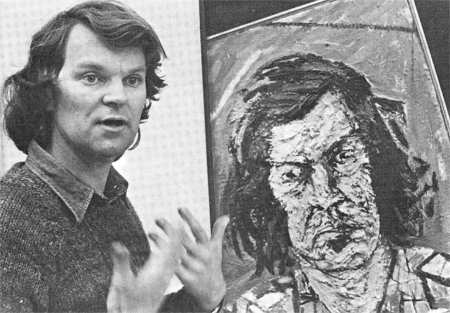
James Ross with
a painting from his
exhibition Heads, Mirrors, Windows
Killeen, that mercurial frog-shooter, was, typically, more than one jump ahead of the game. His series of flag-like geometric abstractions painted on paper or sheet aluminium on his return from the artistic grand tour in 1978 were potent and immaculate emblems of place, and seem to have been Killeen's last essays in this mode before he embarked on the series of cut-out aluminium animals and motifs which have dominated his recent work. This work can now be seen to have heralded a more general swing to figurative concerns.
The two most impressive exhibitions on the Wellington scene in the first quarter of 1900 - by James Ross at the Elva Bett Gallery and Barbara Strathdee at Galerie Legard - were both, prophetically as it may turn out, portrait shows. In 1974, James Ross, class of '66-'69, taught by McCahon at Elam and known in the early 'seventies as art critic for the Sunday Herald, hung an exhibition of unabashed landscapes at Barry Lett Galleries. These paintings, with their subject matter, the trees of his Titirangi home, deeply embedded in a thickly-impastoed oil-painted surface, were not well received in the climate of those times. They lost out to fashion on three counts: they were figurative, they were emotively and powerfully expressionistic, and they were painterly - extremely so. It was decidedly uncool to use paint so self-indulgently in this age of austerity.
In his recent exhibition at Elva Bett's Ross has hung a selection of work painted over a three-and-a-half year period since 1977. Entitled Heads, Mirrors, Windows, this is an exhibition of portraits which demonstrates Ross's preoccupation with both paint and people.
Like his earlier landscapes, these paintings are virtuoso exercises in the mechanics of paint-handling and of colour. In the self-portrait Eating the Apple, the apple, redly glowing, although deeply recessed in the paint surface emerges with a fine three-dimensional roundness. Many of the paintings in this exhibition, with one or two exceptions only, are either self-portraits or portraits of the artist's wife, fellow-painter Gretchen Albrecht. Each work is an examination of, and an essay on, the totally familiar. Beginning with the known features of his own or his wife's face, Ross probes beneath the surface to lay bare emotions and states of mind ranging from the angrily aggressive to the quietly contemplative.
In the most recent works shown here the painstakingly applied surface of built-up oil paint has given way to a more spontaneous paint application, particularly in the recent acrylics, and contrasting areas of flat and built-up surfaces. It is good to see such exuberant and competent painterliness asserting itself on the walls or our dealer galleries. Painting for James Ross is as he says 'a paradigm for human life'. His paintings are 'living things against the dead and inert'.
Barbara Strathdee is not a name well-known to New Zealand gallery goers, for, prior to her return to New Zealand in 1978, she lived for thirteen years in Italy. Her work, however, did surface in this country throughout the' seventies in a succession of Print Council exhibitions; and the Auckland City Art Gallery showing, New Zealand Prints 1977. Her preoccupation then was with the international abstract idiom of horizontal/vertical relationships and the formal qualities of the edge. Her recent exhibition represents a radical change of style, and is a result, she says, of 'coming to terms with her own life' and of a commitment to the 'Woman Art' movement. These paintings, however, have none of the strident polemic, mawkish self-consciousness, or special pleading that has characterised much of the work in this genre seen recently in Wellington. They stand by themselves as robust and stylish statements outside of any ideological considerations.
The exhibition consists of four triptychs, Women Talking, and nine small acrylic paintings on paper. The triptyches read as a succession of cinematic images focussing on mouths and the paraphernalia of women's society - the coffee-pot, the dinner-table and the endless talk.
These four triptyches are decidedly unflattering portraits of four of the artist's friends. They are almost satirical. However to consider them so would be to miss the seriousness of Strathdee's intention: which is to look objectively and unsentimentally at the lives of her friends, and, it should be stressed, her own life also. What emerges is the familiar neurosis, feelings of which are heightened by strong geometric compositional elements, of women trapped in the daily round of wifely and hostessly obligations.
The nine smaller works on paper are most unusual and blackly humorous. Inspired by Greek terra-cotta figures, they are like archeological relics of our own society. Everywhere is the ubiquitous telephone-lifeline and umbilical cord for so many women imprisoned in their suburban palazzos.
This is a splendid exhibition, refreshing in both its stylishness and original treatment of ideas. Certainly, it is illustrative: but it is deliberately so, drawing as much from the world of the glossy women's magazine as it does from Beckmann and Pop art. It is a real breakthrough for Barbara Strathdee.