
Work in Several Dimensions
The Constructions of Neil Dawson
GEORGE BALOGHY
On entering a gallery containing sculptures by Neil Dawson, one is confronted by an apparently empty, white expanse of gallery space. It would be easy immediately to write the experience off as just another Art-Political statement: but on closer inspection, diminutive and fragile structures become visible on the walls, clinging tenaciously at a variety of heights and in a variety of places - walls, corners, windows - struggling to command the space that they so precariously occupy.
They do not so much lack presence, as demand a different way of viewing from the usual gallery exhibition. One expects to see small scale sculptures mounted on pedestals or tables, not hanging like pictures. Their size makes them look like scale models for some larger structures, or toys.
Dawson, a teacher at Christchurch Technical lnstitute, has been exhibiting his work for a number of years in the South Island and Wellington. Only recently, however, has he been recognised for the innovator that he is. Unlike many of the younger sculptors who have moved into performance, video and readymades, he has chosen to continue working with static, fabricated objects.
NEIL DAWSON
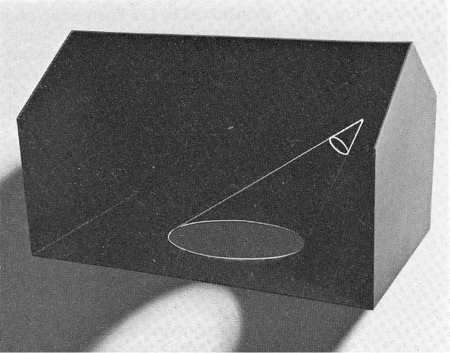
Interior 12 1980
Styrene sheet with
painted piano wire,
150 x 249 x 152 mm.
(Collection of Hamish Keith)
His sculptures function on several levels and, unlike the work of many of his contemporaries, they have a certain public appeal in their directness. That is: they are beautiful objects in their own right, but still command intellectual interest.
Neil Dawson's recent exhibition in Auckland at the Denis Cohn Gallery, was his first survey exhibition. It was also the first chance the public has had to survey his past and gain an indication of future development. The show included works from four series, dating from 1978. In chronological order, these are the House Alterations, Interiors, Seascapes and Order/Chaos series. They show a remarkable development over the short period of two years.
The first impression thrown up by a close examination of the works is one of thoroughness and impeccable craftsmanship. The exhibition is totally even. Dawson sets a high standard, both intellectually and in the execution of the pieces.
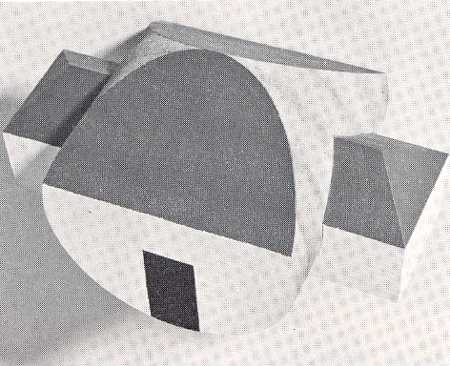
House Alterations, first shown at the Brooke/Gifford Gallery in 1978, consists of a number of tiny wooden houses, standing on little platforms. They are constructed of blocks of wood, painted white with red roofs. Here, Dawson is concerned with exteriors only, in the same single-minded way that in the next series, Interiors, he is concerned with interiors only. Any openings, such as doors, in the 'houses' are denoted by black painted shapes. Through their stark simplicity, they appear whimsical and toy-like.
NEIL DAWSON
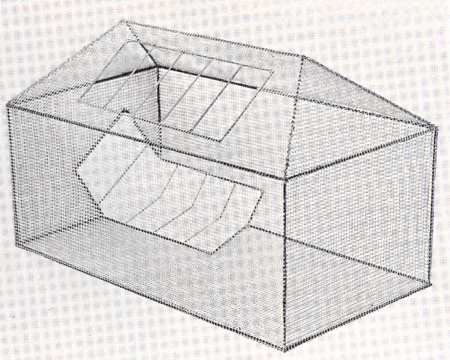
House Alteration (Projection)
piano wire and nylon mesh,
180 x 120 x 120 mm.
Interiors and Seascapes are the most fascinating two series. The houses of Interiors are plain enough - the barest essentials convey the fact that they are houses: a shoe-box rectangle with a triangular roof section. Somehow, the viewer is forced into also being interested in the interiors of these structures. It was with some amusement that the writer observed people continually going up to Interior 7 to peer through the openings when it was perfectly clear that there was nothing inside.
In Interior 12, where the basic house shape is represented by mesh walls, a single electric light - made of wire, of course.,-casts its arc on to the floor and walls. That simple piece taps an experience sufficiently common to enable the viewer immediately to reduce his scale and enter that room as a participant with the sculptor. The human presence is continually implied by such things as steps leading up to a house - simple things that add a human touch to what might otherwise be purely abstract.
Interiors and Seascapes are wire and mesh constructions, occasionally including a plastic sheet. Their scale dictates that they be looked at from a very close distance: about the distance from which one would view a hand-held object. At such close range, the works become intimate and tactile. One wants to touch them, and here lies the enigma and the fascination of these series: that Dawson has defined and created space by suggesting it with, for instance, wire, and that this space becomes so real that one wants to touch it.
NEIL DAWSON
House Alteration (Magnification) 1978
102 x 160 x 99 mm.
(Denis Cohn Gallery)
To illustrate this point, Marte Szirmay's work provides an illuminating comparison. She creates very touchable little table sculptures, where the hand and eye reinforce each other in sensuously perceiving a solid object. With Dawson's work, on the contrary, there is nothing to touch but a bare framework of wires. A tension is thus set up between what the eye perceives and what the hand expects to perceive - but is unable to. This is similar to the phenomenon which occurs in perspective line drawing where depth is suggested by line only.
Indeed, if one looks at these wire structures from a little distance they begin to appear as nothing more than black lines on a white wall. Paradoxically, it is the movement of the viewer around them that creates the illusion of space: similar to viewing a computer picture of an object rotating on a screen. The screen is flat, but the movement creates space. And that is the reason why photographs of Dawson's work, being static in nature, appear flat, like line drawings.
Another important aspect of these two series is the shadows cast on the wall from the single-source light that plays on them. The shadows effectively provide another view of the structure, another dimension.
The latest series, Order/Chaos is a complete departure from his previous works. The pieces appear to have been inspired by the Abbotsford land slip, and use amorphous materials to recreate fractured land-forms, with house-like structures embedded or disintegrating in the solidified masses. This series, although deriving from a particular event attains universality by restating a fundamental physical law: that all order eventually gravitates to a state of entropy.
To sum up, Neil Dawson's sculptures have a certain succinct clarity about them. He sets himself objectives which, if in some cases modest, are always achieved. At a time when many younger local sculptors are moving further into esoteric and obscure rituals and performances that seem bent on alienating all but a cult following it is refreshing to see somebody working in a static medium who clearly understands the basic precepts of sculpture.