
Artists as Photographers
GORDON H. BROWN
During the early part of April, Real Pictures Gallery displayed a selection of Photographs by Four Painters: Don Binney, Paul Hartigan, Tony Fomison and Denys Watkins. As an exhibition of photography it was only mildly successful for, while there were isolated colour prints of quality from Watkins and Hartigan, the only one of the four to emerge as a photographer with a consistently viable and coherent vision was Don Binney. In his relatively small black and white prints he gave the landscape image an over-all mottled tonal effect which lent to both detail and natural forms a visual uniformity uniting the different locations in the photographs. Unfortunately, because these photographs avoided anything pictorially dynamic or picturesque, the more subtle qualities which they did possess were easy to overlook.
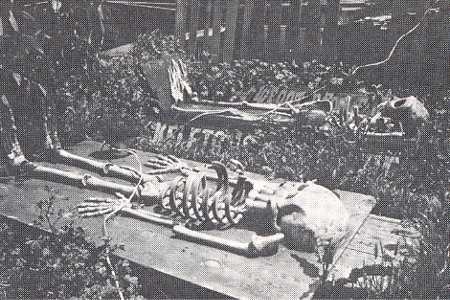
DENYS WATKINS
Laid Back, Porta Costa, California 1979
colour photograph
(Real Pictures Gallery)
I considered that as a whole the exhibition's major interest was in the working relationship of the artist to the photographic image. Wider issues are also involved, (which in a review of this length must be restricted), including one of the most intriguing issues: that of how a photographer imposes on the total mechanics of photographic technique and processing a personal style, identifiable as his in finished prints.
In recent years the interaction between photography, on one hand, and painting, sculpture and its allied activities on the other has developed in complexity to the point where a clear delineation between photography and the other visual arts is very difficult to make. Rather than take examples like Andy Warhol, Robert Rauschenberg, Chuck Close, Dennis Oppenheim, Ian Dibbet, John Baldessari or Marcia Resnick from overseas, we might discuss that problem in terms of examples found within New Zealand (irrespective of any influence these might reflect from abroad).
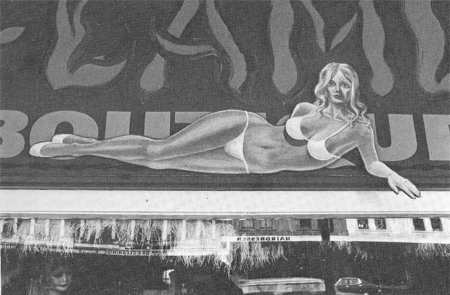
PAUL HARTIGAN
Flame Boutique, Auckland 1980
colour photograph
(Real Pictures Gallery)
The relaxation of hard and fast divisions between the various art forms, together with a certain dissatisfaction with the role of painting in particular, have caused photography to adopt an ambivalent function. Because its applications are many and its aesthetic position is open-ended, it has come to occupy a gap between what is frequently accepted as the function of art and its own long-standing position as a means of visual communication.
This is clearly demonstrated in the area of Post-Object Art, where the three-dimensional definition of the 'art idea' is performed rather than constructed. Except for the few participants or spectators directly involved, little of significance remains from a performance other than the written preliminary sketch, occasional post-performance notes, and the photographic documentation of the performance itself. Jim Allen's Body Articulation/Imprint, Bruce Barber's Bucket Action (Art New Zealand 5) or Andrew Drummond's The Ngauranga Set (Art New Zealand 11) are cases in point. Such documentation has overtones of an art historical approach. Ironically, this gainsays the anti-art-establishment origins of such conceptual art.
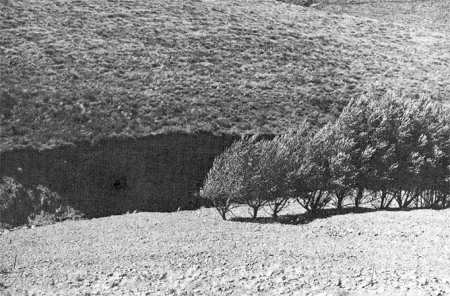
DON BINNEY
Mackenzie Pass (1)
black and white photograph
(Real Pictures Gallery)
In such cases the camera's use differs from the traditional role artist/photographers like John Kinder gave to the photograph. For him it was a source of visual information to be used in his work as a painter - a practice still in use. If there is a precedent for this function of photography then it is in the recording of the creation of a single work of art as work on it proceeds. Mark Adams's progress photographs of Philip Clairmont's Staircase Triptych are a case in point (Art New Zealand 11). Frequently in performance art, somebody other than the artist (who is likely to be involved in the act of performing) is responsible for the photographic record from which the performance will be assessed visually in the future.
Similar, as well as differing, circumstances arise from the practice and the recording of earth-art activities: especially where the natural process of growth modifies the work, as in Andrew Drummond's The Grass is Greener installation; or where the forces of time and weather join eventually to disintegrate the art work. With such works artists are likely to undertake their own photographic record. Unhappily, few show the skill demonstrated by Eva Yuen when photographing her stone arrangements on Kapiti. Too often the resulting photographic record is dull because it fails to completely capture the nuances of the artist's idea as expressed through an impermanent physical entity or a transient sequence of events.
The traditional use of the photographic image can be found, and even surpassed, in the work of photo-realists like Martin Ball. A newer variant is seen in the way Robert Ellis, in his Surveys and Observations series, has closely coupled photograph and painting while keeping each medium separate.
The technology derived from photo-processing has been another important factor in conditioning the interaction between photography and the visual arts. Derived from the Pop Art idiom - the modification of the photograph in screenprints like Paul Hartigan's Has Your Tongue Been Stung Lately (Art New Zealand 7) or Denys Watkins's Whispering Hope (Art New Zealand 14) is held in balance by flat areas of superimposed colour.
The visual distinction between art and photography is further reduced in Victoria Edwards's etchings Bath Diptych (Art New Zealand 1). Conversely, without Hartigan's knowledge of Pop Art and Photo-Realism his photographs of shop fronts and hoardings would hardly have been possible. A more pertinent example are the 'abstract' colour photographs of Babbie Aitken, with their Mondrian-like divisions and flattish areas of colour. The practice of a photographer quoting art is nothing new, as Julia Margaret Cameron's 'A Rembrandt'; Sir Henry Taylor clearly demonstrates: but the contemporary practice reflects a different level of indulgence. Such visual 'quotations' are now often carried out in the most blatant manner, as in Max McLellan's Studio Happening with its multiple photocopied image after a Goldie painting.