
The Bishop Suter
Memorial Art Gallery
RICHARD NUNNS
The Bishop Suter Memorial Art Gallery was built in 1898 as a memorial to the late Andrew Burn Suter, Bishop of Nelson from 1865 to 1895. The Bishop was a man of wide cultural interests and he, along with two or three others, was instrumental in founding the Bishopdale Sketching Club - the forerunner of the present Nelson Suter Art Society.
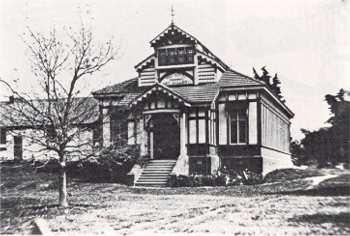
The Suter Gallery in 1898
After Bishop Suter's death in 1895, a group of leading citizens, upon consulting with Mrs Suter, decided that an Art Gallery would be the most appropriate form of memorial; and money for this purpose was raised by public subscription. Paintings from the Bishop's collection (given by Mrs Suter in accordance with her husband's wishes) formed a substantial nucleus for the new gallery. Gifts of property from Mrs Suter and the Nelson School's Society did much to further the project.
Eighty-two years after its opening, the gallery has recently been renovated and extended at a cost of $350,000. While a number of galleries throughout New Zealand in recent years accommodated their space and programmes to incorporate a range of activities and performances, the Suter Gallery renovations have been designed to allow for flexible/and adaptable spaces for the promotion of a continuum of cultural activities.

The original Bishop Suter Art Gallery
Trust Board, 1886
The modernisation had become absolutely essential. The building was by then run-down and unattractive; the exhibition space was poor; storage facilities were cramped; and the permanent collection was suffering. The newly-appointed director Austin Davies chose to centre his attention on the rapidly deteriorating state of the John Gully watercolour collection. The ensuing furore enabled the trust board to move on a tide of interest and indignation towards a programme of modernisation.
The renovations and extensions (designed by Miles Warren of Christchurch) included the establishment of optimum conditions for the care and housing of the permanent collection (valued at $750,000 and the sixth most valuable in the country. Excessive temperature change has been eliminated; and with the building of a special watercolour gallery, paintings can now be hung in conditions that are equal to that of any overseas gallery.
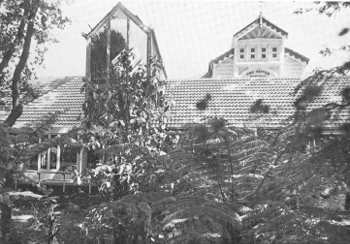
Suter Gallery extensions, 1979
There is nothing unique in this: any new gallery would automatically make such provisions. It is the emphasis in the design on multi-functional use, and the currently emerging programme, that make the new Suter worthy of note. The two large galleries are both admirably suited to intimate performances and recitals, and the centre gallery has been designed to allow for the screening of 16mm films and the presentation of lectures and seminars. Couple these facilities with a restaurant/coffee-lounge and a craft shop which holds a good range of pottery and weaving, and the result is a genuinely multi-purpose complex.
The populace has responded accordingly. In the months since the renovated gallery opened, more than 42,000 people have visited for one reason or another. Throughout its more moribund days visitors to the gallery averaged four or five a day. The average is now 170 a day; and this figure does not include the large number of people who attend recitals and performances in the evenings. Since re-opening there have been jazz, rock and folk music concerts, piano and guitar recitals, cabarets, dance, drama and mime.
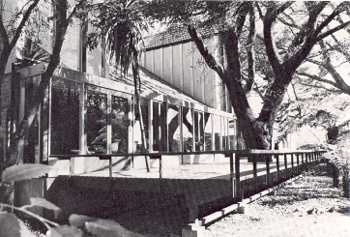
The restaurant balcony
at the Suter
The recent two week Nelson Arts Festival centred largely on the gallery and in the second week a children's arts festival ran exclusively at the gallery. In every useable space, groups of children and tutors were engaged in weaving, painting, clay-work, dance, drama, kite and mask-making.
The Nelson Film Society now has a permanent and comfortable home with a sound-proof projection room and large screen facilities.
Local interest in and support for the gallery grows weekly. A 'Patrons of the Gallery' scheme has a paid-up membership of 1300 - which indicates that one-in-thirty Nelsonians is a gallery patron. It is worth noting that the next largest group of this type in the country is at the Auckland City Art Gallery, which has about half this number of patrons.
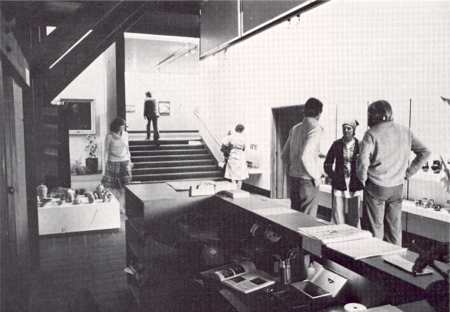
The entrance foyer
of the renovated Suter
The old claim that an art gallery caters only for the pleasure of the affluent, middle-class and middle-aged cannot be sustained with regard to the Suter Gallery. Visitors include all sorts of people from children to the elderly, from commune-dwellers to archetypally 'straight' people - all meeting in a cultural environment that is an asset to Nelson.