
Exhibitions Wellington
NEIL ROWE
Don Driver Retrospective Exhibition
The Don Driver retrospective exhibition, mounted by the Govett-Brewster Gallery and toured with the assistance of the Queen Elizabeth II Arts Council, passed through Wellington in February.
Don Driver is one of New Zealand's most singular artists and has won both the Benson and Hedges Painting Award (1972) and the Hansells Sculpture Award (1974). He has exhibited in Tokyo (International Young Artists Asia Exhibition 1971), Sydney (Bonython Gallery 1969) and in various Mildura Triennials. In 1963 the Adult Education Department organised a one-man show which toured North Island centres. Driver has shown in several dealer galleries, and at Victoria University library and the last Christchurch 'Group' show as guest exhibitor (1976).
Driver has had major shows, prior to this one, at the Govett-Brewster (1973 and 1977) and at the Dowse in lower Hutt (1977); and yet his name is not a household word in this country and his work is not well known. The present retrospective exhibition, touring to such towns as Nelson, Masterton, Wanganui, Gisborne, Hastings and Rotorua, as well as the main centres, should do a lot to remedy this.
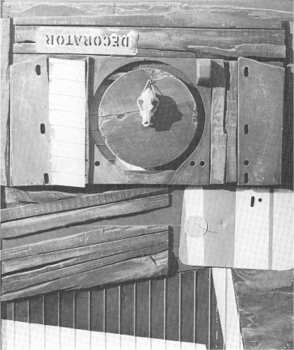
DON DRIVER
Midwest 1965
wood, skull, aluminium, 1845 x 1020 mm.
(Collection of Mr and Mrs K. Adams)
The exhibition is a selection of Don Driver's art - thirty-three pieces in all - from 1965 to 1979: which reveals, despite the work's apparent wide diversity, the consistency of the New Plymouth artist's concerns over this period. A preoccupation with colour and materials dominates, as do investigations into problems of ambiguities and opposites.
The exhibition is effectively a survey of the artist's mature period: after the young Driver had worked his way through African inspired woodcarving and the influence of many movements in British sculpture in the 'fifties and 'sixties, when he began to develop a personal style. The work of this period has reflected the concerns of American artists such as Johns and Rauschenberg: but it should not be seen in terms of imitation. It is rather a parallel antipodean phenomenon which was a logical and organic development in Driver's work. Indeed Driver maintains that he had never heard of Rauschenberg prior to a trip to the USA in 1965. This trip which exposed him to the current ferment in American art, was to confirm Driver in the direction his work was taking as well as opening his eyes to the wealth of fruitful avenues of investigation dormant in it.
The first work executed on his return from the USA and the first entry in the catalogue is Midwest 1965. This large, human-scale assemblage (its proportions correspond approximately to the length of the artist's outstretched arms), of time-worn timbers, painted metal debris and dog's skull, is a powerful evocation of the mid-western landscape and is the most figurative piece in the exhibition. From this point Driver's work has become increasingly abstract, falling into two distinct stylistic categories: the hard-edged formal 'immaculate' reliefs incorporating such materials as painted canvas panels, lacquered aluminium, stainless steel and perspex, and the 'found object' assemblages making use of such varied materials as tarpaulins, battery cases, vinyl, sacks, doormats, washing machine lids - generally the flotsam and jetsam of the consumer society.
The immaculate works, although reliefs and not paintings as such, with their bands and planes of vibrantly interacting colour and shaped canvases echo the concern of Noland, Stella, Davis and the artists of the Post-Painterly Abstract New York School. These works are right in the mainstream of international 1970s art. Their innovative use of materials and colour handling distinguishes them as among the most accomplished work in this genre executed in New Zealand.
It is in the assemblages, however, that Driver's originality and flair are most apparent. Juxtapositions of incongruous objects and textures are arranged and controlled with consummate skill; as is the colour which is as 'found' as the materials utilised and which is manipulated with great subtlety. Driver excels as a colourist and in the most apparently random or haphazard piece the attention to colour is as meticulous as is the arrangement of other elements.
Don Driver is to be numbered among our foremost artists - one who has always been ahead of the game. In breaking down traditional barriers between sculpture and painting, he has shown a new direction. The Govett-Brewster Gallery is to be commended for mounting this excellent exhibition and for compiling the useful and informative catalogue which accompanies it.