
Exhibitions Christchurch
JOHN COLEY
Jacqueline Dunlop
'Boxes' at the C.S.A. .
'Glass' and 'Streets'at the McDougall
It took the Arts Festival to revive the Christchurch galleries from their summer lethargy: although the Robert McDougall Gallery catered for holidaymakers with a sparkling show called simply 'Glass' an historical survey of the development of glassware from pre-christian times to the present. All the pieces were culled from museums and private collections within the country and included contemporary industrial and craftsman-made examples.
The Brooke/Gifford Gallery opened its 1980 schedule with a decorate show of stained canvases and watercolours by Jacqueline Dunlop. Her luminous colours were floated, splashed and washed over the raw canvas in generous gestures: but the fragments of a somewhat obscure poem referring to a paper tiger that had been added to otherwise vividly direct paintings gave them the appearance of fanciful illustrations for a children's book.
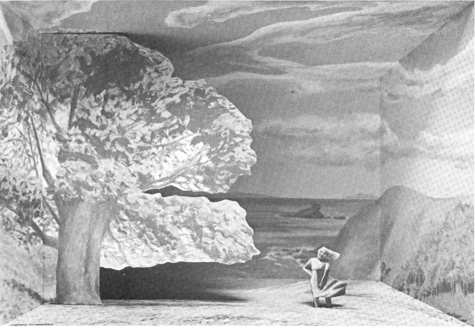
TERRY STRINGER
Waiheke Hill
mixed media
(Photograph courtesy of the
Christchurch Star)
The Canterbury Society of Arts began the Arts Festival and the society's centennial year with an exhibition called Boxes, based upon the idea that the box is a form unique to mankind, expressing through the multitude of purposes for which it is used the peculiarly human genius for invention.
Painters, printmakers, sculptors and craftsmen were invited to participate and fifty-eight contributors forwarded more than 130 good-natured, entertaining and instructive works.
The initial impact on entering the gallery was not impressive: although Philip Trusttum's large canvases in the shape of opened out cardboard cartons anatomising and improvising on the forms of commercial packaging dominated the space.
The mainly small works rewarded the quiet browser, who could come upon such delights as Derek Ball's Reliquary of the petro-chemical era, a glittering casket of coloured perspex with elliptical openings revealing a cunningly fashioned plastic bone. As intended, the object conjured up the shin bone of an Arabian twentieth century oil tycoon rather than the dusty remains of some ancient holy man.
Pauline Rhodes is a Christchurch sculptor with a compelling personal style. She created an installation for the Boxes exhibition called Earth Energy Container in which folded pieces of cloth and carefully matched rocks were saturated with red oxide pigment and arranged in a cubic space in layers separated by clear glass. The work conveyed a sense of discovered artefacts from an orderly and inventive civilisation, the fragments stained by long burial in the soil. One regrets that her installations, because they are ephemeral and spaced far apart in time, do not receive the attention of a wider audience.
Terry Stringer offered a trio of his soft-spoken works which showed this sculptor's fascination with the planar trickeries of paper engineering. His pieces seemed to derive their inspiration from greeting cards and pop-up books arid were none the worse for that. He invited the viewer's involvement with wheels that had to be turned in order that images might appear and disappear in an aperture cut into his Mt Eden Round. Waiheke Hill was a landscape in a box with a flat, cleverly painted tree and a figure occupying real space like a tableau in a Victorian Pollock theatre.
Warwick Freeman's exquisite small bronze box entitled The Bride demonstrated that tiny can not only be beautiful, but can, when fashioned with sensitivity and style, transcend scale. This fine piece, with its figured surfaces and carefully balanced proportions, had a commanding presence lacking in many works of greater size.
The Robert McDougall Art Gallery's response to the Christchurch Arts Festival was to clear out their permanent collection and give their spaces over entirely to their Streets exhibition, a presentation intended to make visitors more aware of the city as a manifestation of man's inventive, expressive and organisational talents.
Gathering together art objects to express this idea was not the main concern of the gallery staff. Rather they sought to create a multi-media experience that would heighten the awareness of those who passed through the exhibition to the sensory enjoyment of the city.
Singer Malcolm McNeil presented a recital of street songs, while photographer Margaret Dawson's ten prints observed law on the streets, a subject she had studied over a three month period accompanying the police on their duties.
Christchurch citizens could see the changes that have occurred in the form of their city over the last century by comparing recent photographs with those taken by the pioneer Canterbury photographer Dr A.C. Barker.
The 'original architect's' renderings of familiar city landmarks were presented by that Christchurch Branch of the New Zealand' Institute of Architects and street hardware, signposts and billboards assembled.
A piece based on the articulations of the derailleur gear shift, Bicycle-a detail, Brian Dawe's contribution, while fellow sculptor Neil Dawson installed in one of the gallery's bays an eye-teasing interpretation of the grid layout of Christchurch's streets.
Wise's Yellow Street Map (J-10) by colourist John Hurrell raised the question of why some suburbs have a far greater population of streets than others.
Murray Hedwig walked the Christchurch streets to capture surfaces scale and motion with his cameras.
Street Sounds was Chris Cree Brown's electronic composition forming a fifteen minute tape of sounds which most of us think of as background noise - church bells, transistor radio contrasted with spoken word.
This popular exhibition drew a wide range of people to the gallery and stimulated fresh thinking about the environment of the city.