
Three Playwrights describe their feelings about and their experiences with the productions of their plays
BRIAN McNEILL writes on The Naval Officer
Mercury Theatre, Auckland, July 4 to August 4, 1979
I had just, somewhat painfully, eased myself from the recommended joys of a half-lotus, and was in the process of coaxing the flow of blood back into my tortured thighs, when the doorbell burst in upon my self-ministrations. It was one a.m., and in the words of that old song, my defenses were definitely down. I picked up my dhoti, cast it swiftly about my loins and hobbled manfully to the door. There he stood. The 'interviewer'. Resplendent in plastic mac, his hand-held 'mike' already at the ready; tape-deck whirring incontinently beneath his synthetic yet spirited bulk. 'The Naval Officer,' he hissed. I staggered back across the darkened vestibule, stunned by the effrontery of the man. 'Is it being done elsewhere?', he continued. 'A disaster', I croaked, tucking my dhoti firmly in between my legs and waving him off.
'Oh, come now', he boomed, clasping me affectionately between his equipment. 'It wasn't as bad as all that. I saw it myself, on the last night.'
'Did you?' I ventured, disentangling myself from the press of cord and gadgetry.
'Not too bad at all. The costumes were good.' I dredged up a weak smile.
'And I thought the set was first-rate.' I was about to thrust the door firmly back into his face when he jostled me aside and bounded up the stairs to the kitchen.
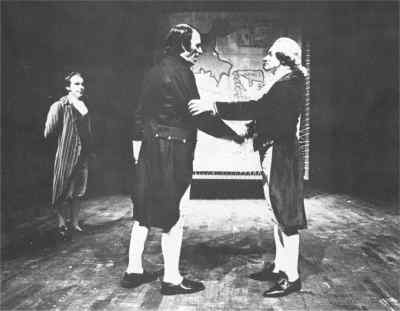
Waric Slyfield and
Paul Robinson in
Brian McNeill's
The Naval Officer
(Mercury Theatre, 1979)
'Tell me', he called back over his shoulder: 'What did you think of the critics?' I slammed the door back into its frame and wove my way up through a deluge of falling masonry. He greeted me anew with winsome smile. 'The Listener didn't do you too badly I thought.' I nodded. 'The Herald and Star were a bit skimpy though. Didn't think it was great theatre or something.' I clutched weakly at the balustrade.
'The critics in this town', I shrieked, 'are bloody imbeciles! Barely able to write English, let alone appraise a new and major work.'
A fetid sigh escaped his lips. 'Got to you did they?' he said and helped himself to a glass of Cook's Chasseur that stood remindingly on the draining-board.
'Not only were they incapable of assessing a new work', I raged, 'but they were also incapable of any sense of occasion whatsoever. It took me a year to write that play. It was probably the most complex work yet attempted in New Zealand theatre. It cost the Mercury and myself a great ,deal of time and money to present and we did it with the altruistic aim of celebrating the life of a great man on the bi-centenary of his death. I did not set out to write a 'great play': I set out to write an honest account of Cook's life in as entertaining a fashion as possible.'
My interviewer at this juncture unzipped his mac and flashed his tape spools. Content that the machine was still recording my words, he stretched out and poured himself a further glassful of vino.
'Nevertheless', he murmured. 'The play did have its faults.'
'Of course it had its faults!' I thundered. 'In London we would have had seven to eight previews before the show opened. Over here we had one full day only on the Mercury stage before first night. In Europe or America', I gabbled on, 'we would have 'tried out' the show in the provinces before bringing it into town. . . Half the costumes weren't ready until the first performance. The technical rehearsal was a nightmare of missed cues and botched entrances. Half the props turned up late and the other half were too ludicrous to treat seriously.'
'Like the plastic pig?'
'The plastic pig was all right'. I replied. 'it looked quite lifelike.'
'Well, what then?' he asked, helping himself happily to a gaggle of stuffed olives.
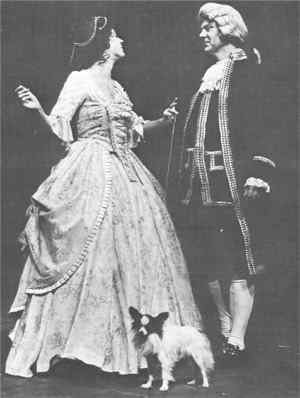
George Pensotti and Faye Flegg
in Brian McNeill's The Naval Officer
(Mercury Theatre, 1979
'For example', I said: 'I'd asked for a facsimile of the London Gazette for 1779. The actor who was meant to be reading from this publication was handed, on the dress-rehearsal, a copy of the London Sunday Times for 1978, with a large full frontal of Maggie Thatcher emblazoned across the front cover. Hardly appropriate for an eighteenth century newspaper I would have thought!'
'Mm - a minor detail', my interviewer burbled into his glass.
'Minor but vital', I snapped back. 'Also', I continued: 'I had specifically asked for two huge spears to plunge down out of the flies in the last scene. They never materialized.'
'Pity', he replied, evidently becoming rather bored at my flights of self-pity.
'Neither did the bare breasts on my Hawaiian maidens materialize', I added. He spat out a volley of olive pips and advanced towards me.
'So, you weren't satisfied with the production then?'
I held my ground - and my dhoti. 'Yes, I was - very satisfied. The whole company worked enormously hard to make the whole thing come together. I'd probably asked for too much: that was all - with close to thirty actors in the play.. .'
'And yourself.'
'And myself. There were bound to be weak points. The funny thing was, that just before the end of that first performance, I thought we'd made it. I'd never intended it to be an easy play. In the first half I'd intentionally written some rather oblique scenes. . . '
'Obscure don't you mean?'
'Not at all', I replied. 'I'd diffused the action intentionally - widened the whole spectrum of relationships. At no time did the play become heavy or self-indulgent; it required attention from the audience, that was all. Amazingly enough, the scenes I was most 'worried about - the simultaneous playing of three actions at once - worked supremely well.' '
He smiled down at me.' And when was it, exactly, that you first realised the play wasn't going as well as you might have hoped?'
'About ten minutes after the final curtain. When the 'first-nighters' began to drift down into the green-room.' He reached across and handed me a cigarette from my own pack on top of the refrigerator. 'If there's a purgatory for failed playwrights then I've been there', I .said, drawing hungrily on the proffered fag. 'Rarely did any of these illustrious theatre-goers glance in my direction. Or, if they did, they looked right through me with that peculiar expression reserved for the losers of this world. And... " I continued, 'when they did deign to acknowledge my presence it was either to inform me as to what they themselves were up to . now, or who they'd personally slept with last Saturday night.'
'I thought you gave a very good performance in the piece.'
'Thank you.'
'And I still think that the costumes were superb.' I rose grandly from the kitchen chair, my dhoti cascading gracefully about my ankles.
'Have you quite finished with the interview?', I said.
'I think so, yes.'
'Then perhaps you wouldn't mind getting out.'
'Certainly', he replied, and made for the stairs. 'Oh, by the way', he said. 'Quite well hung if you don't mind my saying so.'
I slammed the door hard against his tape-machine, satisfyingly severing several yards of microphone lead in the process. If there was one thing I didn't wish to be reminded of at this time it was the memory, fame and grandeur of Robert Lord.