
Three Playwrights
describe their feelings about and their experiences
with the productions of their plays
ROGER HALL writes on Glide Time, Middle Age Spread, State of the Play and Cinderella
I've been lucky with the initial productions of all my plays. And lucky, too, in that I was able to get my first play on within a few months of completing it. Everyone's heard stories of scripts lying around theatres unread for months - it happened to Joe Musaphia, among others, with Victims, which proved a great success when it was eventually put on.
With Glide Time, I sent a copy to Playmarket, a copy to The Fortune, and was about to send a copy to Downstage when Mervyn Thompson announced the year's productions for the whole of 1976. A year! I couldn't wait a year! The next day I saw Ray Henwood browsing in Whitcoulls, and asked him if the newly- formed Circa Theatre might be interested in reading it. 'Of course', said Ray.
First to read it was Grant Tilly, whom I'd had in mind all along for the part of Jim. He read it and phoned me.
'Er. . . is the part of Jim. . . finalised? I mean. . . can it be altered in any way. . . it's just. . .. '
'Yes, yes, yes, yes, yes WHAT DID YOU THINK OF THE PLAY?'
'Oh, mm, yes, good, mm, had quite a few chuckles.'
Not the rave review I'd hoped for. But stage two was the first read-through with producer-designate George Webby in charge. We all met one evening at the Drama School-cast and members of the Circa Council. It was the best evening in the theatre I've ever had. The cast proved to be both the perfect performers and the ideal audience. The laughter seemed to go on and on and on - and there's no nicer sound in the world than laughter at something you've written. Circa decided to open their new theatre with it. Excitement!
Then George Webby pulled out of producing, and Tony Taylor was asked if he'd do it. I heard he'd read the play and was worried because there didn't seem to be many laughs in it. The production was postponed. Perhaps it would be the second, no third... well, later on this year... Gloom!
In the meantime Playmarket finally returned the readers' reports. One glowing, the other damning it utterly. Nothing from The Fortune.
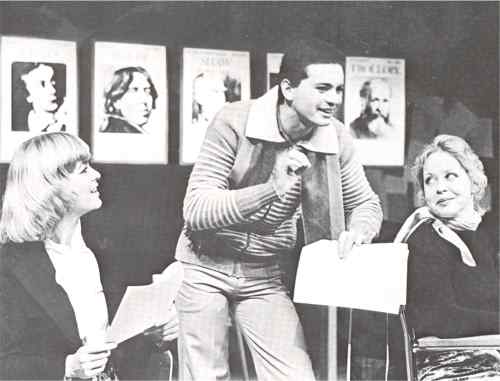
Claire Oberman,
Clifford Wallace
and Donna Akerston
in Roger Hall's
State of the Play
(Mercury Theatre, 1979)
At last, rehearsal stage. In the event, Grant Tilly couldn't be in it; Michael Haigh came in as Jim; and Fergus Dick as the Boss. Rehearsals began in small rooms above Cuba Mall. At the first rehearsal l attended, the cast picked at the lines. I stayed away and the lines seemed to become acceptable. I popped in occasionally, commented rarely, made the odd suggestion, and then stayed away for good. There was nothing more I could do.
A phone call from Tony Taylor. 'Cuts. Brace yourself.' He cut pages and pages. Apart from a little internal bleeding at the disappearance of many of my favourite lines, I protested hardly at all. I knew he was right. Without the cuts, the running time would be close to three hours. Nobody could sit on Circa's seats for three hours.
The opening. We gathered a party of friends to go, and had them all up for drinks first. Bribery I suppose: but I thought if it was going to miss out, then I'd rather it did so in front of friends. I wasn't particularly nervous - I had nothing to lose.
What followed was the stuff dreams are made of - full houses, return season, a season at the Opera House, another season at the Opera House. Sitting in a box, secretly watching the audience, waiting for the laughs, became a drug. I couldn't keep away.
For the opening of Middle Age Spread I was terrified. Once more we had friends for drinks. In the middle of them, I nearly burst into tears. What I was frightened of, and what I knew everyone was waiting to see, was that Glide Time would be a oncer.
Rehearsals had gone suspiciously smoothly. Michael Haigh directed it without fuss: confidently, calmly. Difficult to believe it was the first play he'd directed. No changes to the text. No cuts. In fact, he'd added to the material. To cover the changes necessitated by the flashback scenes, he'd hit on the idea of using sequences of slides showing the characters away from the setting that the theatre audience saw them in. The idea worked excellently - John Reid directed them with great sensitivity, so that many of the sequences were in themselves amusing or moving. How fitting that later it was he who was chosen to direct the film version.
I had tried to write Middle Age Spread so that it was seen as different from Glide Time. But the number of local references in both plays meant that many people lumped them together. On the opening night at the Mercury, I heard someone say 'Not as funny as Glide Time'. I had to resist the urge to grab him by the lapels and say 'listen chum - it wasn't meant to be as funny'.
And so to State of the Play. I got the idea while preparing sessions for a University Extension course on playwriting. As I thought of the different activities and scenes I'd get the group to do, it hit me what a great potential this setting would have for a play. That night I lay awake, too excited by its possibilities to sleep. Before the actual classes began, I'd worked out nearly all the events and construction. Once again, I tried consciously to break away from a particular type of play. I don't want the public to settle comfortably in their seats thinking that they know the type of fare to be offered simply because Roger Hall is the name on the by-line.
It is with State of the Play that the text has been altered to the greatest extent. By the time a play gets into rehearsal, it's usually months since the thing was finished. So when actors begin to ask 'Why did you write it this way. . . what did you have in mind when. .?' it's very difficult to remember. The thoughts and ideas which excited you at the time, which caused you to make changes, which made you place things in a certain sequence, to get characters to do certain things - all this has been long forgotten. It is finished, that's the way it is, now you are on to something else which is absorbing your attention. Rehearsals come almost as an intrusion.
But the fresh eyes of the director, and the cast, provide another essential hurdle for the play to surmount before there can be an opening performance. One reason that I like working with Tony Taylor is that his theatrical instinct knows very shrewdly what changes need to be made - as he did with Glide Time.
With State of the Play, Tony made two major alterations. He delayed Neil's confrontation with Dingwall until almost the end: the row led more naturally to Dingwall's breakdown and 'confession' and also helped the flow of the last act. The other change also involved Neil. When Neil emerges as Isadora Duncan, it was also to reveal himself as a transvestite. Between them, Tony Taylor and Michael McGrath felt that it was not in character for Neil to do this. I'd had my doubts - not that Neil wasn't a transvestite, but whether he'd reveal himself under those circumstances. These doubts, together with the others' comments, were enough to make me agree to the change, and I was happy enough with the final outcome. But part of me still hankers after seeing it done as it was originally written: and I'm still not sure which is the 'correct' version. Probably I never will be.
In some ways, the greatest cooperation I've had with theatres has been with the productions of Cinderella. The Fortune and the Mercury bent over backwards to present it as closely as possible to the demands of the script. For the Fortune it meant making more than 150 props. At the Mercury for example, the back-stage crew slaved for hours to devise a pop-up toaster that popped up. The elaborate scenery and costumes were produced without demur. But that's one of the things I love and admire the theatre for. With all productions of any play, everyone concerned slaves their guts out to get things right - cast, director, stage crew, lighting director, sound man... everyone works willingly until the small hours: not for the money(!) nor for the glory. . . but because of the pride in getting it right. And, outside the theatre, that's increasingly rare these days.
(Part of this article appears in the published text of State of the Play published by Price Milburn Victoria University/Currency Press, 1979.)