
Henry Fuseli and the British
MICHAEL DUNN
The Fuseli of the recent exhibition at the Auckland City Art Gallery is the private Fuseli - the artist of the sketches and not the Royal Academy exhibitor of history paintings in oils on large canvases.
The big oil paintings devoted to subjects from Milton and Shakespeare for example, made his eighteenth century reputation as a serious artist: but it is his small drawings, unexhibited in his lifetime, that attract interest today. In these the Swiss artist was able to work rapidly, with great technical fluency, and to indulge his obsessive fantasies as they streamed from his subconscious. Dreams and nightmares, he once wrote, were among the most unexplored areas of art. At a time when the beauty of classical art was very much in vogue, Fuseli poured scorn on any servile copying of the antique. He borrowed ideas from other artists quite blatantly; and was not too worried whether the artist was Greek, Roman, or English like his then despised friend William Blake, whom, he once said, was 'damned good to steal from'.
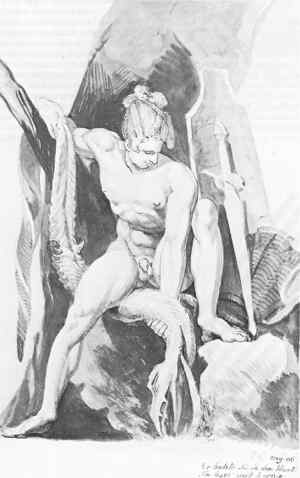
HENRY FUSELI
Siegfried Having Slain Fafner the Snake 1806
pen, pencil and wash, 348 x 237 mm.
(Auckland City Art Gallery)
For Fuseli, the human figure was the main subject of art. He had as little time as Michelangelo for landscapes - then a mainstay of English art, along with portraiture. But it was not the expressionless beauty of neoclassic nudes that was his ideal. Rather, he wanted to show the figure in the grip of passion, energy and emotion. His figures never do things half-heartedly. Fuseli's Polyphemus hurls a huge rock at the Greek hero Odysseus with every ounce of strength his muscular body can muster; his lovers, Huldbrand and Undine, embrace with such feeling that Undine swoons in Huldbrand's arms.
Among the literary sources of Fuseli's art, the mediaeval epic, the Nibelungenlied, has a special place. This tale of heroic deeds, of treachery, of lust and violence, was a perfect stimulus for Fuseli's artistic imagination. He was introduced to the book by one of his early mentors, the Zurich scholar Bodmer, also a translator of Milton and Dante. The ill-fated love of Siegfried and Chriemhild gave him scope for scenes of violence and extreme emotion, such as the drawing of Chriemhild throwing herself on the slain body of Siegfried, .Nhere ,the two lovers seem to flow together Into an image of grief.
To achieve his effects, Fuseli sacrificed naturalism. Influenced by the theatre, he resorts to exaggerated expressions and gestures of a rhetorical nature. Also, he stresses lines that convey the idea he wants, such as the curves of Chriemhild's sobbing body and the rigid angularity of Siegfried's corpse. Often his poses verge on caricature, such as that of the drooping aged parents in Parental Care whose spines are so curved their heads touch their knees. At times, in his search for grand designs or symmetries, as in Hamlet and the Gravedigger, the postures can look mannered and unconvincing.
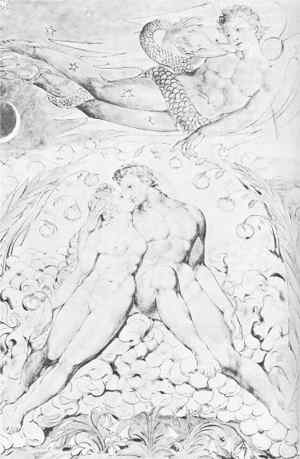
WILLIAM BLAKE
Satan Watching the
Endearments of Adam and Eve c1822
pen and watercolour, 519 x 397 mm.
(National Gallery of Victoria, Melbourne)
Fuseli's interest in the bizarre often flowed over into a study of illicit and erotic subjects. He made many explicit drawings of sexual acts between men and women, among which some with lesbian themes have survived. This is despite a purge of such drawings by his wife, who burnt many of them after the artist's death. The Auckland collection contains none of the pornographic material: but it does include a few studies of courtesans displaying their charms at balconies or windows, as if soliciting the viewer. These works have an air of fantasy about them. They were worked up from memory or the imagination and not based on actual drawings of real life prostitutes. Interestingly enough, Fuseli's wife seems to be the model for several of these designs.
Fuseli's relationship with women is an intriguing topic. In his early career he had fallen for the glamorous lady painter, Angelica Kauffmann (Miss Angel as Sir Joshua Reynolds called her in a rare moment of infatuation), but had been rebuked. Other women who spurned his advances included Anna Landholt, whose portrait appears on the back of one of his paintings called The Nightmare. Fuseli's vanity (which is well documented) can hardly have suffered these rejections lightly. In the end he married 'beneath him', as Peter Tomory puts it, to an artist's model he met at Bath. She seems to have provided little intellectual stimulus for him - a shortcoming Mary Wollstonecraft was apparently prepared to remedy by her suggestion of a 'ménage à trois'. In his art women often are dominant and threatening creatures - not at all like the genteel submissive ladies, concerned with home and family, who appear in much contemporaneous British painting. Fuseli's women flaunt their charms unashamedly, as in Three Women at a Curtained Window, or they have the man in submission, as in the Siegfried and Chriemhild where he kneels at her feet. They dress with elaborate costumes, with lots of bows and ribbons, and usually have hairstyles of great complexity in fantastic reworkings of mediaeval or classical styles.
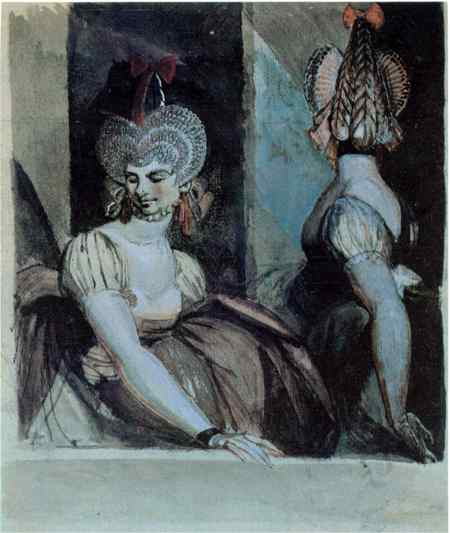
HENRY FUSELI
Two Courtesans
with fantastic
Hair-styles and Hats
c.1796-1800
pen and colour wash,
179 x 162 mm.
(Auckland City Art Gallery)
Fuseli's art is unique. The other artists included in the exhibition, such as Blake and Flaxman, help to give a context for his achievement but do not eclipse its originality.