
The Sculptures of Terry Stringer
STEPHEN ELLIS
Since the Renaissance, a perennial problem in the visual arts has been the reconciliation of the two- and the three-dimensional. Relief sculpture is one time-honoured solution (but only ever marginally successful); three-dimensional painting is another (again, almost by definition, doomed to less than resounding success). Fortunately for the artist who sees possibilities in both flat and formed elements, there is another choice to make a feature of the intrinsic conflict.
That conflict is the fulcrum of Terry Stringer's art. Stringer works in two dimensons: painting and arranging the elements of his sculptures into three - always conscious of the conflict (or the conversation) between the two vocabularies.
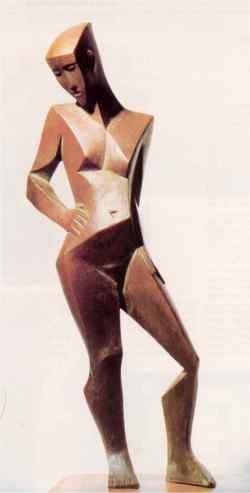
TERRY STRINGER
Fifties Nude 1978
bronze, 300 m. high
(Denis Cohn Gallery)
What Aucklanders saw in Stringer's most recent exhibition at the Barry Lett Galleries, were hard-edged, apparently neo-Cubist, bronzes. They were all small and hand-coloured, and they represent the latest development in Stringer's explorations. How Stringer arrived at this point involves some unexpected sources; and all developments revolve around the 'essential conflict'.
Stringer experiments with both two- and three-dimensional elements, and with colour as an adjunct. He has never been seduced by the Cubist theory, although his latest work may appear derivative. Stringer's manner derives from distortion, with which he began to experiment after leaving the Elam school in 1967. He limited himself to two sources of distortion: the camera and folk art. He took photographs around a head or figure, and subsequently rearranged them into a collage giving the illusion of volume. The effect is predictably reminiscent of Frances Bacon. But Stringer's aim was to evoke 'three dimensions masquerading as two' rather than vice versa as in the painter's idiom.
The photomontages led to attempts in three dimensions, direct translations from montage to fibreglass. The results are faceted, directionally biased (a criticism that could be levelled at much of Stringer's work) pieces with the facets painted realistically as fragments of a rearranged object. These works were quite successful, and lent themselves to further development: but Stringer was looking elsewhere - to folk sculpture.

TERRY STRINGER
Face Looking Up 1979
polychromatic bronze, 250 m. high
What Stringer assimilated from the folk tradition was its emphasis on the part, rather than the whole. A folk sculpture is an assemblage of individual elements, with their own space and significance totalling a whole. Stringer threw out the formal academics of 'parts subject to the whole' and adopted the folk approach. He married the photographic and folk distortions into more fibreglass works, which were minimally painted and which retain much of the power of the folk originals - except that the naivety is conscious. Though these pieces are formed strictly in the round, Stringer recognised in them the possibilities of combined 20 and 30 elements in the same sculpture. The reference was again to the essential conflict.
What followed (from 1972 to 1975) was a long line of transitional works exploring the reconcilability of two- and three-dimensional elements. Initially the results were clumsy and disjointed, with the elements competing vigorously for control of the whole. But by 1974 Stringer was managing the conflict more confidently, as evidenced by Falling Woman of that year. Falling Woman is the landmark piece in Stringer's development. It marks the crossroads between simple 2D/3D manipulations and his later experiments with the exclusive use of planes and with jointing. Where the flat planes meet the more robust forms in the 2D/3D pieces there is a certain unconscious mobility; there was no obstacle to the step to conscious mobility. Stringer now articulated the dialogue between the 2D and 3D elements. The joints were hinged and vertically biased, so that two main forms emerged in these works - the screen and the book. Some figures appeared with modelled torsos and hinged flat limbs, but later the modelling disappeared to be replaced by exclusively 2D construction - realistically painted cut-outs hinged and stood up to create depth and movement. Due to their 2D preoccupation few of these pieces are outstanding sculptures. But Stringer the painter developed enormously while working on them.
With the painting stronger and the flat plane's possibilities realised, Stringer turned back to the conflict, and rethought the place of the cut-out elements. Subsequently he produced works that could now be described as typically Stringer. Mother as a Girl is the archetypal piece, and probably the most successful, from this period. (It was reproduced in Art New Zealand 7.) Cut-out flat planes meet and intersect, or are statically jointed and distorted horizontally. The planes are realistically painted. The whole has an unexpected solidity and a three-dimensional completeness.

TERRY STRINGER
Woman in Hat of 1945 1979
polychrome bronze, 300 m. high
(Private collection, Auckland)
Mother as a Girl was one of the last painted cut-out pieces. From these Stringer turned to modelling in polyester resin: the paint subsequently disappeared from these works. After the colour had gone, and the modelling had come back, it seemed to Stringer a logical step to attempt casting in bronze. A grant from the Queen Elizabeth Arts Council for that purpose in mid 1977 provided the impetus. Although bronze is a traditional sculpting material it was one with which Stringer had never worked before, and it required a whole new technical approach. In the bronzes shown at Barry Lett's, Stringer shows he was confident only with the small scale: but he feels that soon he will be ready to tackle larger bronze castings.
Since the original paint washed off ancient Greek marble sculptures it has been considered crude or compromising to colour works in three-dimensions. But colour is an intrinsic part of the conflict that Terry Stringer is investigating. For his sculptures to masquerade as two-dimensional Stringer had to go some of the way toward adopting the painter's idiom. In the early painted works, and up to 1976, Stringer the painter was strongly influenced by the hard-edge style pioneered by Rita Angus and further developed by Don Binney. There are stylistic ties also to the Pop realism of the 'sixties, and a Lichtenstein-like delight in the vagaries of the printed pulp image. Stringer also attributes the colour and tone of his painted pieces to a fascination with cheap two- or three-colour posters from as far back as the 1920s, with their lithographic texture. He is now less than happy with that style, and intends to develop the painting to keep pace with the sculpture. He intends to become less explanatory with the colour, and to use it flatly or graphically so that it will work more convincingly with a stronger, simpler, sculpture.
The bronzes shown at Barry Lett's, collectively entitled 'polychrome bronzes', were also coloured. However the colour was kept to a minimum in most pieces, or did not appear at all. Stringer's modelling created the hard edge and the shadow (hence the Cubist appearance) making the painted shadow obsolete. What colour had been applied to the bronzes had been scraped or rubbed back to convey the feeling of an artifact, or patina-like traces. Stringer's feeling for the metal itself must have occasioned these changes. We see him turning from explicit paint to a less traditional and more modelling-oriented use of colour.
Concurrent with his work in bronze, Stringer has been taking a holiday from the figure as subject. The object has made an appearance - four works in the Barry Lett's show were still-lifes. He has also begun experiments with furniture: distorted according to the laws of perspective and intentionally biased in direction. These furniture pieces are all illusion (and Stringer feels committed to the figure): but they provide the perfect vehicle for experiments with the more graphic colour. A chair was exhibited in the Lett show, although not catalogued.
For the future, Stringer sees a series of figures in, or as, boxes: a possible link with the furniture pieces, and a more exacting use of volumes and rectalinear forms. He also intends to produce a series of large bronzes, keeping as close as ever to the 2D/3D conflict.