
Exhibitions Wellington
NEIL ROWE
Tony Lane
Malcolm Benham
Two Wellington painters, both of who turned thirty this year, Malcolm Benham and Tony Lane, have each, over the last four or five years, been developing a rather more than purely local audience for their work. This year Benham has had important shows at the Brooke-Gifford and Barry Lett galleries (with Rob Taylor and Julia .Morison), as well at Wellington's Galerie Legard; while Lane has mounted one man-shows at Elva Bett's and at Denis Cohn's.
In the work of both these artists, this year, there are discernible new directions and new strengths. Benham has been making strenuous efforts to break out of the straitjacket of carefully-considered formal composition hat has characterised his painting to date; while, conversely, Lane has tightened up his compositions to a very large extent.
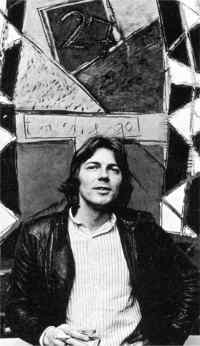
Malcolm Benham
with his painting
Bitter Sweet, 1979
It is remarkable the difference that framing has made to Lane's large canvases. Suddenly, by encIosing the picture-plane and defining its edge and limits, his recent painting has acquired an authority and a structure previously lacking in his earlier loosely-flapping banners, with the amorphous splodges of paint.
Colour too has an important part to play in Lane's new painting. Where in the past it has frequently been muddy, here it has a new depth and luminosity. The translation of inner states and emotions on to canvas has become Lane's predominant concern, along with investigations into the psychological nature of colour - which, like McCahon, van der Velden and Hotere he uses metaphorically.
These recent paintings are darkly glowing interior landscapes which depict the struggle of the human spirit against the existential void. They are the most cohesive and assured works that Tony Lane has exhibited to date.
Malcolm Benham, in his recent painting, is working with a new verve and spontaneity. Where in the past his work has been carefully thought out and structured, now he is relying on a more expressive and intuitive approach. Gone is the earlier preoccupation with marrying figurative and abstract elements. Instead, spatial concerns predominate.
Benham's mixed-media surfaces and built-up textures are as distinctive as they are tactile. Where once they might have been Iaboured and overworked, now they are second-nature, and his technique has acquired a fluency and virtuosity that enables him to fork with a new directness and immediacy.
These are interesting new developments in Malcolm Benham's work of this year - evidence of an aggressiveness and resolve that have not previously been apparent in his rather polite canvases to date.