
Exhibitions Christchurch
MICHAEL THOMAS
Ralph Hotere
Don Peebles
A rare opportunity to assess similarities and differences in the recent work of two of New Zealand's most important contemporary painters, Ralph Hotere and a Don Peebles, was presented recently by the Robert McDougall Art Gallery when exhibitions of each artist's work 'overlapped' for a two-week period in July. The work shown by these artists was fresh from the studio: nearly all the pieces having been completed during the last year.
Hotere's paintings result from his trip to Spain, Italy and the south of France in 1978. They mark a new period in his development. They are freely expressive, emptive, very open and easy to relate to.
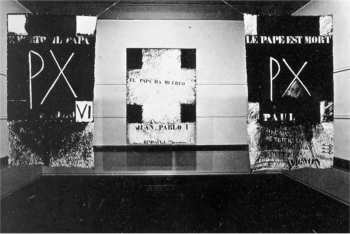
Installation of the Ralph Hotere
exhibition at the
Robert McDougall Art Gallery
Peebles shows exciting new canvas reliefs and related drawings. The painted reliefs come nearer to his drawing than any of his earlier paintings and contain many of those characteristics found in his most typical work. They, too, represent a significant stage in his artistic development.
The free-hanging paintings executed on unstretched canvas in Hotere's exhibition fall into four distinct series: Return to Sangro referring to the Sangro River War Cemetery on the Adriatic Coast where the artist's brother is buried; The Pope is Dead painted in reaction to the death of Pope John Paul in 1978; the mottled-light-suggesting Avignon canvases; and the haunting Window in Spain series.
Hotere's great strength (and perhaps this comes from his Maori ancestry) is that his paintings seem to emerge from, and communicate to, the soul. People do not have to be art experts to feel the emotive power of the pictures and to empathise with their meditative nature: they seem to penetrate that 'collective human soul' which we know is there but can never 'nail down' in words. 'It is something intangible, something spiritual and human but definitely non-material which is expressed.
The works speak for themselves, and too much cerebral analysis seems to get in the way of one's 'gut' reaction. Sombre black symbolic crosses, T shapes, recur throughout, words handwritten or stencilled interplaying with freely-handled, gestural paintmarks. Colour is personal and brooding, blacks and whites predominate with browns and ochres - earth colours - sometimes set alight with a dash of burning orange.
Presentation of the exhibition in the McDougall Art Gallery is superb: the freely hanging canvasses being suspended away from the walls where they can be absorbed without the distraction of wall detail. The whole atmosphere in the gallery is quiet and meditative - totally in keeping with the rich evocative mood of the pieces.
In his latest work Hotere is more outgoing, open and uninhibited than he has been before. These paintings are less tight, more freely expressive than much of his earlier work, such as the Black Paintings and Malady series of the early 'seventies, which were extremely subdued and minimal. It seems as if Hotere is less concerned with artistic perfection than with human expression; and that he has sufficiently absorbed technical challenges and now wishes to express as directly as possible a human, social and spiritual experience.
Don Peebles differs from Ralph Hotere in that this work is not consciously concerned with meanings, symbols or emotive feelings; and unlike Hotere there is no reference to anything outside the work. It is the unity of the 'concrete', tangible elements - the 'plastic facts' - which is the 'raison d'être' of Peebles' art.
It is not true to assume of course that underlying Don Peebles' work there is no emotion or feeling - quite the contrary: his latest reliefs are 'warm' endearing objects, not sterile examples of sophisticated aesthetic-seeking, but living pieces. The basic concern however is plastic rather than spiritual.
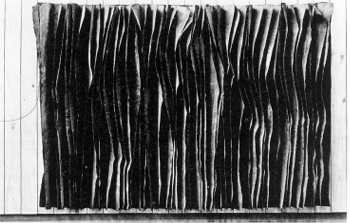
DON PEEBLES
Untitled Canvas Relief 1979
The latest reliefs consist of 'fins' of canvas which are machine-sewn on to a canvas backing at various distances apart, creating an effect on the wall rather like a giant book seen from the front. As one looks at the works, slight modulations of texture and tone appear across the surface, and the gentle wavings of the frayed edges interplay with natural shadows, creating a continuity of movement which marries perfectly with the natural irregularity of the buckled flaps.
The works are distinctively-coloured - one over-all hue predominating as the key distinguishing factor in each piece. In the later reliefs the paint is more transparent, blending with the canvas to produce a raw 'hungry' look.
Peebles' pursuit of new problems is demonstrated in his Untitled Canvas Relief, where two strips of canvas are placed on the floor in front of the relief, thus introducing an additional set of relationships. The question of whether the two parts relate as a whole is posed, and a tension added which is a central part of the work. In fact there does seem to be a unity in spite of the almost arbitrary nature and placement of the cross. As a statement of Don Peebles' current concerns there is no better example than this piece.
A set of acrylic and charcoal drawings is also exhibited. It is interesting to note that two acrylics consisting of vertical streaks of paint which curve an twist, and resembling exactly the vertical fins of the latest canvas reliefs, were made in 1974. This illustrates Peebles' working process, in which, rather than progressing in ordered sequence from one idea to the next, he is constantly re-evaluating earlier works, re-working and developing them.
In these shows, both Hotere and Peebles demonstrate significant new directions. Although their intentions are radically different, there are some interesting similarities in the 'language' which each artist uses to express ideas. The handling of paint is loose and sketchy; there is a feeling in both painters' work of hung rather than stretched canvas; and colour is personal, not plain and impersonal. Arbitrary marks are important compositional elements. There is a very strong aesthetic sense in which the rough and 'tatty' are used positively. These qualities together characterise much contemporary painting in New Zealand; and it is this style of 'painting language' which distinguishes work going on in this country from painting overseas.