
The Woodcut and the Linocut
ROY COWAN
The print has been called a democratic art form. In their association with the rise of printing and the spread of literacy, the woodcut and the wood-engraving at least can well claim to be democratic art forms. To be such, the images should be direct and easily apprehensible (for a twentieth century example look at the 'Picture Novels' of Frans Masereel). The woodcut, wood-engraving, and to a lesser extent the linocut, continue to fit this description. Etching, on the other hand, in its techniques belongs more to the world of the artist, and provides more frequently a vehicle for private vision.
In recent years two great forces have borne upon the arts: Science and the notion of research. In art-historical studies, psychological and philosophical questions have been taken up. The works of the structural anthropologist Robert Levy-Strauss, with his emphasis on the role of the unconscious, and those of the philosopher Ludwig Wittgenstein, in his use of the striking picture theory as a basis for propositions about the nature of statements (or representations) and the actual state of affairs to which they are aligned, have profoundly influenced learned criticism of the arts, and the scenarios of artists as well.
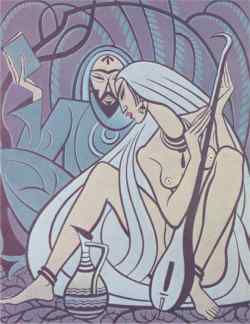
GEORGE WOODS (1898-1963)
A Book of Verse and Thou (Omar Khayyam Series)
colour linocut, 248 x 192 mm.
The visible effect has been towards a dematerialisation of forms - the minimum line around a proposition which may form a basis for studies in cognition, or simply notes towards the idea of a work.
The effects upon sculpture are most notable: but print-making too is well-suited to such studies - particularly the developed forms of etching and the hybridised forms of image production. The. appreciation (or should one say use) of such forms implies special training: and here we move far from the idea of the 'democratic' print. Academicism, and the tendency toward preciosity which surfaces at times in print-making, set off a countering activity. Part of the intention of the New Zealand Print Council, and of the activities of the group 20/20 Vision, and the Multiples scheme of the Barry Lett Galleries was to popularise printmaking.(1)

K.W. HASSALL
Sunlit Clearing
colour linocut, 153 x 180 mm.
The prints that were shown in a recent exhibition at the Wellington University Club all lie over the watershed from the region of philosophical studies: but there is a complementary richness of historical connections. Philip Clairmont's woodcuts, for instance, closely approach in temperament and style the prints of such members of the German group Die Brucke as Emil Nolde, Erich Heckel: and Ernst Ludwig Kirchner - whose style was so influenced by his study of the sixteenth century masters Durer and Cranach. So there is a long line of descent; and Clairmont is not the only young New Zealand artist to work in an expressionist style.
To pass directly from Clairmont and the masters of German expressionism to the works of the Lady Mabel Annesley might seem strange: but the best examples shown in this exhibition drew strength from a disciplined version of the force which surfaces in the expressionist style.
E. Mervyn Taylor's entry into wood-engraving followed a six-year apprenticeship as a jewellery engraver.
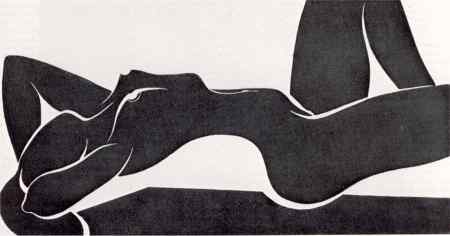
GEORGE WOODS
Nude
linocut in brown ink, 190 x 350 mm.
The jewellers have a special place in the development of printing. The making of movable types was rendered possible by the invention of hardened metal punches and dies; and engraved jewellery, plate, and armour provided both the means and the style for early printed engravings. At first simple and monumental with a disciplined use of formal ornament, engraving developed, then succumbed, to virtuosity and the separation (in the interests of a growing publishing industry) of the artist and the tradesman engraver. The woodcut remained the simpler and more direct and expressive means of illustration.
In the early nineteenth century Thomas Bewick fostered the use of engraving on the end of the grain. This permitted a finer texture, and freedom from the directional effects of the side grain. His work (which formed the model for, amongst many others', Mervyn Taylor's style) became the basis for commercial process wood-engraving, in which the tradesmen worked from all kinds of originals, including photographs. The resultant separation of the artist, the craftsman and the tradesman contained the seeds of decline - as had been the case with engraved illustration after the sixteenth century. However, before these misfortunes afflicted the print and printing, masterpieces of design - such as the pages of Colonna's Dream of Poliphilus, printed by Aldus at Mantua in 1599 - were created, to inspire revivals of the illustrated book as a cohesive work of art, and to lead ultimately to modern ideas about printed design and layout.
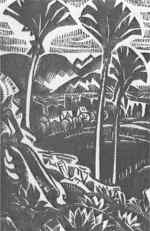
THE LADY MABEL ANNESLEY (1881-1959)
Nikau Palms
woodcut
The graphic work of Mervyn Taylor lies principally within this tradition. It has been said that the relationship of wood-engraving with book-illustration weakens its status as a medium for making independent prints. Perhaps technical changes, the discipline and training necessary to the engraver, costs, and so on are against the mode, and volumes such as Mervyn Taylor's Taina(2) may be the last of their kind.
The other great figure to influence the making of prints, particularly in Britain, was William Blake. From him a school of wood-engravers arose - including Eric Gill, David Jones, Blair Hughes-Stanton and Eric Ravilious, to name only a few. (The work of Stewart Maclennan in New Zealand was influenced by these masters - particularly by Ravilious.)
After so much has been said about the solid craftsmanship and deliberative design of wood-engraving, the works of Campbell Smith have a spontaneity quite exceptional in this medium - more like the freshness of early woodcuts such as those of Caxton's Aesop. The craftsmanship is there: but the crisp cutting gives point, metaphorically, to an impish wit.
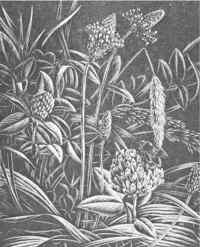
E. MERVYN TAYLOR (1906-1964)
Clover
wood engraving, 129 x 104 mm.
The open design of many early book illustrations was meant to accept hand-colouring: and down to the present many print-makers treat colour as the accompaniment to the message in black. Much more rarely the distinct graphic quality of the colour is allowed to function as a contrapuntal element in the design. The colour linocuts of K.W. Hassall demonstrate the first position.
The colour linos and block prints of George Woods show a much greater degree of liberation of the colour phases. In his colour prints, George Woods sustained a planar image: but he was a powerful draughtsman, with a strong plastic sense amounting to the sculptural. (For an example lying outside the scope of this exhibition .see the acquatint Mamu: Arts Year Book 1946, page 77.)
Finally, Bryan James gives colour an equal status in his linocuts Dunedinites; and so does Para Matchitt in his traditionalist example from the Te Kooti series. The delicacy of balance needed to play along a team of blocks in this way is revealed when we come to Graham Smith's Old Head, where cut-block quality is beginning to yield to painterly quality. The works by Graham Smith, Bryan James and Philip Clairmont all give evidence of the continuing vitality and relevance of the cut or engraved image.

PHILIP CLAIRMONT
Clothesline 1976
Linocut
As noted above, the print has tended to decline when the artist, the craftsman and the tradesman have been separated. Printmaking as a select and specialised art-form appears to be a contradiction. In accordance with social trends the future does seem to lie with the print in its 'democratic' forms.
1. A History of New Zealand Print-making, thesis by Anne Kirker, University of Auckland, 1969. 2. Taina, by C.M. Henderson, with wood-engraving by E. Mervyn Taylor, H.H. Tombs.
Roy Cowan's notes were occasioned by an exhibition arranged by Helen Hitchings at the Wellington University Club in August and September last. It showed original prints from wood and linoleum by thirty-five New Zealand artists; and covered the period from the nineteen-thirties up to the present.
Helen Hitchings opened the New Zealand prototype of the dealer gallery - the Gallery of Helen Hitchings, as it was called - in Wellington in the late nineteen-forties, to show the work of what were considered the most challenging painters outside of the ruling conventions of the art societies of that time. The ideas and philosophy of the Bauhaus influenced the operating style of the gallery towards the concept of a unity of the arts and crafts: that is to say, the development of material culture as a total art form. (At this time the expatriate Viennese architect Ernst Plischke was in the process of initiating New Zealand into Bauhaus ideas: His furniture designs, put to functional use( ideally suited the Helen Hitchings Gallery milieu).
There were few one-man shows. Paintings were shown with fabrics, pottery (before the movement really got started) and furniture.
In 1951 Helen Hitchings formed the project of introducing London to contemporary New Zealand painting. She assembled a collection, and closed the gallery. Perhaps prompted by the vacuum this left, the Architectural Centre then opened a gallery of its own, later to be known as the Centre Gallery. There was a supporting membership, a management council, fortnightly one-man or group shows, and a continuation of the policy of providing an alternative to the art societies' exhibitions.