
Exhibitions Wellington
NEIL ROWE
Christopher Booth Three Large Works
Rudolf Gopas
In 1968, twenty-year-old Christopher Booth left the University of Canterbury School of Fine Arts for Europe, where he hoped to apprentice himself to a working sculptor. He first worked with Denis Mitchell at St Ives (where Dame Barbara Hepworth was an early admirer of his work) and subsequently with the late john Milne. In 1970 he went to Italy, intending to work with Quinto Ghermandi: but as this proved impossible at the time he went to Verona to work with the Australian sculptor Stephen Walker on his water sculpture commission for the Bank of New South Wales head office building in Sydney. Returning to New Zealand in 1971, to the far north where he was born and bred, he built a bronze foundry at Keri Keri.
A regular exhibitor in the annual Hansell's Award exhibition, Christopher Booth's work has, however, seldom been seen outside this context; and in fact this exhibition of three large works at Victoria University library is his first one-man exhibition.
Each of the three works, while exploring different combinations of materials, is a statement about the land: ranging from the polemical comment on the destruction of second growth native forest Iron Grip to the poetic Whangaroa 1979 and Scrubnests 1978. This latter work, with geometric regularity on a wooden base, with small sails of hand-made paper (by the artist's wife) suspended between them, was exhibited in last year's Hansell's Award and was inspired by spider webs in the scrub. Although it is a strong formal statement, the naturalistic point of reference (never far away in Booth's work) is here perhaps more explicit than it is in the other two works exhibited.
CHRISTOPHER BOOTH
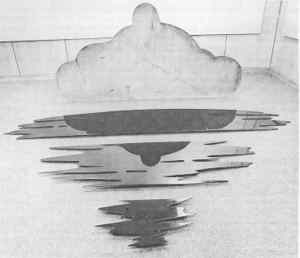
Whangaroa 1979
polished and enamelled steel
Iron Grip utilises manuka again, this time combined with steel shafts which represent the steel rollers used to batter down the secondary bush. The third and most recent work is also probably the best resolved of the three in terms of concept and execution. It consists of cut-out plate steel shapes, one in raw and rusted steel standing vertically; the others, of black enamelled and painstakingly polished steel, lying flat, depicting, land-form reflected in tidal mudflats. There is a simple, almost naive, eroticism about the breast-like hill form in this piece, which has been apparent also in earlier works of this sculptor's - particularly the polyester-resin Road to Claudia 1972 in the National Gallery collection.
It is good to see even a small exhibition in the capital by one of our several younger sculptors who desperately need venues for showing their work. It was to be hoped that the vast disused Dalgety woolstore on Thorndon Quay might have gone some way to providing this when it was taken over by the Artist's Co-op a year ago: however, the enormous potential of this space has not yet been realised.
It is with considerable interest then that I look forward to Christopher Booth's next (and larger) one-man exhibition, scheduled for next year at the Dowse Gallery.
If sculpture is seldom seen here, so too is the work of Rudolf Gopas. It is many years since this influential Christchurch painter and teacher has shown in Wellington. Educated in Germany at the height of the Expressionist movement in that country, Gopas came to New Zealand in 1949 to paint and teach at lIam, where his influence on New Zealand painting has been considerable. Foremost among his proteges are Philip Trusttum and Philip Clairmont.
To say that his art has undergone a radical change in his recent exhibition at Elva Bett Galleries is an understatement. Instead of with purely painterly concerns, Gopas is today preoccupied with philosophy, poetry and astronomy - particularly the latter. This exhibition consists of illustrated manuscripts, including poetry, anti-nuclear-war polemic, philosophical and astronomical observations, mixed together in a highly idiosyncratic soup.
As the notes and private thoughts of a major (and much neglected) painter these are remarkable documents which have a significance and value far beyond their apparent worth as art objects.