
Book review
Illustrated Encyclopaedia Of World Theatre, edited by Henning Rischbieter; translated by Estella Schmid; adapted and amplified under the general editorship of Martin Esslin
Published by Thames & Hudson 1977, 295 pages
Reviewed by ROGER McGILL
Knowledge is of two kinds: either we know a subject ourselves, or we know where we can find information about it. The Illustrated Encyclopaedia of World Theatre is of the second school, and is thus an aid to the achievement of the first.
It does its job well. From A for Abbey Theatre (a playhouse opened in Dublin in 1904), through to Zuckmayer, Carl (the German playwright who questioned the Nazi philosophy), the information is, above all, interesting.
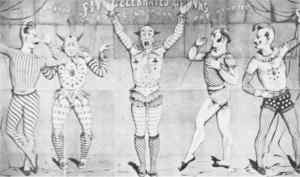
Clowns in a circus poster
And interesting is what an encyclopaedia must be! Vast tomes of dusty statistics are boring: pertinent factual information is not. This book contains material of the latter kind. An average entry of 100 to 200 words, on the playwright, play or theatre term, defines, illustrates, informs and sums-up the basics of the subject, and throws in a short bibliography at the end to aid in reference for further information.
The information is accurate and up-to-date (so far as it would be humanly possible for an encyclopaedia to be). For instance: Samuel Beckett's very recent radio plays are listed with comment from the recent Readers Guide by Hugh Kenner. The 'poor theatre' of Jerzy Grotowski, with his philosophy of an actor's 'self revelation' is documented.
As in all encyclopaedias, however, there are only the references and the basic facts - the taste of the fruit; the mere sniff of something a reader would like to devour. It would of course be impossible for such a book not to be guilty of this crime. A general book on such a diverse subject as the theatre is bound to frustrate, simply by virtue of covering the subject, oh so briefly!
The illustrations in the World Theatre Encyclopaedia are of a very high standard. Although they are all in black-and-white they have been selected by someone who knows theatre. A reader wishing to obtain information on the visuals of the original production of Harold Pinter's Old Times, or Piscator's production of Schiller's Die Rauber, will be delighted. Somehow, the photographs show what one would be looking for. If this encyclopaedia were to be used as a design reference alone it would serve an excellent purpose.
Indexing of plays is simple, easy to follow and with the listed playwrights easily traceable. Indeed, perhaps the most attractive aspect of this reference book is the accessibility of information in an ordered form. If knowledge is power then accumulated knowledge within easy reach is an instrument of that power. This encyclopaedia will give access to theatres looking for new productions, actors looking for new audition pieces, and directors looking for neglected writers.
The theatre is attracting more and more people as our life-styles change to suit the use of leisure and the search for less materialistic aspects of life emerges. This one volume illustrated theatre encyclopaedia will excite and stimulate anyone interested in theatre - professional, amateur, teacher, or stage-hand.