
A Sullen Silence
Frank Weitzel, Modernist (1905-1932)
GAIL ROSS
The spectacle of an artist being shunned for political reasons has been a rare occurrence in New Zealand but, as the example of Frank Weitzel shows, not an unknown one. Weitzel was the son of German immigrants whose Wellington home became a meeting place for fellow socialists, militants and anti-militarists during World War One.(1) The family's radicalism often brought it into conflict with the authorities and attracted a greit deal of public hostility. After migrating to San Francisco to escape this animosity, Frank Weitzel won scholarships that allowed him to study at the California School of Fine Arts, the New York Students' League and the Munich Acaderny.(2) He settled in Sydney in 1928 where his abstract linocuts, Bauhaus-inspired furniture designs, primitive style sculpture and Art Deco printed textiles earned him a place among the city's avant-garde artists. By 1930 Weitzel was gaining critical attention in London and exhibiting his work with leading modernists Jacob Epstein, Duncan Grant, Paul Nash, John Nash and Claude Flight.(3) Weitzel's success was never reported in New Zealand, where hostility towards his family remained rife.
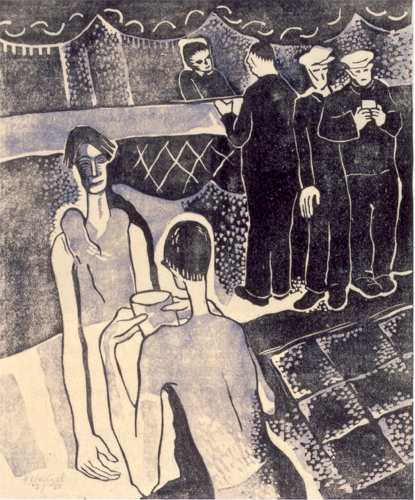
FRANK WEITZEL Café c. 1930 Colour linocut, multiple block, edition of 50, 258 x 212 mm. (Collection of the National Gallery of Australia, Canberra)
Frank Weitzel was born in Levin on the 22 November 1905, the son of German socialists Frederick Weitzel and Maria Benninghoven. The family relocated to Wellington in 1912 where the political situation was extremely volatile. When waterside workers went on strike in 1913 the dispute quickly escalated into a General Strike, which Prime Minister Massey broke by brute force. Thousands of special constables were recruited from rural districts to ride into Wellington and physically clear strikers off the streets.(4) The sight of 'Massey's Cossacks' breaking the strike had a profound effect on the Weitzel family, strengthening their commitment to political radicalism.(5)
Wellington became an even more hostile city for the Weitzels to live when New Zealand joined Britain in declaring war on Germany in 1914. German immigrants were physically attacked, businesses with German sounding names such as Hallensteins vandalised and individuals of German descent arrested and detained on Sommes Island on suspicion of being spies.(6) While other German immigrants tried to avoid harassment by anglicising their names and blending in to the community, the Weitzels became actively involved in the anti-conscription movement. According to the New Zealand Herald: During the war the family lived in Buller Street. The house was the rendezvous of anti-militarists and revolutionaries of a pronounced character .... All these men were arrested for talking anti-conscription .... It simply pleased the Weitzel family to encourage anything that would weaken the British fighting power.(7)

FRANK WEITZEL Abstract Design c.1930 Colour linocut, multiple block, edition of 50, 290 x 226 mm. (Collection of the Christchurch Art Gallery, Christchurch)
Frank Weitzel claimed that the internment of his father as an enemy-alien added to the sense of persecution felt by the family, and continuing harassment after his death resulted in several family members deciding to leave New Zealand.(8) The police certainly closely monitored Frank's mother, particularly after an incident in December 1918 when she gained admission to the Parliamentary Public Gallery and threatened to kill a Member of Parliament.(9) With her financial resources disappearing and angry at what she saw as her unfair treatment by the authorities, Mary Weitzel applied to External Affairs to have herself and three younger children repatriated to Germany.(10) However, her application was refused on the grounds that she was not destitute.
Sixteen-year-old Frank Weitzel had only just begun attending art classes when his mother migrated to San Francisco in 1921, taking Frank and one of her other children with her. Frank's sister Hettie, a student at Wellington Teachers' College remained behind to complete her studies. A founding member of the Communist Party of New Zealand, Hettie was arrested within months of her family's departure for selling copies of The Communist on Lambton Quay in Wellington.(11) Her trial was widely publicised and culminated in questions being asked in Parliament about the Weitzel family's patriotism.(12) Spared from the furore, Frank Weitzel enrolled at a high school in San Francisco and in 1923 won a scholarship that enabled him to spend the next three years studying at the California School of Fine Arts.
Weitzel studied sculpture under Bert Mangard who encouraged his interest in Pre?Colombian Mexican art, and he also took classes in textile design and drawing.(13) The Dean of the School was former Auckland artist Eric Spencer Macky, a founding member of the California Society of Etchers, who may have encouraged Weitzel's interest in printmaking.(14) Weitzel began exhibiting his sculptures with the San Francisco Artists Association in 1925, and a year later won a national scholarship for sculpture, which led to him spending 1926 at the New York Art Students' League and 1927 at the Munich Academy. After his Munich studies he travelled extensively in Europe before relocating to Sydney in 1928.
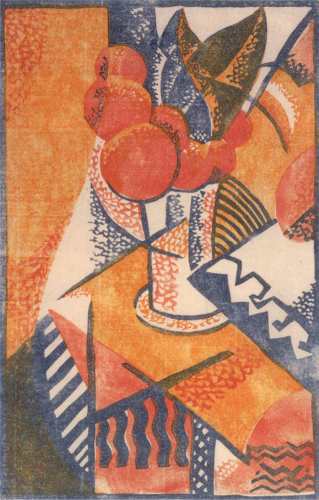
FRANK WEITZEL Vase of Flowers c.1930 Colour linocut, multiple block, edition unknown, 258 x 164 mm. (Collection of the Museum of New Zealand Te Papa Tongarewa)
Soon after his arrival, Weitzel began creating a series of abstract monochromatic linocuts of Sydney streets, tramways, hotels and building sites that reflected his fascination with city life. As Tram Lines, c. 1928 demonstrates, he placed emphasis on pattern and design rather than literal representation. Weitzel's choice of subject matter suggested he was aware of the urban realism of American Modernist printmakers while his style showed a debt to the decorative blend of Cubism and Futurism practised by British linocuts artists associated with Claude Flight School. Weitzel's most remarkable abstract print of the period was Sydney Bridge, c. 1929 which focused on the geometric patterns of the steel girders being placed during the construction of the Sydney Harbour Bridge.(15) Weitzel's work attracted the attention of modernists Thea Proctor and Adrien Feint who invited him to join the Contemporary Group, and his work was featured in the September 1929 issue of Art in Australia along with that of other group members.
In December of the same year Weitzel was invited to participate in the Burdekin House Exhibition of Antique and Modern Furniture, an exhibition credited with having initiated interest in Art Deco furniture and interior design in Australia.(16) Artists were allocated rooms to decorate for a particular purpose, with Weitzel and Henry Pynor assigned responsibility for designing a man's study. The exhibition catalogue describes their furniture designs as Bauhaus in style, and Weitzel's geometric wall hangings also showed a distinct debt to the Bauhaus aesthetic.(17) Weitzel's growing reputation brought him to the attention of Dorrit Black who had recently returned from studying linocut printmaking with Claude Flight at the Grosvenor School of Art in London and Cubism with André Lhôte in Paris. Dorrit Black persuaded Weitzel to join 'The Group of Seven', a circle of Sydney artists who shared Black's enthusiasm for Cubism and PostImpressionism. Weitzel participated in The Group of Seven's first showing at the Macquarie Galleries in March 1930, a landmark modernist art exhibition in Australian art.(18) He exhibited several sculptures including heads of artists Roland Wakelin and Henry Pynor and a work entitled Girl and Goose and Family Group. Art critic Colin Simpson declared 'Since Australia, from the point of view of sculpture, is nine-tenths desert, one feels very thankful for young Frank Weitzel, who is a sculptor accomplished and sincere'.(19)
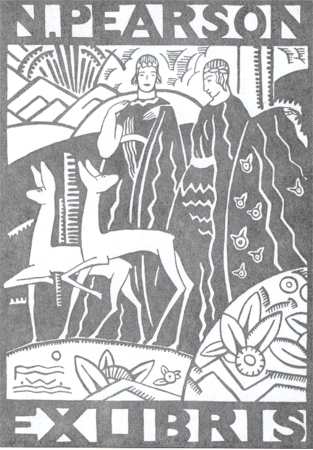
FRANK WEITZEL Bookplate for Noel Pearson Colour linocut, one block, 100 x 68 mm. (Hilda Wiseman Bookplate Collection, Auckland City Library)
Although Weitzel was recognised by fellow-artists, the public was slow to accept the modernity of his work. Disillusioned he decided to relocate to London and held exhibitions at Dorrit Black's Modern Art Centre and Macquarie Galleries to raise the necessary funds.(20) These exhibitions featured prints, sculptures and examples of linocut batik scarves and shawls. Weitzel also created bookplates, such as the elegantly Art Deco plate he designed for Noel Pearson.(21) Lack of recognition for his art was not the only reason Weitzel had for wanting to leave Sydney. One of his most ardent supporters was the writer Ethel Anderson, a highly placed figure in the conservative establishment, who believed that modem art like Weitzel's could provide a safeguard against the rising threat of Bolshevism.(22) She argued that 'In Modern Art, where a free technique allows the artist a perfect self-expression (which Bolshevism does not do), we may share the spiritual adventures and experiences of minds greater than our own.'(23)
Anderson's polemic placed Weitzel in an extremely awkward position - not only was he supportive of Communism, but his sister Hettie Weitzel had recently been elected leader of the Communist Party of Australia's Militant Women's Group.(24) Hettie Weitzel often spoke at large public rallies and was under surveillance by Australian security officials who had noted that since her arrival in Australia 'her activities and hatred of the existing order have become even more pronounced'.(25) Ethel Anderson seemed to be blithely unaware of Weitzel's political sympathies and family background, but with Hettie attracting ever-increasing publicity and controversy, it was inevitable that they would come to her attention. Not surprisingly, Weitzel made a strategic and timely departure from Sydney.
Weitzel arrived in London in 1930, where Dorrit Black appears to have arranged for him to meet Claude Flight, Britain's most avant-garde printmaker. Flight promoted a printmaking style that blended elements of Cubism, Vorticisrn and Futurism, creating decoratively abstract linocuts that celebrated the speed and rhythm of modem life.(26) Flight had no hesitation in inviting Weitzel to join the linocut artists associated with the Grosvenor School, and his prints featured in both the 1930 and 1931 Exhibitions of British Linocuts organised by Flight at the Redfern Gallery. Writing to Dorrit Black, Flight enthused 'I am very pleased to have Mr Weitzel's work for the show. I like it very much, it is original, strong, good of its kind & just the sort of work we want' .(27) Under Flight's influence, Weitzel began creating multiple block prints that blazed with colour, such as Vase of Flowers 1930 and Abstract Design c. 1930, and figurative prints including Café c. 1930.

FRANK WEITZEL Sydney Bridge c.1929 Linocut, one block, edition of 50, 330 x 180 mm. (Collection of the National Gallery of Australia, Canberra)
Not everyone was impressed with his work - when Weitzel visited the Nonesuch Press in 1931 seeking work as an illustrator, editor and Bloomsbury Group writer David Garnett thought his drawings were 'useless', but after seeing his sculptural work realised he was an artist of considerable promise.(28) Garnett commissioned Weitzel to create heads of his wife and son, and introduced him to artists in his circle. This led to Weitzel exhibiting his work with leading modernists Jacob Epstein, Duncan Grant, Paul Nash and John Nash, and gaining critical attention from Roger Fry. An ebullient Weitzel wrote to art critic Colin Simpson in Sydney 'Apart from meeting everyone of any importance among the writers and painters, I have shown in decent shows with Epstein and Duncan Grant and the Nashes.'(29) David Garnett also provided Weitzel with a place to live; he lived rent-free at Hilton House, the Gamett's country home in Cambridge, in return for acting as an unpaid caretaker. Weitzel hired an old carpentry shop in the local village to use as a sculpture studio and was preparing for his first one-man show when he died of tetanus on 22 February 1932.(30)
His death, like the rest of his life, was met by a sullen silence by the New Zealand press, but the Australian and British art communities showed no such churlishness. In Sydney, critic Colin Simpson wrote a moving tribute that was published in the Daily Telegraph. Describing Weitzel as a brilliant young artist he declared 'Here is a tragedy. Frank Weitzel seemed certain to reach the high places of art; he seemed marked for distinction as a sculptor and designer .... it is hard to think of Frank Weitzel? dead. It seems wrong'.(31) Ethel Anderson's memorial article on Weitzel's career was included in the August 1932 issue of Art in Australia.(32) Weitzel's artworks were returned to Australia for a memorial exhibition organised by Dorrit Black at the Modern Art Centre in Sydney in June 1933.(33) It included examples of Weitzel's sculpture, linocut prints, drawings and poster designs for the Empire Marketing Board, London Underground Railways and Shell Motor Spirit. In Britain, Claude Flight paid tribute by including a linocut by Weitzel entitled Carnival in his book Lino Cutting and Printing published in 1934.(34) Rex Nan Kivell, the New Zealand director of the Redfern Gallery, purchased several of Weitzel's linocuts and later gifted them to public galleries in this country.(35)

FRANK WEITZEL Tram Lines c.1928 Linocut, one block, edition of 50,230 x 155 mm. (Collection of the National Gallery of Australia, Canberra)
The National Gallery of Australia and the Art Gallery of New South Wales have acknowledged Weitzel's stature as an Australasian Modernist by acquiring a comprehensive collection of his linocuts, and works in other media. However, Weitzel remains under-represented in New Zealand public collections and entirely absent from our art history.
1. Kerry Taylor, 'Weitzel, Hedwig 1900-71' in Dictionary of New Zealand Biography, updated 31 July 2003. http://www.dnzb.govt.nz/ 2. Basil Burdett, 'The Contemporary Group of Australian Artists', Art in Australia, no 29, September 1929, np. 3. Colin Simpson, 'Fame - Then Death. Weitzel And His Work. Artist, Sculptor', The Daily Telegraph (Sydney), 12 March 1932, p. 3. 4. Len Richardson, 'Parties and Political Change', in Geoffrey Rice (ed), The Oxford History of New Zealand, second edition, Oxford University Press, Auckland 1992, pp. 215-216. 5. Martin Sullivan, 'Hettie Ross Formerly Hedwig Weitzel', Hecate, Vol 22, Issue 1, 1996, p. 127. 6. Brigette Bÿnisch-Brednich, Keeping a Low Profile: An Oral History of German Immigration to New Zealand, Victoria University Press, Wellington 2002, p. 16. 7. 'Banned Literature - Woman Student Fined', New Zealand Herald, 20 August 1921, np. 8. David Garnett, The Familiar Faces: being volume three of the Golden Echo, Chatto & Windis, London 1962, p. 121. 9. New Zealand Police, Report of Detective Sergeant W.E. Lewis relative to forthcoming Royal Visit. Mrs Mary Weitzel, German, Considered Dangerous, 2 April 1920. Archives New Zealand Ref AAAB 478, llal. 10. Correspondence between Mary Weitzel and J.D. Gray, Secretary, Ministry of External Affairs, 2-4 September 1920. Archives New Zealand Ref AAA13 482,25e. 11. Roger Openshaw, "A Spirit of Bolshevism: The Weitzel Case of 1921 and Its Impact on the New Zealand Educational System". Political Science, Vol 33, No 2, December 1981, p. 128. 12. New Zealand Parliamentary Debates, Vol 191, August 1921, p. 970. 13. Graeme Sturgeon, The Development of Australian Sculpture 1788-1975, Thames and Hudson, London 1978, p. 106. 14. David Angeloro, 'Macky, Erie Spencer', Dictionary of Australian and New Zealand Painter-Etchers 1800-1940, AVA - Australian Visual Arts Database, David Angeloro, Pty Ltd & Discovery Media, CD-Rom. 15. The status of this print in the Australian artworld is reflected by the $10,000 AUD valuation placed on the National Gallery's copy of it in 1999. Artist's Record, National Gallery of Australia, http:// www.australianprints.gov.au. 16. Michael Bogle, "The Demon of Modernity: Art Deco Furniture in Australia". Mark Ferson & Mary Nilsson (eds), Art Deco in Australia, Sunrise Over the Pacific, Craftsman House, Sydney 2001, p. 25. 17. Sydney Ure Smith, The Burdekin House Exhibition Catalogue, The Burdekin House Organising Committee, Sydney 1929, np. 18. lan North, The Art of Dorrit Black, Macmillan Company of Australia and Art Gallery of South Australia, Melbourne 1979, p. 53. 19. Colin Simpson, 'Six Painters and a Sculptor', The Daily Guardian (Sydney), 27 March 1930, p. 13. 20. Jean Campbell, Early Sydney Moderns, John Young and the Macquarie Galleries 1916-1946, Craftsman House, Roseville NSW 1988, p. 115. 21. It offered a complete contrast to the Cubo-Futurist bookplate designed for Pearson by fellow New Zealander Len Lye. 22. Humphrey McQueen, The Black Swan of Trespass, The Emergence of Modernist Painting in Australia to 1944, Alternative Publishing Co-operative Ltd, Sydney 1979, pp. 65-66. 23. Ethel Anderson, 'Modern Art as a Cure for Bolshevism', The Australian Quarterly, 14 September 1932, p. 99. Catalogue of Australian, International and Contemporary Paintings 23-24 August 2004, www.christies.com 24. Audrey Johnson, Bread & Roses, A Personal History of Three Militant Women and their Friends 1902-1988, Left Wing Book Club, Sutherland NSW 1990, p. 10. 25. After being denied a passport to join her mother in the USA, Hettie had arrived in Sydney in 1922 where she married fellow communist Hector Ross. Frank's mother then left the USA and also settled in Sydney. Attorney-General's Department, Commonwealth of Australia, File on Miss Hedwig Weitzel (Mrs Hector Ross), National Archives of Australia, Item 337898. 26. Gordon Samuel & Nicola Penny, The Cutting Edge of Modernity, Linocuts of the Grosvenor School, Lund Humphries, Aldershot 2002, p. 20. 27. Claude Flight quoted in Stephen Coppel, Claude Flight and His Followers: The Colour Linocut Movement Between the Wars, Australian National Gallery, ACT 1992, p. 17. 28. David Garnett, ibid, p. 121. 29. Frank Weitzel, quoted in Colin Simpson, op. cit. 30. Weitzel contracted tetanus while digging for clay for his sculptures and died in Huntingdon Hospital. The Garnetts arranged for him to be buried in the Hilton Village Churchyard. David Garnett, ibid, p.132. 31. Colin Simpson, ibid. 32. Ethel Anderson, 'From The Unstill'd Cyclades', Art in Australia, Third Series No 45, August 1932, pp. 35-39. 33. Christie's Auction House, Christie's Auction House, Sydney 34. C. Flight, The Art and Craft of Lino Cutting and Printing, Batsford, London 1934, p. 64. 35. Weitzel's linocuts were included in a gift of several hundred prints donated to public art galleries in New Zealand by Rex Nan Kivell in 1953. I am grateful to Peter Vangioni, Curator of Works on Paper at Christchurch Art Gallery, for bringing this to my attention.