
Exhibitions Dunedin
Liz Abbot Shirin Neshat Fiona Lascelles
KATHRYN MITCHELL
Liz Abbot's recent exhibition Open at Marshall Seifert Gallery provokes a contemplation of the historical significance of landscape paintmig in New Zealand. The artist has clearly developed since producing her last body of work which presented an expressionistic, gestural painting style reminiscent of Dutch painter Petrus Van Der Velden who is renowned for such early New Zealand landscape works as Otira Gorge (1912). Like Van Der Velden, Abbot's work does not traditionally focus on the pristine elements of the landscape. Van Der Velden was described as a madman as he was known to travel out to paint in stormy weather and to be seen lying asleep in the sun in fine weather. Abbot's works examine 'journeys', specifically those that occur at times of fleeting light such as dawn and dusk. Here the landscape appears chilled - fresh greens become dark and dirty against skies troubled by turbulent clouds in deep grey and purple.
Abbot's paint application in this new body of work is smoother and more laboured with careful attention to detail. Yet, this somewhat diminishes the sense of experiencing the landscape in glimpses, as a driver or passenger would when travelling in a car along the bay. However, there is also a sense of silence and of calm not present in past work and arguably enhanced by the stylistic shift. The works seem to embody elements of the photographic in that they appear as moments, cut from and frozen, in time.
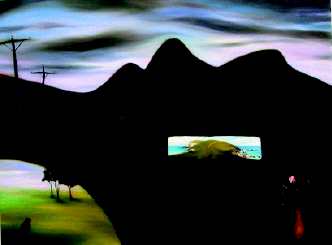
LIZ ABBOT Rear Vision 2005 Oil on linen, 1010 x 6550 mm.
Works such as Rear Vision offer a lingering gaze rather than a glimpse, which is facilitated by the smoother style. The view through a car's rear view mirror appears as a sharply defined horizontal rectangle floating disembodied against the landscape. The passing of time is suggested through the contrast of what is seen behind and what lies ahead. Here a vivid green verge with a pathway leading to a lighthouse are being left behind as the car approaches the damp black/brown hills ahead. One feels the desire of wanting to return and lie in the sun on the grass or perhaps to explore the mysteries of the lighthouse rather than to continue on into the darkness towards home.
The artist's focus on the transitory periods of dusk and dawn leads the viewer to develop an awareness of the passing of time and of our lives as a series of perpetual journeys with uncertain destinations. This is also apparent in the artist's portrayal of flowers throughout the work. Some are in vases while others are suspended against a dark background - roses partially in bloom and dandelions letting their new seeds spread out into the darkness lead one to reflect on the nature of life's passage. Abbot situates herself in relation to this body of work when she depicts herself floating, weightless in a sea of flowers. Even though she is partially submerged in a swirling purple/red ocean with arms spread, she embraces the stormy sea calmly, seemingly confident that it will keep her afloat.
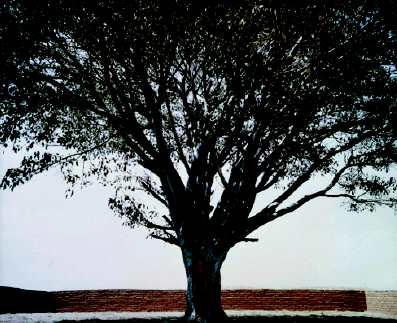
SHIRIN NESHAT still from Tooba, 2005
Shirin Neshat' s thirteen-minute long film Tooba, currently showing at the Dunedin Public Art Gallery, challenges the viewer to see the world in opposition. Neshat's film is divided between two large screens so that the viewer enters the darkened space and may select their own vantage point from which to view the work. Viewers had differing ways of dealing with the two screens which are placed directly opposite each other so that one looks from one screen to the other throughout the duration of the film.
Initially the two screens are divided creating contrast between the body and the land as one screen slowly pans back from the artist's closed eye to reveal her face and in turn her body clothed in black and embedded in a tree. The tree is surrounded by a brick fence. The second screen pans across parched hill tops and gradually the viewer becomes aware of black figures emerging from the top of the screen. These figures clothed in black, sweep across the hilltops like an infestation either fleeing or desperately seeking asylum. As the pilgrimage nears the tree a circle of chanting worshippers appear and reappear becoming more frantic as the figures reach and finally climb the fence and surround the tree. The woman inside the tree vanishes or becomes one with the tree as the figures approach, the two screens then briefly meet portraying the same scene.
Neshat is known for her photographs that draw on ideas relating to Iran, her country of origin, and her relationship with her heritage as an exile. Those that are familiar with Neshat's photographs of bodies, inscribed with text and alluding to violence and those without voice, may see her new film as compellingly unique. Here she addresses a new and much broader audience employing the use of music and delivering universal human themes. The visual environment provokes inclusion despite the fact that there is no spoken language in the film. Viewers are left to find their own meaning. Tooba is the vehicle for the narrative that questions ideals surrounding gender, cultural conflict and the universal struggle for power and land.
The sacred tooba tree is discussed in the Qur'an as providing shelter and shade, food and clothing to all who seek it in Paradise. The garden is a recurring symbol in Persian art and like the Garden of Eden represents a spiritual need for an otherworldly Paradise. In Women Without Men author Shahmoosh Parsipour writes about five women coming to terms with what it is to be an Iranian women in the 20th century. In the face of gender inequality the women decide to leave the world of men in search of a magic garden where time stands still and where one of the women plants herself in the garden as a tree. Neshat is said to have been inspired by Parsipour's story of women struggling to find their own identities who finally find happiness in a garden Paradise.
The longing for an 'elsewhere', or unknown realm is explored in Fiona Lascelles Natura Stupet at the Blue Oyster Gallery. The Blue Oyster Gallery has recently relocated to a central Moray Place location and now occupies a space below street level accessible via an alley way. This site as well as the renovated gallery space requires the viewer to take the initiative to explore. Lascelles' exhibit was found through an opening in a brick wall leading down some steps to a cool concrete Paradise. A barred window allows a small amount of natural light to enter the dimly artificially lit and intimately small space. The work is at floor level requiring the viewer to gaze over it from a distance which makes it difficult to take in the miniature world created by the artist. The work is inspired in part by a pathfinder mission to Mars in July 1997, when images were taken that revealed areas in which a similar spectral signature to chlorophyll was identified.
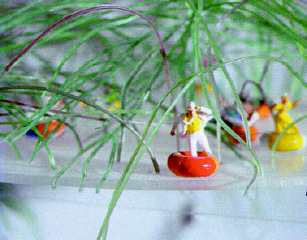
FIONA LASCELLES Natura Stupet - detail 2005 Installation at Blue Oyster Gallery
Here Lascelles creates an artificial world on an environmentally barren and wasted planet surface - the gallery's concrete floor. The work overall appears from a distance as a kind of science experiment where grass like specimens form networks fastened by robotic clear perspex arms. The game of Space Invaders is referenced as a framing device as vinyl shapes surrounding the work form the shape of a computer screen and alert the viewer to the 'score' and to how many 'lives' are remaining. On closer inspection for those bold enough to step amongst the work and get up close this work is more than just an interplanetary science experiment this world has become a holiday recreational destination for the rich and famous.
A number of saucer-shaped robotic forms on wheels have been constructed to support plant life - a synthetic natural environment where tiny plastic holiday makers take part in recreational pursuits such as gymnastics or lounge around on lilos sheltered by an exotic canopy of experimental greenery. Smaller constructs on wheels supporting plant life have been specifically constructed for mobility. One can't help but feel that this particular colonisation of an otherworldly Eden is overshadowed by the notion of inevitable exploitation.
One experiences Natura Stupet as simultaneously an explorer and voyeur, echoing the search for life on other planets the viewer performs this search - getting up close - taking notes - while also speculating on the activities of the natives. This feeling is enhanced by the miniature nature of the installation leaving the viewer feeling like some kind of giant stepping around clumsily, forming conclusions and making judgements when it is impossible to gain an accurate picture of what is really going on. This is where the success of the installation lies, as it requires more of the viewer than a mere glance, it demands that one becomes part of the work and this is facilitated by performing one's own exploration of the wonders of this otherworldly paradise.