
The Travelling Cartoon Show
Recent Work by Mark Braunias
SALLY BLUNDELL
Over the last three years a blue Toyota station wagon has pulled up outside some of the country’s major galleries. It has been to Auckland, Dunedin, Wellington, Christchurch, Titirangi and back to Dunedin again, offloading the material for a long one- man visual monologue that can be traced back to a five-year-old’s obsession for Donald Duck, or a teenage mania for MAD magazine, and has ended—or at least stopped over summer—as a vast tragicomic pageant of comic figures and cartoon forms swarming across the 151 square metre Big Wall at the Dunedin Public Art Gallery.
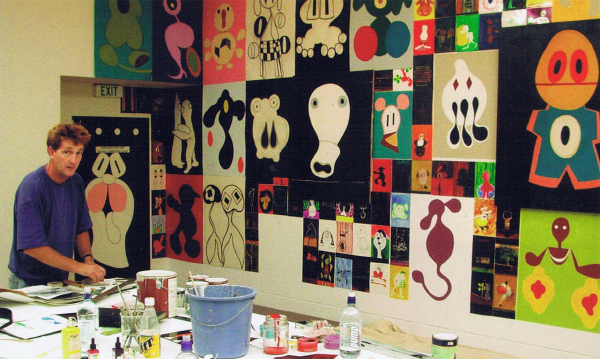
Mark Braunias working on The Cartoon Show, Auckland Art Gallery 2001
In 2001 Kawhia-based artist Mark Braunias contributed a large mixed media storyboard of comic characters on paper, acetate, canvas and board to Auckland Art Gallery’s The Cartoon Show. It was a significant exhibition, demonstrating the affinity between the skill of the cartoonist and that of the fine artist. For Braunias, it was an opportunity to explore his natural playing ground of drawing, figuration, comic art and abstraction.
The following year he was invited to be part of the Visiting Artists Programme at the Dunedin Public Art Gallery. The result was First-time Caller, a galaxy of caricatures of the lost and the lonely, the voices that call out over the late night talk-back radio waves. Small figures slipped in and out of comic pastiche, sketchy portraiture, and abstract shapes on paper, plywood and gallery walls. Their droll appearance and blank gazes caught all the pathos of the keen to please; wide-awake faces staring out at a staring gallery space—humanity at its funniest and its most despairing. As DPAG curator Justin Paton said, ‘What emerges is halfway between a chorus and a cacophony, a series of graphic calls and responses that pops into life on a work-bench and then unfurls around the room with a pratfalling, tail-chasing energy.’ (1)
In 2003 A Day in my Life appeared at Wellington’s Peter McLeavey Gallery—a formal installation comprising a grid of realist computer-generated caricatures (‘This a shot of me and this real hunk I met . . . , Hey, like wow, this stuff is like so wicked. I used to do Art too when I was living in Oz. Nude chicks and shit . . .(2) and The Table-heads, a cluster of flat plywood profiles, all curvy black hairstyles and wobbly eyes.
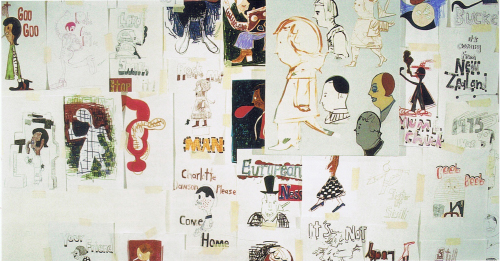
Mark Braunias’s My New Art God at Lopdell House Gallery, Titirangi 2004
This exhibition was followed by Recent Works at Christchurch’s Jonathan Smart Gallery—a swarming, teeming rabble of cartoon-type characters gathering like a crowd of film star wannabes vying for the attention of the movie director. They swelled in numbers, crossing the walls, circumnavigating the door frame, reaching up to the ceiling. Tacky driftwood figures sprouted like mushrooms from a mulch of paint and blank space. There were the Thumb boys in their comic cool (resurfacing from Braunias’ 1993 Praha series), the Girls for Free, the dumb arse work mates—self-defiant and self-defining. In a top ten of the boxing ring (Braunias is big on boxing, a long-time enthusiast),’ (3) ‘Roaring Bill Hammond’ sat at number one in a broadside at the art market, like Peter Davies’ 1997 ‘The Hip One Hundred’, reducing cliquey art to the shallow ratings game of a TV entertainment show.
Character was distilled, pared down to the most guileless of features. Art itself was honed down to the essentials of representation—the circle, the line, the minimal suggestion of a McCahon ‘I’, or Hammond’s dripping brush.
At the beginning of 2004 Braunias presented My New Art God at Lopdell House Gallery starring huge panels of sketched figures — a ‘slouched fraternity’ (3) sliding self-consciously before the viewer’s gaze. There were runaway cut-outs covering tables and floor space, My New Art God (a portly figure in yellow waistcoast and ballooning thighs — an upside down, ridiculous figure), and The Contenders, Braunias’ artist shortlist, the big name boxers this time with the Fact Files of a sporting rag (‘Peter Robinson — Height: Tall. Weight: None of your damn business mate’).
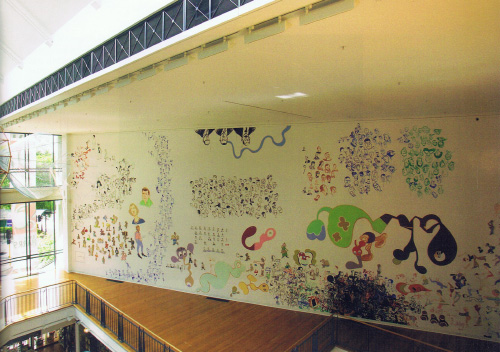
Mark Braunias’s Lemons and Rats at Dunedin Public Art Gallery 2005
In each of these exhibitions, the singular skill of the drawing artist, the sketcher, the caricaturist, was the genesis. What happened after that was a wild, robust fecundity.
Figures seemed to procreate in their own genetic pool of ink and twink and computer-generation, oils and acrylics and 3D plywood cut outs. Defined by the economy of line, the laconic style of the comic artist, they floated in their comic book-style frames, strung up by their own pencil lines, their own sad bylines.
Down on the Big Wall, after three years of mixed media installations, the medium is paint, the canvas a sheer cliff of wallspace. It is a grand swathe of paint, where brushstrokes mimic pencil lines, biro scribbles and felt pen doodles, where cartoony dots and sketchy curves spell out the small jokes and gaffes of human nature. It is a comic artist’s drawing board, blobs and lines and pithy calligraphy rallying across the gallery space, pushing a confluence of form and abstraction in cheery human guise under the noses of those used to having their art neat.
This is Braunias the artist, looking at the looked-at in a never-ending hall of mirrors. This is Braunias the office man, sleeves rolled up, filling his blotter pad with a crowd of faces, phrases and the deceptively easy loops of distracted pen work before smoko.
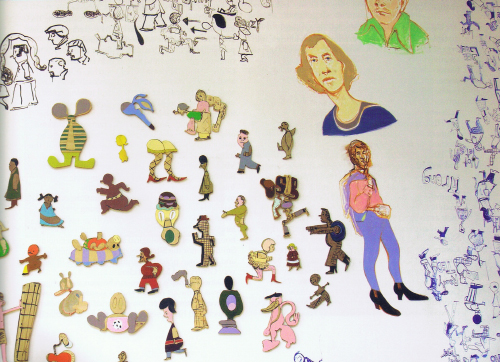
Mark Braunias’s Lemons and Rats at Dunedin Public Art Gallery 2005
Here then is ‘70s New Zealand: walk socks and sandals, a kind of prim dorky boyishness and plump glee. The cool guys, the pretty girls, the trussed-up curvy matrons, all bulging calves and coiffured hair, clown feet and rounded jowls, self-seeding in a weedy mass of irreverent imagery. It is a small town multitude, bringing to mind the words of Philip Larkin:
The fathers with broad belts under their suits
And seamy foreheads; mothers loud and fat
An uncle shouting smut; and then the perms
The nylon gloves and jewellery-substitutes
The lemons, mauves, and olive-ochres that
Marked off the girls unreally from the rest.(5)
The figures here, tripping gleefully or standing uncertainly as if still under construction—these too are marked off ‘unreally from the rest’. They are small identities, clinging to a raft of approved stereotypes, where each line, each dot, each self-conscious pose adds to a personification of art itself that is woefully, brilliantly apt.
The result is an infestation—a cast of self-made men and women, small allegories of suburban society, of Jims and Susans, of artists and curators, sketching out their own guises in a strange act of self-creation.
There are the gallery guards, the square-nosed girls, the overweight company men. The figures are droll, their dash to the lemming cliff (‘Action is consolatory,’ wrote Joseph Conrad. ‘It is the enemy of thought and the friend of flattering illusions’) (6) a mad, sad act of self-destruction.
Braunias captures the banal style of the masters of comic art—Robert Crumb, Bill Elder, Philip Guston—at his raucous, riotous best. Here is the slapstick—the foot and the oversize bottom, the clichéd phrases, the excruciating posturing of a Ricky Gervais. And here too is an older, less commercial tradition—the effete Frenchman of nineteenth-century European illustration, the blithe buffoon, the foppish gentleman with his effeminate sensibility: the pointed toe, the bulbous torso, the chequered cloth of the society dandy.
Take Gavin. Gavin from Gore. A genial-looking guy in a too big shirt and no shoulders, stripped down to the lines of the comic form. In this one dogged bloke there is all the cringing, self-deprecating self-consciousness of the subject. The looked at. The viewed. All the raw uncertainty of the man caught in the spotlight of his own clumsy disguise.
Braunias has long caught this straight-up front-on gaze of the poser, the unseeing stare of the looker-on. He has prodded and poked around national identity in his series of paintings on the ANZACs and the All Blacks. He has looked down binoculars and telescopes and rifle shafts to see what we see, then turned to stare right back at the viewer, bug-eyed and curious. The resulting images shift from the abstract to the figurative and back again, from the bright gloopy amoebic shapes to the cutesy ‘wuv-me’ gaze of the unassured.
According to the American writer Linda Yablonsky: ‘First you laugh. Then you wonder why. This is the one-two punch of humour in art today, where laughter is nervous but never cheap, and comic turns are but the gateway to a world of doubt.” (7)
Humour in contemporary art is loaded with irony, self-doubt. It scores away the academic waffle and po-faced gallery orthodoxy to show us something raw and unfeigned and deeply embarrassing. The primitivism of the comic form is an exercise in clarity and truth, a type of human veracity implicit in the drawn line of the artist. Here on the Big Wall, human character is an extension of the line, the amorphous blob. When the lens zooms out (there is a pair of binoculars across the landing for viewers who want to zoom in) the big puddles of paint look like the primordial goo of life on this planet, the speechless thought bubbles of comic art. Around this the figures float, a relentlessly chirpy cast of winners and losers popping down from the ceiling, posing in a standard grid formation, sliding down into the trash (a dark tangle in the foreground of the wall, a reject pile of human and artistic ‘failures’).
In each of these exhibitions art is subject as much as medium. The art viewer is the observed as much as the observer. And the gallery, usually the public space for the finished ‘product’, reveals all the disorderly conduct of the studio (including the inevitable erasure—in March the artist returned to help paint over the work in an ungallery-like gesture of total defacement).
For many of these exhibitions the artist worked after hours, in the subversive act of painting on gallery walls when the doors are locked and the blinds pulled down. Lemons and Rats, however, was a very public exercise. Braunias had to work on scaffolding before a school holiday stream of upturned faces watching the progress of The Artist (the large myopic eyes, the nervous glances, the blank full-on stares—they appeared on both sides of the paint). And nothing is wasted. In various stages of drawn-ness there are the ideas, the ‘finished’ forms, the altered shapes, the mistakes ejected mercilessly from the nest.
Jack Kerouac put his pen to a long, fast torrent of thought that would have filled whole blocks of blotter pads. Mark Braunias uses a paintbrush, pares down the thought, peels away the extraneous matter and fills a wall with the essentials of character, figure, form. He has taken the shorthand of comic art—the drawn line, the humour, the gushy Hallmark card idiom, the stock characters—and translated it into paint. Using the unfettered freedom of a Friday afternoon blotter pad, he has mapped out an artform of cartoons and calligraphy, all blended into a great spreading, sprawling whole. Lemons and Rats is a grand comic satire on art and society, celebrity worship, product placement and the contrivance of cool. It is a stream of visual wit that takes the conceit out of Georg Baselitz, the grungey, apocalyptic drama out of Philip Guston, and imbues the comic form with —human vulnerability (the buttoned up shirt, the , preloved phrase). It is a visual story of art and artifice : told with the simplicity of a curved belly, the silliness of a fat man fleeing.
1. Justin Paton, Nationwide Overnight with Mark Braunias (News and Sport Half-hourly), Dunedin Public Art Gallery, Dunedin 2002.
2. Mark Braunias, Digital Drawings by Mark Braunias, in association with the Peter McLeavey Gallery, Wellington 2003.
3. Mark Braunias, in an interview with the author, 25 November 2004.
4. Bronwyn Fletcher, Art Gods and Underdogs: the Tragi-comic World of Mark Braunias, Lopdell House Gallery, Auckland 2004.
5. Philip Larkin, ‘The Whitsun Weddings’, in The New Golden Treasury of English Verse, Macmillan, London 1980, pp. 486-488.
6. Joseph Conrad, Nostromo, J. M. Dent and Sons, London 1950, p. 66.
7. Linda Yablonsky, Editorial, ARTNews, September 2004.