
Exhibitions Dunedin
PENNIE HUNT
Artists against Aqua Is As: Landscape as Metaphor Gregor Kregar
The decision by Meridian Energy to scrap Project Aqua, which sought to develop the lower Waitaki River as a canal system for hydro-electric power supply, must be a cause for celebration for the participants involved in Artists Against Aqua. The group show, that ran late last year at the Forrester Gallery in Oamaru and was afterwards reconfigured at the Temple Gallery, Dunedin in November, was indicative of the range of issues and feelings surrounding the project which were publicly and vociferously voiced, particularly in the local media.
The history of protest art in Otago is a strong one. In the 1980s the artistic core of opposition to the proposed aluminium smelter at Aramoana produced an impressive array of works synonymous with a powerful political voice, among them Ralph Hotere's now iconic Aramoana series. Artists Against Aqua featured works by several of the seasoned art campaigners, some of whom were involved with the 'no smelter' protest and before that in demonstrations against the Manapouri hydro-electric dam - contributors included Cilla McQueen, Brian Turner and Marilynn Webb.
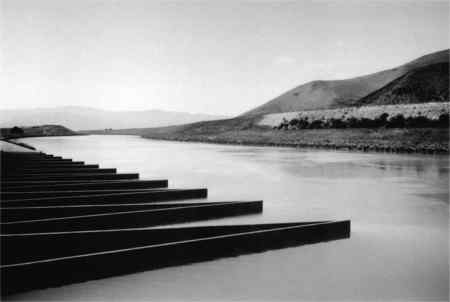
WAYNE BARRAR Across Spillway On Ohau Canal 2002 (printed 2003) silver gelatin print framed size 662 x 835mm
Organised by Oamaru artists Mary Horn and John Mitchell, the show's premise was brief: artists were simply asked to elicit a response to Project Aqua or alternatively, to mark a celebration of the Waitaki river. At the Forrester Gallery the stout front room was lined with works, among them Ewan McDougall's Merdarin the Waitaki, 2003. The work educes a pun on Meridian, suggesting an injurious attempt to strangle every last drop from the channelled tributaries of the riverbed. In McDougall's work the Meridian executive is shown as an amped-up power junkie, lit by floodlights whilst in the foreground, beside the proposed canal-rendered here as a deep black slash dissecting the work, a figure poised with his fishing rod in hopeless pursuit.
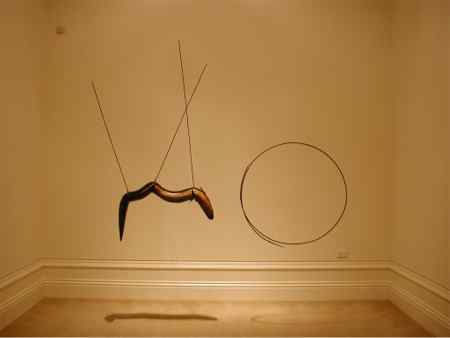
BING DAWE Spring Creek - (The Waitaki River) 2003
In a separate room two large-scale works by Bing Dawe and Ken Laraman were effectively offset. Dawe's Spring Creek - (The Waitaki River) 2003 is a work at once beautiful and quietly shocking. Depicting a large, thick-bellied eel slung limply beside a steel arc, the loose circle evoked a conduit for water, the tunnelling of what is perhaps our most precious commodity. Dawe's work is a metaphor for the vitality of the river and by extension for life itself, evoking the ways in which we treat the land that both sustains existence and generates it. Opposing Dawe's work was Laraman's Oh Shit! (2003), an installation comprised of 72 plastic bags in which clods of dried cow dung were sealed, specimens that were pinned up the length of the room's 16 foot wall. The comedic nature of the piece was highlighted by its gross ability to suggest the trapping and containing of nature and raised concerns about the pollution of the Waitaki River and Valley as well as issues about water usage, irrigation and farming in the area.
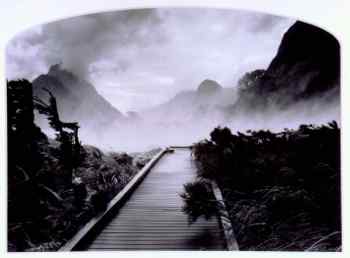
WAYNE BARRAR Beneath Bowen Falls To Mitre Peak, Fiordland 2000 (printed 2003) selenium toned silver gelatin print framed size 530 x 429 mm
Other artists chose to meditate upon the beauty of the Waitaki, to consider the impact of damming and channelling. Marilynn Webb, whose works recently featured in an exhibition at the Otago Museum and in the touring show Six Artists in Doubtful Sound, contributed The Waitaki River - The Sound of Weeping Water, 2003. The work, a mandala cleaved by liquid offshoots, issued a lament that contemplated the destruction of one of New Zealand's great braided riverbeds. Similar issues of human impact were expressed in Peter Cleverley's Bread and Water (2003). As the title of the work suggests, existence can be pared down to the most basic and necessary of things, thereby lessening our effect on the land. In front of layers of moon-lit acid green sky, the deep black of the hills of Kurow range are seen from outside the wrought iron fence of the cemetery, like a sinking meditation on the Waitaki. Here the new moon's effect on water suggested something hopeful, its cyclical pull infers that there are seasons in all things.
Though the Project Aqua issue has inspired more debate locally than nationally, the control of our natural resources is an issue for all New Zealanders. At the Temple Gallery in Dunedin the addition of works by local contributors, among them Ralph Hotere and Mary McFarlane, heightened the show's overt political charge. Hotere and McFarlane's paired pieces entitled What about the Waitaki Pete? (2003) utilised Labour Party campaign placards to address the works directly to the Minister for Energy and Dunedin North Member of Parliament Pete Hodgson. The artists overwrote the affirmative campaign message, instead demanding the right to an explanation for the implementation of Project Aqua and a justified response.
Artists Against Aqua was one of the most popular exhibitions yet staged at the Forrester Gallery and the wide-ranging interest the project stimulated in Dunedin made the works known to an even broader audience. Whilst Meridian chief executive Keith Turner felt it was 'no longer prudent or responsible to continue with the project' it was fiscal prudence that ultimately made the project untenable. Whether protest art alone can be affective in combating the agendas of serious corporate enterprise is unlikely, rather it serves to activate opposition, to voice a political conscience and to raise an awareness of issues - here the control of resources and consents, that surrounded Project Aqua.
Landscape was again on display in the first of three survey shows that Milford Galleries Dunedin ran consecutively with The Pre-Raphaelite Dream, works from the Tate Collection exhibited at the Dunedin Public Art Gallery. Entitled Is As: Landscape as Metaphor the first survey dealt with New Zealand artists' responses to the environment. Though less overtly political than the views expressed by some in Artists Against Aqua, Wayne Barrar's photographs shadow similar concerns. His images navigate environmental interventions - architectural placements that bisect the land with a conscious oddity. In Across Spillway on Ohau Canal (2002) the gaping sawtooth ridges of the canal's causeway contrast with the bare geomorphology of the land whilst in Beneath Bowen Falls to Mitre Peak, Fiordland (2000) human agency is exemplified by a boardwalk cutting through the bush floor. This is a path that leads us in and strands us at the foot of the great mountain, yet the familiarity of the view, seen in colonial sketchbooks and photographic prints, counters the evocation and grandeur of the sublime. Barrar tempers the drama of the landscape by showing the means of our access to it. Glass artist Ann Robinson was represented in Is As by two works, both leafy plant forms in which the glass, fat and heavy with its lead-crystal colour, seemed to capture the very succulence of nature itself. Her Twisted Flax Pods 12 & 13 (2003) are solidly cast vessels that diffuse tidemarks of light and hue in steady gradations. Whilst Robinson's work seems to preserve an observation, other artists dealt with their experiences in intemperate climes. In Garry Currin's work Landfall: Detail of a Journey (2003) gnarled skies sought to replay the relapses of light and shadow that shift over solid forms.
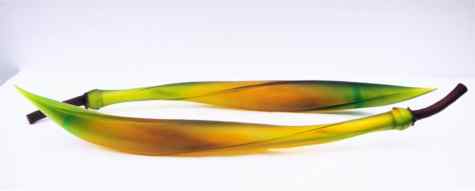
ANN ROBINSON Twisted Flax Pods #12 & #13 (2003) 45% lead crystal glass total size 160 x 1185 x 310mm
Bringing the human presence back into the landscape, ceramicist and sculptor Gregor Kregar's work I Appear and Disappear (2003-2004) at the Dunedin Public Art Gallery comprises a line up of clay figures fashioned after his own likeness. Created from a plaster mould of the artist, with subsequent castings and firings generating shrinking clay figures, the disconcerting array of descending duplicates spans the length of the gallery's front window, their glazed clay eyes seeing nothing of the Octagon spread out like an offering before them. Like the myth of Prometheus who fashioned the human figure out of mud into which the breath of fire stolen from the heavens was used to quicken life, similarly Kregar's clay castings, shaped from a raw and pliable ingredient were used to forge an array of artistic clones.
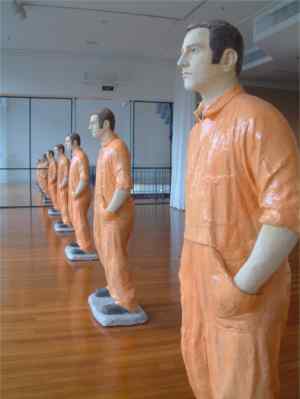
Gregor Kregar's I Appear and Disappear at the Dunedin Public Art Gallery
I Appear and Disappear is not Kregar's first show in Dunedin. Last year he collaborated with Glen Spencer in an exhibition at the Blue Oyster Gallery. Taking its title from Matthew 12:12: 'surely man is worth far more than a sheep' the artists placed 144 ceramic sheep in the centre of the room. As with most flocks, one' was barely distinguishable from another, so Kregar and Spencer intervened, clothing each with a brightly coloured woollen jersey. For the adorning of his own doppelganger Kregar has been far more modest, each figure is dressed quite simply in a pair of orange overalls, the garb of the proletariat or more recently of the prisoner. A recurring theme seems to question what distinguishes and indivuates us as human beings, are we just one in the flock or are we worth more?
The piece is a work in progress that Kregar hopes to finish for exhibition in Auckland later this year and one imagines that should the figures keep getting smaller they will gradually become formless and ultimately disappear. Were it not for the relics of their de-evolution, it would be as if the boon of fire that harboured their creation had never been and they had simply dissolved back into mud.