
Exhibitions Auckland
DENYS TRUSSELL
B.G. Lett: Head & Shoulders, Paintings & Drawings
This exhibition had much of the solid, but bony and angular strength expressed by the head and shoulders of a well-knit body. It also revealed some of the incalculable meaning that shifts across the human face; to be fixed as an image only by painters with sufficient discipline and instinct to see beneath the masks we make of self-possession.
The image of man in this century has suffered disintegration and kaleidoscopic reconstruction: a fact that is reflected in the wide range of styles that painters have developed to express the psychic rhythms of human subjects in the twentieth century. All these tell of the complex and multitudinous nature of personal identity in an environment of uncertainty. So it is good to see painters like B.G. Lett who can still insist on the formal wholeness of the human face without false sentiment or complacency.
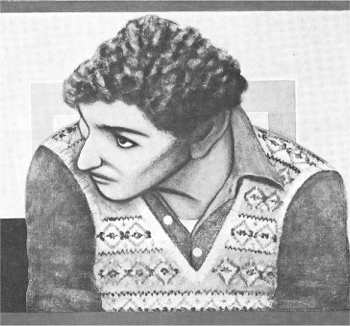
B.G. LETT
The Fair Isle 1978
oil on canvas on board, 635 x 670 mm
(Peter Webb Galleries)
Lett has strong predecessors in New Zealand. The portraiture of Rita Angus in particular shares with his work the effect of giving human character a high definition in space and time. But Lett's subjects have a very different poise or tension about them: they fight their way out of the two dimensions of the painting at angles that suggest they have long wrestled with the forces of dissolution. They are winning their way towards form and inner definition, and so still have the posture of battle about them. It is as if we see them growing out of the existential void into the recognition of their ineluctable personalities. In Rita Angus, on the other hand, character has arrived.
Few people are named: perhaps because they are phases in the struggle of one person, the artist. There is none of the complaisance and sang-froid that is always so fashionable socially. They are firmly wrought, and marked by the problem of identity. In a written statement the artist used the phrase 'a matter of identity', and I feel that sums up the content of the exhibition as a whole. It is a sincere affirmation of the features of humanity in an environment that tends to their obliteration.
These figures express varied attitudes to existence. Some are prophetic (No 9 and 10); others resonate with loneliness (No 5 and 7); others still are alert and quizzical (No 4). But all are strongly alive. One can sense the life that passes electrically through their bones and nerves: that is not reduced just by their being painted images.
They are stated against simple, monochromatic backgrounds. The simplicity is deceptive though, because these are not undifferentiated surfaces of colour. They are carefully textured, and not at all inert as far as the statement of the painting goes. There are pinks, yellows, deep-blues and turquoise - vivid surfaces that refract the person in each painting. Mood and the quality of inner experience is suggested by these colours: they too are emblems of a deeply-felt condition. If nothing else these colours stand for the feelings of time and space that exist in the figures of the paintings. Background is literally the space the figure occupies, and Lett's figures dwell in regions where little else intrudes to fill infinity. They are statuesque, almost sculptural, by reason of the manner in which their strongly-dimensioned features spring from a space without dimension.
In his drawing Lett seems to be able to control strongly-differing styles. The full romanticism of the girl's head (No 20) contrasts markedly with the angled head of a man (no 18): yet both are successful in their own terms, and though their moods are opposing, each has its singular poetry. Certainty of line is hard to achieve, but I found most of the drawing painstaking and positive.
There are influences: Rouault, McCahon, Fomison, even Picasso and Matisse. But these are assimilated and turned to account. They are teachers, and this pupil is a learner, not a mimic. He has thought deeply about style and found therefore a way of shaping concern for the human person that is very much his own.