
Exhibitions Auckland
JOHN TARLTON
Rob Taylor
George Baloghy
Rob Taylor, winner of the 1978 Ashburton Art Society Centennial Art Award, is a prolific and ambitious (if only in size) painter: an oil-paint gymnast who bends and manipulates his canvas into active swirls of colour, movement, and symbolism. Taylor apparently leaps the problems of varying scales (ranging from post-cards to full wall murals) in a single bound: usually, and commendably, landing on his feet. His long-confessed interest in archaeology and natural history is evident in the artist's choice of colour, compositions, and content. Taylor's paintings have been referred to as 'kaleidoscopes of colour', a reference justifiably reinforced by the major painting on display, Terricolere. Here Taylor has combined oil and enamel paints to produce a five panel, full-wall illustration of abstracted tissues, fissures, and stratas of earth and sky elements. Technically the panels incorporate both subtle areas of detail and bold, unrestrained slashes of colour. Some of the paintings where Taylor has deliberately limited his palette in order to concentrate upon form have much in common with paintings by such artists as Orozco and Rivera. This can be seen in the handling of jungle-like composition in Greenscape Journey; and in an excellent pencil drawing entitled, Stripping the Skuttle. In other paintings, Taylor concentrates upon form by silhouetting his colourful twists and turns in fields of over-painted white. The larger paintings are the most impressive. It is unfortunate that more of these mural-sized works do not find a place in public and private buildings.
GEORGE BALOGHY
Peter
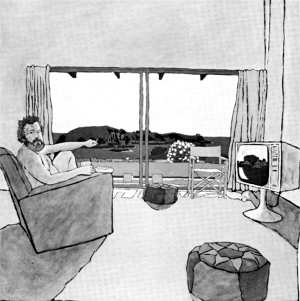
acrylic on canvas, 1130 x 1380 mm.
(Barry Lett Galleries)
Gordon H. Brown summed up the fourteen paintings by George Baloghy as ' . . . a good example of art feeding off art'. This observation, I feel, the critic would like us to take in the negative. However, to my way of thinking, the favourite food of 'art' has always been itself: the aesthetic snake devouring its own tail. If it wasn't for Leutze's Washington Crossing the Delaware, Larry Rivers might still be waiting on the pier. Baloghy is an eclectic: but the eclecticism is openly and positively used.
Through compositions and styles based in Pop, Baloghy's paintings cover anything from pencil, rubber, and 'art marks' to tongue-in-cheek evaluations of national and international states of affairs. Baloghy seems to drive familiar roads, yet somehow manages to use different exits. To Baloghy no artist, whether local or international, is allowed to own a motif. In Peter, David Hockney's 'deliberate naivety' has been delightfully injected with Baloghy's interpretation of the New Zealand landscape. In Questions of National Importance, three Magritte-like bowler hat-clad nonentities take their inferior position within a grid where sheep predominate. The two dimensional, flat fact of easel painting is hammered home in Warning: This Painting May Be Shallow. If we are to accept Jim Dine's saying that 'Pop is concerned with exteriors', then it seems only natural that Pop is also surface, or as Baloghy sees it, shallow. To further the quality of flatness, Baloghy employs wide, solid areas of colour overpainted upon grounds of black. By leaving areas of raw canvas borders on his paintings Baloghy never lets us forget the fact that easel painting is two. dimensional and surface. Baloghy is a young painter with wit, imagination, and technical ability. And if ours is 'essentially a tragic age', someone has thankfully forgotten to tell Baloghy.