
Exhibitions Dunedin
PENNIE HUNT
A new exhibition venue has been slowly evolving in Dunedin over the last few months. 82 Bond Street Contemporary Art space opened in May with a performance and exhibition by Otago Polytechnic Artist- in-Residence Ian Balch. A stunning introduction to the gutted space, Balch had an orchestra play in the dismantled lift shaft as the audience upstairs surrounded the discordant cavity. Fashioned from the industrial shell of the Donald Stuart building founded in the mid-1880s, the space (which is still a work in progress) was until quite recently the home of Dessford Tea, importers of Ceylon's finest; blended, packed and sorted on site. Though the building has had other associations; it was quarters to a lawyers agent, a wine and spirit retailer and even the Belgian consul, from 1916 its primary function has been as the distribution base of tea merchants providing succour for the morning and afternoon rituals of a Victorian city.
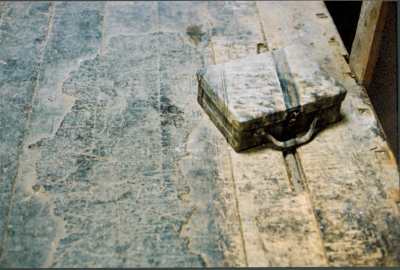
IAIN CHEESMAN & GARY MCMILLAN Case 2003
Paying homage to colonial tradition and to the history of the space in which they exhibited, eight contemporary artists, all of the Otago Polytechnic ilk, assembled an exhibition entitled Tease. The obvious pun was deployed as a working metaphor used to negotiate the on-site connotations of tea importation and distribution.
Sourced by necessity or desire and shipped from the East, Ana Terry evokes tea's journey of passage in her work Out of Order. In the door of an old wooden wardrobe studded with small electrical capacitors embedded like crusty barnacles, a video porthole provides the vacillating viewpoint from the rig of a boat. Tracing the passing sea below, the camera's point of convergence is untenable, abdicating the possibility of charting the aqueous. Once it had arrived at port the tea was perhaps then shunted someway further by train and the small hinged wheels of Terry's displaced object are derailed from their accompanying toy tracks leaving the vapid closet stranded, awaiting further repositioning.
At Bond Street tea was repackaged, boxed and subtitled as the beverage of the nation. Exploring notions of packaging and containing, Di Halstead's Cosy is a teapot crocheted from recycled supermarket bags and bears the remnants of an appropriate 'New World' logo. Cosy is more like a sieve than a vessel, a strainer that filters diffuse embers, reading the detained leaves for portents of the site's future and its past.
Accompanying the work were two C-type handprinted photographs entitled Night and Day. In these Halstead draws together opposing sides of the space, appropriating the flowered grid from the painted window in the opposite corner of the room, once itself a window on a small tea room on the building's top floor. Evoking the passage of time through change and decay the photographs are similarly interlaced with site specific meaning yet overlaid with a purposeful grid, much like the lines of an architectural plan imposed on the changing space.
Several of the works evoked subtleties of space, ameliorating their reactive function with trompe l'oeil artistic devices. Ruth Cleland adhered her photographs directly onto the squalid brick walls. Wall and Lino are the best examples of how these photographs parallel their supports. Cleland's images were easily overlooked, though once noticed they drew attention to the surrounding decay, the spoors of damp and the odd features of the disabled space.
Likewise Iain Cheesman and Gary McMillan's small case was almost lost in the large room. Guided to the object by the soundtrack it encased, the work made an impact at first through loud sampled dialogue excepts giving rise to ghost-like memories of sound, time lapses of industrial parley. Painted in McMillan's typically realist style, the suitcase easily fused with the punctured and dusty floorboards like a squandered tea chest. Adding a final touch of whimsy to Tease, Ana Terry filled the crumbling brick and stone wall cavities with sugar cubes, the cup of tea's natural condiment and a final cursory comment on the notion of the white cube gallery.
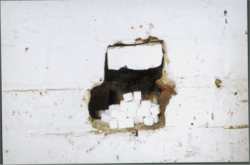
ANA TERRY Cube 2003
Over the course of a lifetime a person might make hundreds of images, placing the camera between themselves and their experiences to create clean palettes of time. Like visual cues to aid cultural memory, the breadth and scale of Gary Blackman's Survey at the Dunedin Public Art Gallery exemplifies over half a century of image making. Blackman's contribution accounts for a fascinating record of Dunedin people and places, the historic and the modern.
Blackman's career as a contemporary artist began in the 1950s when he started exhibiting with 'The New Group' whose members included the sculptor John Middleditch and wood engraver Rona Dyer. During this period Blackman was showing paintings, prints and drawings. Photography came secondary to these pursuits and certainly subsequent to his profession as an Associate-Professor of Pharmacology at the Otago Medical School.
Later in the 1960s Blackman was active in the Visual Arts Association which initiated dialogue on contemporary arts in New Zealand at a time when public collections were focused on procuring works from abroad. The Association organised lectures, encouraged group shows and fostered an interest in design - scouring local retailers for everyday objects from cutlery to sewing machines to exhibit in the Otago Museum Foyer.
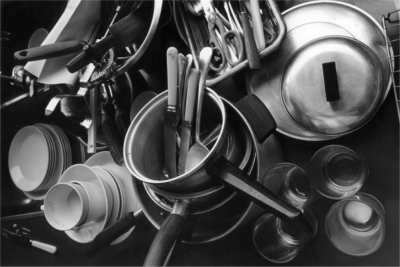
GARY BLACKMAN Dirty Dishes
Dirty Dishes (1977) expresses something of this interest, a composition at odds with the formal order of Blackman's traditional architectural studies which have a weighty presence in Survey, and more like the assemblage of a cubist tabletop, mostly tilting surface and shallow depth. At the Museum Foyer the group were instrumental in establishing contemporary art exhibitions, fostering the emergent careers of lesser-known exhibitors - among them the young Jeffrey Harris, whom Blackman has captured seated in front of one his first shows in a 1975 gelatin silver photograph.
Having associated with Charles Brasch, a fellow member of the Visual Arts Association, Blackman regretted not having asked to photograph the patron's home before its contents were dispersed to local institutions after his death. Subsequent requitals were made in images of other important Dunedin personalities, historical documents which testify to the extraordinary cultural life of a small New Zealand city. Brasch's friend and fellow patron of the arts Rodney Kennedy, immortalised by Brasch as the playful Puck in his poem The Estate is framed at home in Blackman's photograph, within the literary recession of his bookcases, his expression conveying a haughty acquiescence with the photographer's presence.
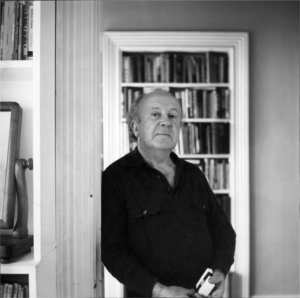
GARY BLACKMAN Rodney Kennedy, 28 March 1975 Black-and-white photograph
Photographs of photographers feature too, among them Peter Peryer, Adrienne Martyn and the prolific Dunedin photographer and author Hardwicke Knight. Knight is shown in his old bayside crib, a space confined by the accumulated pursuits of a lifetime and perhaps standing only by virtue of these eclectic props. At odds with the dirt floor and driftwood furniture of Knight's home, Blackman captures an antique French clock perched in front of the pottery of Michael Cardew, an acquaintance of Knight's before he emigrated to New Zealand in 1957.
Documentary portraiture is a genre Blackman has mediated, exposing the photograph as an embalming memento. Nowhere is this more telling than in the photographs of the Home of Patricia France, taken two days after her death in 1995. The Vermeer- like attention to detail of France's home is revealed in colour prints effused by natural light. The poignancy of absence is felt in Noticeboard where the usual things, a takeaway menu, a taxi card, are tacked up along with a Presbyterian home support order, photos and a note from Jeffrey Harris and a poem entitled 'After Death'. The photographs in the show are great in number and subject yet reveal an acute vision. In a sense they are personal effigies that chart a life and offer speculative participation in a sentient past.
In honour of Joanna Margaret Paul the Marshall Seifert Gallery assembled a show comprised mostly from works loaned by the artist's local friends, a tribute to the life and talent of a former Dunedin resident and Frances Hodgkins Fellow. Convening upon the small sun-filled gallery paintings and drawings characteristic of Paul's rare sensitivity and quietly patterned clamour were hung, converging to create smaller scale interiors within the space and revealing the treasured privations of the domestic.
Inside the painted interior of 22 Royal Terrace (1971) space is composed of a cusp between inside and out, the curved interior window is open, a periphery though which a triangle of porous light illuminates a recently vacated couch, covers adrift. In Paul's work, though people might be absent, their presence is always felt, as if they have vanished to shortly return and further attend to the solace of the scene.
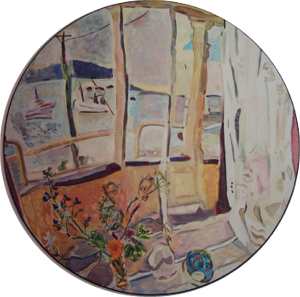
JOANNA PAUL Window, Kaikoura 1982 oil on board, 1010 mm diameter, private collection
Likewise in Window, Kaikoura (1982) occupancy is signalled by ordinary comforts. An unruly bunch of flowers is yoked awkwardly by its vase, restricting defeated limbs curling toward the window's light and a paua shell sits atop a table behind which the observer, from high alights. Often described as a domestic artist, Paul's work is not confined by this, rather it observes materiality wrought through with an intimacy touched by life.