
Memetic Field Trials
Christchurch's SCAPE 2002
MALCOLM BURGESS
It's publicly funded, privately sponsored and has no qualms about biting the hand that feeds it. It thrives outdoors, infesting the hardiest of gardens and flowerbeds. It can be so tiny you need a naturalist's eye to spot it against a mahogany background or in a tropical conservatory - and sometimes so resource-hungry, it outstrips the wherewithal to reach its projected size.
A menagerie of public art escaped en masse into Christchurch-at-large at the beginning of September 2002, and won't go back into the studio. Although SCAPE - aka the Art and Industry Biennial 2002 - was scheduled to end in late November, many of its carefully cultivated specimens had irreversibly jumped the species barrier at the outset. They invaded good, old-fashioned institutions - with their full complicity, let it be said - championed by everyone from small business owners to giant funding bodies.
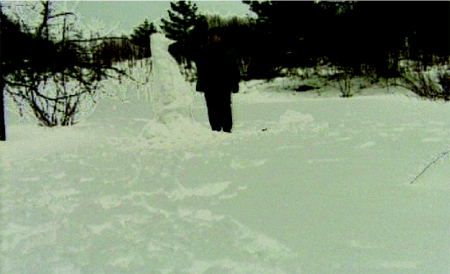
ANY LEHTONEN Shovelling Snow 2000 Video tape: looped
With the blessing of so many usually antagonistic sectors of society, it is tempting to label it the 'third way' of art - some kind of cultural cure-all to bandage the excesses of a market-driven nation. At a glance, the featured works were all fairly tame - nothing shocking, decomposed or involving bodily fluids of any kind. Yet, as long as such objects contain no explicit criticism or controversy, ambiguity - often an effective tool for spawning public debate - can become a safety net behind which vested interests may hide.
However, this was no service animal, full of unstable and recessive genes. When removed from the 'sterile' conditions of the gallery and trialled in Canterbury's fields of green, the long-term effects would be anyone's guess. During the three months from September to the end of November, the seeds began to sprout, each at its own pace, with some dormant or already wilted by the time this reviewer dropped in. Although around half were from foreign shores, our own varietals managed to cross the wide spectrum of art on their own.
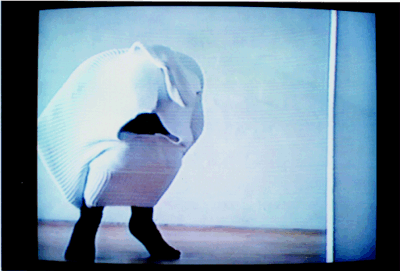
ERWIN WURM 59 Stellungen/59 Positions 1992 Video: 20 minute loop
Detailed classification quickly netted a broad cross-section of genera, with video-based lifeforms proving the most interactive and hands-on. These weren't always easy to find. Displaying throughout SCAPE's duration, they had more than enough time to blend into their surrogate environments, both mentally and physically. In many cases these 'Daleks' - video screens set atop a sponsor-logo bedecked dais - required manual reactivation by would-be scrutineers and were also spread far and wide. Orienteering for art may sound fun, but it's not exactly best practice to judge a work on how hard it is to find. However, that's not to say a dense infestation among Cashel Mall's purveyors of mainland couture didn't provide welcome relief for weary soles.
Symbiotic, subversive or sublime - how to define the relationship between the venue and the work. Did this form of art merely conform to existing counter-cultural advertising paradigms or offer something more? In a surveillance society you are likely to be captured on camera each day for almost as long as you watch television. But, for the unlikely scenario of actively looking for video screens within a commercial setting in the expectation of enlightenment, there are no statistics.
Yet nothing risked, nothing gained. Worthwhile window-shopping uncovered Lucy Orta's 'refuge wear', documented in the work Identity + Refuge. This centred on her 'transformation' workshops, which blurred the lines between clothing and architecture, as well as old and new food through the pickling process. This was further illustrated by her human chain - or 'Nexus Architecture' - in which community arises from a tube-like connection between protective suits, reminiscent of Hundertwasser's layered skins concept. High fashion wrought from old belts and gloves guarded the window display in a further shading of shop, screen and sculpture.
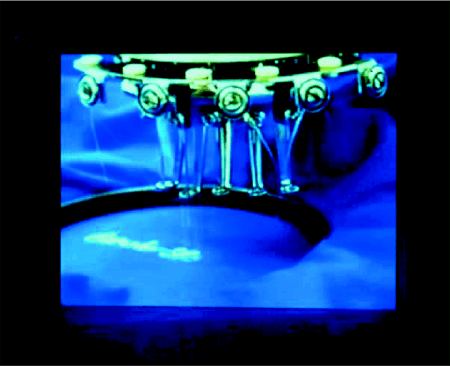
KATHLEEN HERBERT Untitled (Music Box and Embroidery Machine) 2001 Video tape: looped
Meanwhile, Kathleen Herbert's Untitled (music box and embroidery machine) meditated nearby on the mechanisation of creativity, and the way anticipation and uniqueness can be programmed into industry. Erwin Wurm's video triptych 59 Stellungen (59 positions) cycled through a veritable kamasutra of cardigans, in the jumper section of Christchurch's immortal halls of the aged, Ballantynes. Evoking thoughts of poultry carcasses, the cover of The Female Eunuch, Francis Bacon, and Dr Seuss's shy but empty green trousers, this Joy of Sex for jerseys inverted the unifying nature of fashion, highlighting instead how it can in fact deform the body. An innocent bystander said it best with the remark, 'Where is the head?' An enoyable still-life slideshow, it played counterpoint to his Flugsimulator (Flight simulator) in the window of a distant bank, which smacked of a European Jackass in its treatment of Schadenfreude of the self, and our willingness to act the part of crash-test dummies in both market-research and education for a future that never arrives.
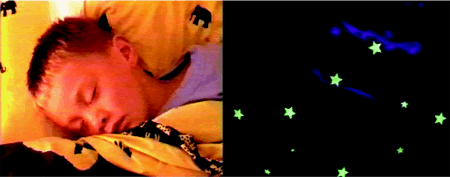
NATHAN POHIO Sleeper 1999 Two monitor video: looped
Around the corner snoozed Nathan Pohio's Sleeper, depicting a child in repose - alternating with a telescoping view of luminescent stars and the segueing of half-sleep into dream. Set before a bed for sale, Pohio's observations of a subject beyond the camera's control turned up the contrast on the clash between genuine consumer power and acceptable market variations.
Anna Lehtonen's Shovelling Snow plotted the matter-of-fact downfall of a young man and his subsequent religious enlightenment, from the vantage-point of an independent bookstore - an embodiment of enlightenment for sale. Over a film of a snowman being built (and played in reverse), the voice-over tells us of his drug dealing and prison conversion - all brought about by circumstance and a dearth of ego and romance.
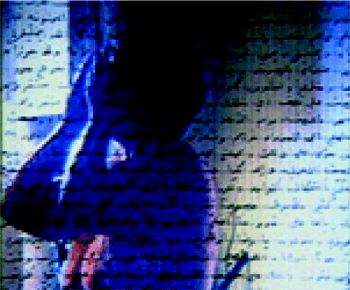
MONA HATOUM Measures of Distance 1988 Video: 15 minutes
Mona Hatoum's Measures of distance treated visitors to the public library to a layered exploration in which the artist's photographs of her mother showering, taken during a trip to Beirut, increase their bond in subsequent correspondence, yet open up a rift exposing the father's jealousy and sense of exclusion.
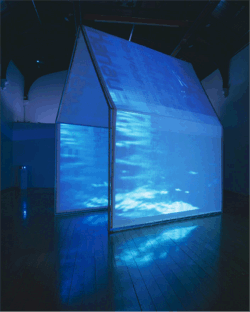
Whare 2002 SoFA Gallery Looped video projection onto tent structure (Image: Rachel Rakena, Mihi Aroha)
Centrally located at the SoFA Gallery, a virtual 'whare' set the scene for a formal collision between sculpture, architecture, video and stills. The 'Whare' itself found its inspiration in Sir Apirana Ngata's revival of Maori architecture in the '20s and '30s, and his quest for structures in which a more secular youth could shake off its fear of 'tapu' while retaining a sense of cultural place. Its situation beneath the Gothic spires of the Arts Centre is no accident - this was integral to Ngata's designs for modernising the whare runanga. The young artists of Maori descent, including Darryn George, Eugene Hansen, Lonnie Hutchison, Ngahiraka Mason, Maree Mills, Nathan Pohio and Rachael Rakena, use deliberations on the Maori fascination with the Western, the mobile whare, and the 'cybermarae' to build discussion topics for future cultural development.
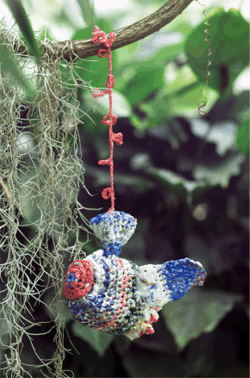
ANI O'NEILL Hamoured 2002 Raffia & recycled breadbags, various sizes. Shown in Cunningham House, Christchurch Botanic Gardens, 4 September - 15 October 2002. In collaboration with Rangi Ruru Girls' School
Ani O'Neill's experiments with introduced species drew on the assistance of students of Rangi Ruru Girl's School - in a marvellous parallel to Kevin Roberts' recent exploitation of South Auckland for the benefit of Nike. Making cutting edge art using craft skills passed-down from her grandmother, O'Neill populated a tropical conservatory in the Christchurch Botanic gardens with fauna and fungus fashioned from such material as bread bags and raffia, at times almost imperceptibly.
A rich and fertile location in itself, the inclusion of refuse-become-life combined with ideas of isolation, the pioneer spirit, and the fragile resilience of the biodome to extraordinary effect. The colonial overtones of the setting drew in facets of the mid-century European craftsman-as-artist, to evoke a time when commercial art aligned itself more to survival than a show of status or lifestyle.
Simon Morris chose the biennial to paint in plant-matter - using the biological time-scale as another axis of artistic expression. While his garden work Tilt and Grow confused the eye at first sight, his predilection for minimalism became clearer the longer the viewing, with repeat performances fuelled by natural growth and the changing of seasons.
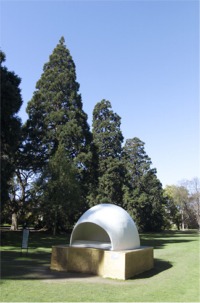
CHRIS CREE BROWN Aeolian Harp 2002 Concrete / ferro cement,wood & nylon, 5 x 4 x 7 m. Shown on the Archery Lawn, Christchurch Botanic Gardens, 4 September - 30 November 2002
Meanwhile Chris Cree Brown's sound shell and Michael Parekowhai's rabbits took to task the traditional concept of public art - the monolithic sculpture - with their various attempts to shoot at the moon. However, funding - like proteomics, the study of genetic expression - would appear to be either arbitrary or just poorly understood in this case. Like the tortoise and the hare, only one could win, if you could call it even that. Failure to raise $80,000 kept Parekowhai's plans for two 5m-tall Disney-like rabbits - Cosmo and Jim McMurty - at the maquette stage, with a slide show of his imaginings on show in the central visitor's centre. Fortunately, Brown's larger, but nevertheless scale model of his intended full-size walk-through Aeolian Harp enticed even the tone-deaf across the archery lawn with its siren call, kept in tune by the local composer and music lecturer's dedicated hand.
Considering the importance of the longitudinal study to epidemiology, Ed Osborn's Antarctic Images Project was a welcome chance to test its artistic application. In a room off Canterbury Museum's Antarctic display area, Osborn pitted separate timescales and perspectives against one another - aerial shots of vast tracts of icy terrain, a web cam depicting daily life and finally home movies. Instead of making the foreign seem common, details of the home movies soon changed all that. Experiments in freezing volunteers - presumably for hypothermia research - brought out the bitter taste of wayward science, amplified by the ceaseless cataloguing co-ordinates in the aerial voiceover. Orders of magnitude in such proximity brought forth Frost's concept of the end of the world (and the ends of the earth) in ice instead of fire. Behind this, the tendency of the poles to kill under the guise of preservation stared a chill smile at those with disposable income still hankering after the cryogenic dream of immortality.
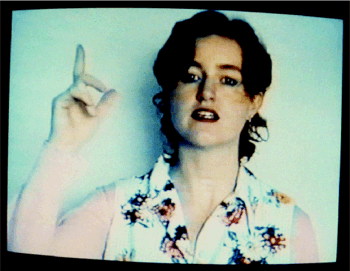
JOY HARDMAN Scrying 1995 Video tape: looped
Public art may well cross-pollinate with everyday objects, but it still uses that mainstay of artistic isolation -' ostranenie' or alienation. Pretending the gallery functions as a clean room for ideas ignores the way its blandness can intensify the effects of the inner landscape. Which leaves us to ask if ordinary objects were affected. Had there been any horizontal memetic transfer? If one meme - the semiotic equivalent of a gene - survives in the fertile Cantabrian soil, it is that while the tortoise may have won the race, the hare - or in this case his rabbit cousins Cosmo and Jim McMurty - is now a household name.