
Book review
Carved Histories: Rotorua Ngati Tarawhai Woodcarving by Roger Neich Auckland University Press, Auckland 2002NGAHUIA TE AWEKOTUKU
Nearly a decade has passed since the publication of Roger Neich's pivotal work, Painted Histories: Early Maori Figurative Painting, which challenged the accepted notions of Maori 'naive' or 'folk' art, and positioned the work within the context of Maori creative production and nineteenth century Maori and New Zealand history. After Painted Histories, the terms 'naive' or 'folk' seldom surfaced again in Maori Art History. By detailed examination of the surviving houses and associated objects, Neich outlined the development of a resourceful and transformative schools of figurative painting across several tribal regions; he concluded the study with the observation that the efflorescence of figurative painting actively devalued by a government subsidised programme to establish and maintain an orthodoxy in Maori art.
The roots of this orthodoxy were found in the genius and generosity of the carvers of Ngati Tarawhai, whose stories and taonga form the substance of this impressive new book.
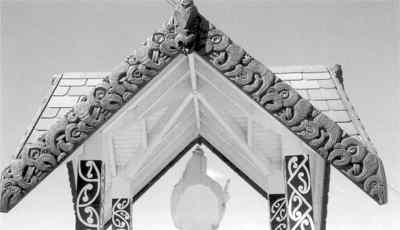
TENE WAITERE Maihi decorating shelter over the bust of Queen Victoria, Ohinemutu (Photograph: Roger Neich)
Carved Histories is astonishung for its comprehensive and thorough detail, its sheer density of reference and resource material, and its instructive and original methodology. Neich sets out to examine Ngati Tarawhai carving, by measuring its developmental changes and describing the emergence through the agencies of pakeha and later government patronage, of self consciousness in the artists themselves. Notably, he considers the contextualist dilemma of time, place and purpose; of Maori interests and pakeha; of tribal narrative and contained colonial, documentation. He achieves his analysis through a skilled combination of museum research on actual objects and artefacts, and careful investigative field work, on the houses and the living communities who are their proud stewards. Perhaps this is, the only irony of this magnificent publication-that it is primarily academic, written for the scholarly reader in a laden prose that most of the mokopuna find challenging indeed.
Lavishly coloured and black-and- white illustrations brighten and enhance the text, along with a series of excellent tables and summary diagrams, but its sheer physical and intellectual weight make it initially inaccessible, though the book has been eagerly probed and enjoyed for the pictures alone. Because it is also quite shamelessly Ngati Tarawhai-centric, there are a couple of minor inaccuracies concerning other hapu of the lakes region.
The Ngati Tarawhai carvers of the Rotorua Lakes district have been recognised as tohunga whakairo sustaining a distinctive style over many generations. Neich introduces them, and the book, in chapters on their early and more recent history, including their involvement in the Land Wars, and the actual identification, at that time, of individual carvers.
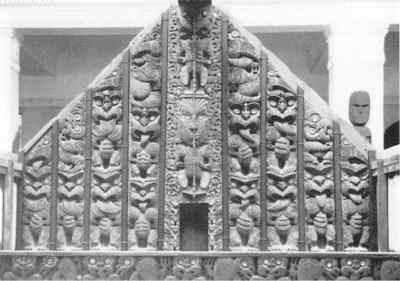
Porch rear wall carvings of Te Puawai- a- Te-Arawa storehouse from Maketu, carved by Wero in 1878-80 (photograph: Auckland Museum)
From this point, he discusses the art theory of woodcarving and questions the influence of a colonial European aesthetic on the indefinable but nevertheless undeniable existence of a Maori aesthetic. Neich considers art and beauty in one of the book's most provocative and engaging sections; and thus effectively stretches and warps the parameters of a Maori art history. He casts the word 'art' as an untranslatable European concept in the Maori language, and reflects on other writers on the subject. He also queries the manipulation of such words as 'tohunga', and 'whakairo', and anticipates the discourse on arts and agency.
Extending the contextualist dilemma, he brings into his argument such notions as the simple reality of how work was produced according to whether a carver sat on the ground or at a table, and where and when he carved. These ideas become particularly vivid and persuasive in his chapters on patronage, both Maori and European, historic and concurrent; there is also fascinating material about the exchange economy and the relative trade value of woven garments for carved war canoes in the pre musketry period. Neich describes a society in which art - storehouse then war canoe then meeting house construction - celebrated tribal pride and displayed tribal wealth to expand eventually and inevitably into the entrepreneurial environment.
Meticulous research and laborious cross referencing and comparison have contributed to a superb series of examples either confirmed or attributed to be the work of Wero Taroi, Anaha Te Rahui, Tene Waitere and Eramiha Kapua, to name a few of the carvers. Neich does not bypass them. He not only names them, but through their correspondence, Land Court Minute Books and people's memories, he reveals their personalities, their vulnerable and creative humanity, particularly in the tourist environment where voracious appetite for their work seemed both a curse and a blessing. Again, in the sections in which he discusses tourism and patronage, Neich is at his critical and probing best. The quaintness of portable souvenir objects - pipes, containers, walking sticks, dog-shaped bowls, tinder boxes, model (miniaturised) canoes and ornate canoe paddles - contrast markedly with the grandeur and elegance of pataka, large carved houses and ceremonial gateways.
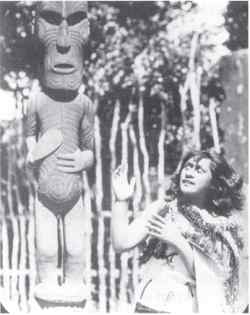
Maori woman performer posing with one of Tene Waitere's palisade posts at the Whakarewarewa model pa (Photograph: Museum of Victoria, Australia)
It is in this section that Neich reasserts his theoretical position on langue and parole, presented in an earlier chapter, and comments on the change from deep relief sculpted work to the two dimensional, heavily ornamented, flat surface work that characterized the tourist and later period. And this is reinforced in the detailed appendices that note the known corpus of Ngati Tarawhai woodcarvings, and also record the relationship of Ngati Tarawhai with neighbouring Ngati Pikiao carvers who are duly named, as are their houses. This prompts the question-is there a third volume, on Ngati Pikiao? I hope so.
Carved Histories is a book I recommend to anyone interested in Maori, Pacific or indigenous art; to anyone intrigued or excited by art theory; to anyone who has ever admired the rampant beauty of Te Puawai o Te Arawa, or considered the edged intricacies of a carved walking staff. To anyone who wonders about being Maori, being pakeha, being kiwi-being here; this is another perspective for you, and it is a significant one.
Heoi ano, e te kairangahau he rite tenei tuhikorero ki te waka whakarei e tau ana i te moana, tau, tau, tau atu ra.