
Temples of Wonder
Peter Wells Returns to Napier
ROBIN WOODWARD
One's first glimpse of Peter Wells' installation Temples of Wonder at the Hawke's Bay Museum is one of those unforgettable moments of magic. Framed tent-like by streamers of blue and white, Emilio Greco's Grande Bagnante III takes centre stage in the octagon, brilliantly illuminated by the dazzling crystal chandelier which has been installed above it. These two stunning pieces, jewels in the crown of the local collection, are revived, revitalised and re-presented in this, the second in a series of writers' projects based on the collections of the Hawke's Bay Museum.
Working to an open brief, Peter Wells chose to tell the story of his vicarious relationship with Napier, a city that fuelled his imagination, kindled hope and handed him a lifeline in the recesses of his past. He fossicked and foraged among the storage shelves of the museum for objects and items to illustrate the Napier of his childhood and his imagination. These he arranged in a series of eight diorama with a focal point of entry. A short film, Behind the Scenes, which addresses the processes and priorities of the piece, accompanies the work.
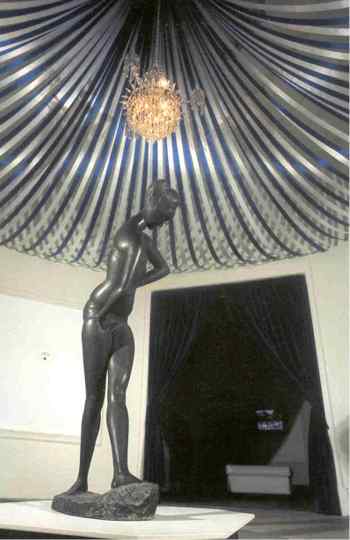
EMILIO GRECO Grande Bagnante III 1913 Bronze (Collection of Hawke's Bay Museum)
Peter Wells' installation bridges three centuries and three generations. Installed in 2001, it images his family and childhood in the mid-1900s and by extension, references his grandmother's life in Napier in the 1890s. For Wells it is a story of the public and the private, the spoken and the unspoken, of judgement and acceptance, a story of one's life and memory-a personal journey. But there is a parallel between the personal and the public. Museum and gallery collections document the broader path and patterns of society-including custodial vision. Wells' installation may be read as a personal museum and as such is subject to curatorial decisions and control. But as a point of departure from standard museum practice, in Temples of Wonder each diorama is accessed only through a spyglass-size peephole. Also, a museum diorama traditionally incorporates a backdrop and scenery to further the narrative. Wells chooses not to do this but to leave the connections open-offering viewers the opportunity to weave their own stories around the exhibits.
Through the titles of the individual dioramas, Wells addresses emotions that characterise a journey of self discovery. Moreover these fall naturally into pairings. Beauty and Success go together. Home and Ambiguity go hand in hand both in terms of exhibition items and in a narrative about one's upbringing. Applause follows (in relation to Home-for a job well done, or for rising above one's background) and with the ensuing pride, Snobbery slips in. Mollie (in Behind the Scenes) is part of that world-but she sees beyond it-Escape. Thus Wells tells his own story. But it is also a universal one, the more so in that we are left to fill in 'the space between'. Museums may be Temples of Wonder but it takes imagination and creativity to bring them to life.
Home is where the heart is - and for Peter Wells it is in Napier. And it is the Napier of his childhood - Napier of the 1950s with its ties to England, its Sunday painters and 'ship-in-a-bottle' hobbyists, its Summer Festival and its Carnival Queen. And - as always - there is the ever-present earthquake and the ensuing Art Deco. The Carnival Queen's crown in Home is that of the daughter of architect and engineer E.A. Williams who was closely involved with the rebuilding of Napier in Art Deco style after the 1931 earthquake. However the role of Sheila Williams (the 'New Napier Carnival Queen' of 1933) in Peter Wells 'hometown' doesn't end there. Hers was the funding which in the early 1980s established the Williams Gallery at the Hawke's Bay Museum, a gallery that focuses on the collection and display of Art Deco material. Seemingly fond memories of 'Home Sweet Home' - but was it all like this? What went on behind the scenes? Enter Ambiguity.
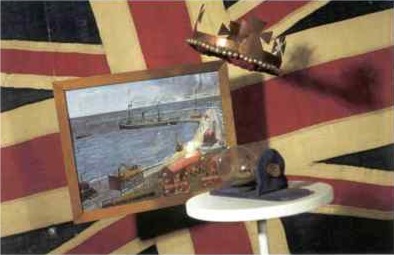
HOME (New Napier Carnival Queen's Crown, 1933; Ship in a light-bulb, date unknown, View of Port Napier, unknown artist, c. 1930, Union Jack) (Collection of Hawke's Bay Museum)
Ambiguity focuses on healthcare - and delivers a clear message that the cure may well be worse than the disease. There's a primitive looking tonsil remover amid an array of dental forceps, each one specially designed to remove a particular type of tooth. For the benefit of the uninitiated (or the student practitioner?) each one has the name of the relevant tooth engraved on the handle. The home remedy kit is completed by a midwife's apron, a mechanical massager and a First World War bullet-proof jacket - made of kapok. The bullet-proof jacket, aka the Chemico Body Shield, was an optional extra that well-heeled infantrymen could purchase to supplement their standard issue chainmail vest. Unspoken is the text that only the wealthy need apply.
The 'upstairs/downstairs' mindset that migrated with the British settlers, informs much of this narrative. Snobbery for instance is illustrated by its direct inverse - its maidservant. Pristine, white starched and handstitched maids' aprons gifted by the Misses Oxford and Oliver illustrate the servility sequestered by snobbery. Servility and slavery, companions in arms - or leg irons, as here. But just how to escape? Wells supplies three (or is it four) possibilities - a set of keys, a ladder, and the glorious golden locks of the fairytale Rapunzel. But if there is no such conventional means of escape, Wells offers us an alternative image - of a hardy gumdigger melting, teasing, twisting and turning a lump of Kauri gum into the delicate strands of little girl plaits tied up with bright red hair ribbons.
Themes of acceptance (of the whimsical) and celebration (of difference) pervade this installation - starting with the entrance octagon. In a cultural climate which has a pervasive bicultural agenda, Wells is grandly Eurocentric in the prizes he proclaims. And it is with a touch of humour that he lays claim to his choice in the very first of the peephole selections - the self-reflecting mirror of The Expert. In his own eyes, Wells may undeniably be The Expert but he is willing to share his title with any other participant in the panorama. Such assertions of subjectivity, choice and the essence of individuality are themes that consistently inform the narrative of Temples of Wonder. They are constantly contrasted with the checks and controls of society and the challenges of expectation and convention.
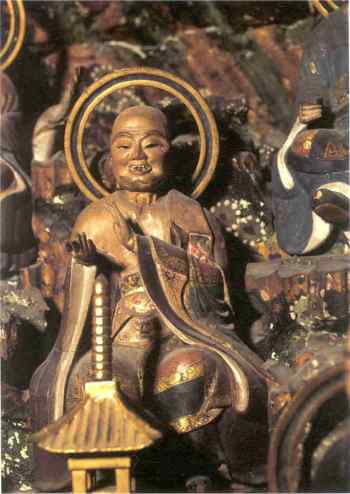
APPLAUSE (Japanese Shrine, 14th-15th century) (Collection of Hawke's Bay Museum)
Just as expertise is deemed to be in the eye of the beholder, so too is Beauty. Not for Wells the classical lines of the Venus de Milo or some other idealised female nude, but an academic study of a rough Italian fisherman by a largely forgotten artist. Thus does Wells slip in and out of mainstream and alternative narrative. In Applause for example, delighted-to-be-invited and roundly applauding this exhibition is a benignly smiling Buddha and a host of his descendants.
There is no doubt about Success however. Success is mainstream - and measured by the quality of a student's copybook. More specifically it is a bookkeeping ledger in copperplate text. Traditional notions of success associated with white-collar work are further referenced by books and a miniature typewriter as well as an elaborate pen wiper. Initially this latter item presents as a delicate porcelain hand and forearm. But the beaded decorative sleeve of the lower arm conceals folds of black felt used to wipe excess ink off a quill or nib pen. As in some of the other vignettes, this rich association of items brings forth a literary or narrative idea. The dainty female hand here will almost certainly not blot her copybook!
Among other items in this cameo is an immediately recognisable symbol of accomplishment - an engraved silver cup. This one though is tarnished and bent, a victim of the fire that ravaged Napier after the 1931 earthquake. Success, like so much else in this story is in the eye of the beholder - and is just as fickle. Academic achievement, physical prowess, public recognition and also social standing - success in the social arena is symbolized by the mirror and cut-throat razor, items suggestive of genteel society. Affluence and social status are insinuated in the very existence of these exhibits. They are from a collection of over 2000 doll's house items amassed by three generations of one English family. And the legendary eccentricity of the upper classes is referenced in the unusual handle of the paper knife - the hoof and lower limb of some animal of uncertain origin.
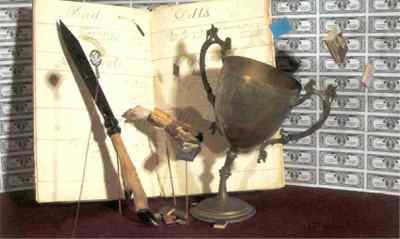
SUCCESS (Pen wiper, 19th century; Engraved cup, date unknown; Miniature typewriter, date unknown; Mirror and cut-throat razor, date unknown; Paper knife, date unknown; School work book, 1888) (Collection of Hawke's Bay Museum)
And is this where Mollie fits in? In Behind the Scenes it is clear that Mollie didn't see much from her little window on the world-but she saw enough to know that there was a whole 'other world' out there. 'Out there' is also that elusive bit of magic that Peter Wells glimpsed through his family artefacts - but for Wells the 'other world out there' was Napier itself. This raises the question of perception, truth and reality. Mollie was trapped in Napier and glimpsed 'life' outside it. Whereas for Peter Wells, as an outsider, kept at a distance, it was Napier itself that was the magical 'other world', that temple of wonder.
And one is left with a similar feeling at Napier today. Looking through our little window - just as Mollie did - we too espy a promised land. Peter Wells' short film that accompanies the installation reinforces this impression. The camera repeatedly takes us right up to a door leading behind the scenes in the museum. Then the curator steps through to the other side and closes the door behind her. One is left with the feeling that there is a garden of delight through there, just out of reach, inaccessible to us. What we are given is a select view - a mere glimpse of what is at the heart of the museum. By weaving his own narrative around the items he singles out, Wells also comments on universal museum practice-the selectivity and subjectivity of the curatorial eye. Any item or object is invested with a meaning dependent on the context in which it is placed. Thus the curator controls and directs a spectator's engagement with the items in a collection. But Wells chooses to leave plenty of space for the viewer in his narrative. For him, Napier as much as any museum, has long been a temple of wonder. His installation, with its windows of opportunity, does nothing to burst that bubble.