
Exhibitions Auckland
MICHAEL DUNN
DON DRIVER Recent Sculpture
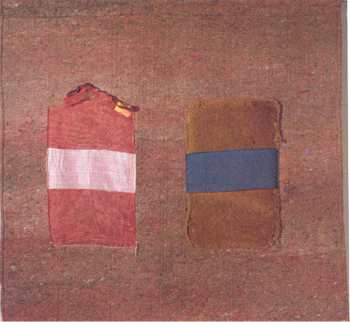
'100 lbs Bartons and Grant grains and powders: industrial grains, powders, North Green N.Y. 12853. Keep this sack dry. World standard.' Words written on a sack, and read not in an industrial setting but in the genteel environment of the New Vision Gallery Auckland. To be read there not by a consumer of such goods but by the buyer of a more refined merchandise. A new twist on words in N.Z. art, maybe. Rather a departure from the prophetic utterances so often encountered on paintings. Instead, a different note, less shrill, less personal. These letters are stencilled on; they carry no personal signature; they belong to the familiar world of mass production, of commerce and utility. To many New Zealanders who have never crossed the threshold of an art gallery, such words are a part of daily life on cement sacks, wool bales, fertiliser packs etc. But, in such a context, they blur into a mass of experiences and are read, if at all, from boredom, from necessity or because they are there.
DON DRIVER
Two Bags
mixed media, 1715 x 1780 mm.
(New Vision Gallery)
It's different at New Vision. The sack has been emptied; it's been flattened out more or less so you can read the letters; and it's been mounted up there on the wall along with bits of canvas and perspex. In away, Driver makes a collage from waste products of a consumer society, much as the Cubists recycled bits of newspaper and glass some seventy years ago. He has deliberately updated things. It is no longer the world of Parisian cafes he evokes but the images of modern farming and light industry - the typical signs and symbols of New Zealand's lifestyle today. Thus his titles, at once witty and cutting. 'Pacific' suggests maybe a sub-tropical scene; Driver presents sacks labelled 'Pacific Salt': 'Top Crop' does not give a vista of golden wheat, but of fertiliser bags cut open and mounted on canvas. The game is consistent. Expectations set up by the art gallery context are thwarted. So, too, are anticipated images of art work. Driver's assemblages work on many levels, in a variety of ways: as formal components of non-figurative design: e.g. Large Cross, a very secular image of door mat, sacks and canvas; or as commentaries on the 'gutlessness' of the fine art scene: e.g. a Top Crop pack has more punch than many paintings and as much meaning visually. Or, again, as witty thrusts at our throw-away society where commercial gain justifies a multitude of waste, and mass-produced words and images. Maybe a New Zealand emblem could be a Top Crop fertiliser bag rather than the nearly extinct bird that has the job at the moment.
So it goes on. Another aspect Driver brings in the heroes of comic books: Dracula, Werewolf, Batman, Frankenstein. In one work, entitled Animal Crackers I, they ride in tandem on the back of a cat. These imported creations of mass culture are at once funny and unfunny. Funny because they belong to a world very different from that of New Vision and High Art, and to see them there seems to send up the whole pretentiousnessofthe gallery situation, its exclusiveness and customary earnestness. I did actually hear some chuckles and laughs from visitors to the exhibition: that in itself is a noteworthy departure from the usual grim silence. Unfunny because these are what most of us have to be satisfied with for cultural diet. Ultimately they are mechanical, commercialized and effete. Comic book art that's anything but comical in its full implications.
Enough said. There is no space to discuss the derivations from Rauschenberg and all that.